
Green thorntail facts for kids
Quick facts for kids Green thorntail |
|
|---|---|
 |
|
| Male, Milpe Bird Sanctuary, NW Ecuador | |
.jpg) |
|
| Female | |
| Conservation status | |
Scientific classification  |
|
| Kingdom: | Animalia |
| Phylum: | Chordata |
| Class: | Aves |
| Order: | Apodiformes |
| Family: | Trochilidae |
| Genus: | Discosura |
| Species: |
D. conversii
|
| Binomial name | |
| Discosura conversii (Bourcier & Mulsant, 1846)
|
|
 |
|
| Script error: The function "autoWithCaption" does not exist. | |
| Synonyms | |
|
Popelairia conversii |
|

Script error: No such module "Check for conflicting parameters".
The green thorntail (Discosura conversii) is a tiny, colorful hummingbird. It's part of a group called "coquettes." You can find this amazing bird in countries like Colombia, Costa Rica, Ecuador, and Panama.
Contents
About the Green Thorntail's Family Tree
Scientists group living things into families. The green thorntail used to be in a different group called Popelairia. But now, it's part of the Discosura group. This helps us understand how different birds are related. The green thorntail is considered a single species, meaning it doesn't have different subspecies.
What Does the Green Thorntail Look Like?
Green thorntails are small birds. Males are about 9.5 to 10.2 centimeters (3.7 to 4.0 inches) long. Females are a bit smaller, around 6.6 to 7.5 centimeters (2.6 to 3.0 inches) long. They weigh about 3 grams (0.1 ounces), which is super light!
Male Green Thorntail
The male has a dark green head and a shiny, metallic green back. Its lower back is a coppery-bronze color with some bluish-black spots and a white stripe. Its tail is deeply forked and looks bluish-black. The outer tail feathers are very thin, which is why it's called a "thorntail." The male's throat is a bright metallic green. Its chest and belly are mostly dark green, with a metallic greenish-blue spot in the middle of its chest.
Female Green Thorntail
The female's upper body looks similar to the male's, but her lower back is darker. Her tail is notched, but it's not as long as the male's. Most of her tail feathers are bluish-black with dark green at the base. The very outer tail feathers have white bases, a blue-black middle, and white tips. Females have a wide white patch on their cheeks. Their chin is dull black with white spots. Their sides are dull green with a white spot, and their chest and belly are dull black.
Young Green Thorntails
Young green thorntails look a lot like the adults. The main difference is that their chin is grayish-white.
Where Do Green Thorntails Live?
You can find green thorntails on the Caribbean side of Costa Rica. They also live on the Pacific side of Panama, Colombia, and Ecuador, almost reaching the border with Peru. Some people think they might also be found on the Caribbean side of eastern Panama.
Green Thorntail Habitats
These hummingbirds mostly live high up in the forest canopy. They prefer the tops and edges of wet montane forests (forests on mountains) and lowland evergreen forests. You might also spot them near flowering trees in open areas.
How High Do They Live?
- In Costa Rica, they usually live between 700 to 1,400 meters (2,300 to 4,600 feet) high.
- In Panama, they are found from 600 to 1,200 meters (2,000 to 3,900 feet) high.
- In Colombia, they can live from near sea level up to 1,000 meters (3,300 feet) high.
- In Ecuador, they are typically found between 300 to 1,000 meters (980 to 3,300 feet) high.
How Green Thorntails Behave
Movement and Migration
Green thorntails usually stay in the same area all year. However, they tend to move to lower elevations during the rainy season.
What Do Green Thorntails Eat?
Green thorntails mostly drink nectar from flowers. They find nectar at the tops of flowering trees, but also from plants that grow on other plants (called epiphytes) and from shrubs. They seem to really like plants from the legume family. When they drink nectar, they hover in the air with their tail sticking up almost straight.
Their diet also includes small insects like flies, wasps, and spiders. They catch these tiny creatures by flying out from a perch (a method called hawking) or by picking them off the underside of leaves while hovering.
Reproduction and Life Cycle
Male green thorntails that are ready to breed will sit on high, bare branches. Sometimes, they perform a special diving display to attract females. The breeding season for these birds seems to be different depending on where they live, but scientists don't know all the details yet. In Costa Rica, it might be from November to April. In Colombia, males have been seen displaying in June.
Like all hummingbirds, females lay two white eggs. The female takes care of the eggs all by herself. We don't know much about their nesting habits or what their nests look like.
Green Thorntail Sounds
The green thorntail is usually a quiet bird. But when they interact with each other, they make soft, squeaky chipping sounds.
How Are Green Thorntails Doing?
The IUCN (International Union for Conservation of Nature) says the green thorntail is a species of "Least Concern." This means they are not currently in danger of disappearing. However, we don't know exactly how many green thorntails there are, and their numbers are thought to be going down.
They are considered rare in Panama and uncommon in Costa Rica and Ecuador. In Colombia, they are uncommon to common. Even though their habitat is sometimes lost or damaged, human activities probably don't have a big short-term effect on this species.
Images for kids
-
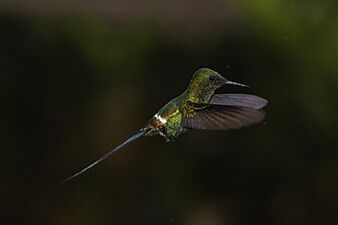
Male, Mount Totumas cloud forest, Panama
-
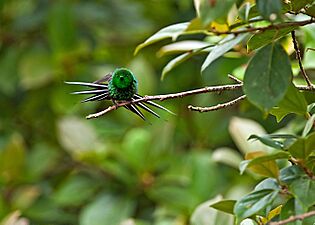
Male
_male_in_flight.jpg)

