
Guadeloupe big brown bat facts for kids
Quick facts for kids Guadeloupe big brown bat |
|
|---|---|
| Conservation status | |
Scientific classification  |
|
| Kingdom: | Animalia |
| Phylum: | Chordata |
| Class: | Mammalia |
| Order: | Chiroptera |
| Family: | Vespertilionidae |
| Genus: | Eptesicus |
| Species: |
E. guadeloupensis
|
| Binomial name | |
| Eptesicus guadeloupensis Genoways & Baker, 1975
|
|
| Script error: The function "autoWithCaption" does not exist. | |
Script error: No such module "Check for conflicting parameters".
The Guadeloupe big brown bat (scientific name: Eptesicus guadeloupensis) is a special kind of bat. It lives only on the island of Guadeloupe. It's one of eleven different bat species found there, and one of just three that are unique to the island. Being "endemic" means it's found nowhere else in the world.
How it Got its Name
Scientists Genoways and Baker first described this bat in 1975. They found the first bat specimen (a 'holotype') in July 1974. This discovery happened in eastern Baie-Mahault, a part of Guadeloupe.
They thought this bat was closely related to another bat called the big brown bat. They placed it in the same group of bats, called the fuscus group. This group is part of the larger Eptesicus genus. Before this discovery, the big brown bat was the only known member of the fuscus group.
The bat's scientific species name, guadeloupensis, means 'from Guadeloupe'. This makes sense because that's where it lives!
What it Looks Like
This bat is the biggest of its kind (genus Eptesicus) found in North and South America. Its wing membranes are black. Its fur has two colors on each hair. The base of each hair is black. The tip of the hair is lighter.
On its back, the fur tips are chocolate brown. On its belly, the fur tips are a light, yellowish-brown color.
Here are some of its measurements:
- It is about 129 to 133 millimeters (5 to 5.2 inches) long from its nose to its tail.
- Its forearm is about 49.6 to 51.5 millimeters (1.95 to 2.03 inches) long.
- Its ears are about 22.5 to 24 millimeters (0.89 to 0.94 inches) long.
- Its tail is about 54 to 60 millimeters (2.1 to 2.4 inches) long.
- Its hind foot is about 11 to 14 millimeters (0.43 to 0.55 inches) long.
Life and Habits
Like all other bats in its genus, the Guadeloupe big brown bat has 50 chromosomes. It is an insectivore, which means it eats insects.
During the day, these bats likely rest in trees. They prefer trees found in gallery forests. These are forests that grow along rivers or streams.
Scientists don't know much about how this bat reproduces. This is because it is not seen very often. However, a mother bat that had recently finished feeding her baby was once found in late July. A young female bat was also found at the same time. This suggests that female bats might give birth in May or June.
Where it Lives
This bat is found only on Basse-Terre Island in Guadeloupe. This island is part of the Lesser Antilles in the Caribbean Sea.
It lives in tropical rainforests and gallery forests. It is most often found in low areas. These areas are usually from 0 to 300 meters (0 to 984 feet) above sea level.
Protecting the Bat
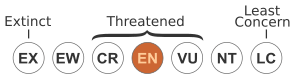
The International Union for Conservation of Nature (IUCN) lists the Guadeloupe big brown bat as endangered. This means it is at a high risk of disappearing forever.
Major threats to this bat include:
- Habitat loss: Its forest homes are being destroyed.
- Hurricanes: Strong storms can damage its habitat.
- Invasive species: New animals like rats, mice, and mongooses are spreading. These animals can harm the bats or compete for food.
- Competition: It might also face competition for food and shelter from the native velvety free-tailed bat. This other bat is very common.
