
Gulf of Tonkin incident facts for kids
Quick facts for kids Gulf of Tonkin incident |
|||||||
|---|---|---|---|---|---|---|---|
| Part of the Vietnam War | |||||||
 Photo taken from USS Maddox during 2 August encounter, showing three North Vietnamese motor torpedo boats |
|||||||
|
|||||||
| Belligerents | |||||||
 United States United States |
 North Vietnam North Vietnam |
||||||
| Commanders and leaders | |||||||
|
|
||||||
| Strength | |||||||
|
3 torpedo boats | ||||||
| Casualties and losses | |||||||
|
|
||||||
The Gulf of Tonkin incident refers to a series of events in August 1964 in the Gulf of Tonkin, off the coast of North Vietnam. These events became a major reason for the United States to become more deeply involved in the Vietnam War.
On August 2, 1964, a US Navy destroyer, the USS Maddox, was gathering electronic information near North Vietnamese waters. It was attacked by three North Vietnamese torpedo boats. The US ship returned fire, and there was a brief battle.
Two nights later, on August 4, two US destroyers, the Maddox and the USS Turner Joy, reported that they were under attack again by North Vietnamese vessels. They fired back. However, later investigations showed that this second attack never actually happened. No North Vietnamese boats were present. It was later revealed that the National Security Agency (NSA), a US defense intelligence agency, had intentionally changed intelligence reports to make it seem like an attack had occurred.
This incident led to the Gulf of Tonkin Resolution, which gave the US President, Lyndon B. Johnson, more power to send US forces to Vietnam. This marked a significant increase in US military involvement in the Vietnam War.
Contents
Why the Gulf of Tonkin Incident Happened
The Gulf of Tonkin incident took place during a time of growing tension in Vietnam. After a war in 1954, Vietnam was divided into North and South. There were plans for elections to unite the country, but these never happened.
The United States supported South Vietnam against North Vietnam, which was led by communists. The US worried that if one country fell to communism, others in the region would follow, an idea known as the domino theory. Because of this, the US sent military advisors to South Vietnam.

Before the Gulf of Tonkin incident, the US was already involved in secret missions against North Vietnam. These missions, called Operation Plan 34-Alpha, involved South Vietnamese commandos attacking North Vietnamese coastal facilities. At the same time, US Navy destroyers conducted DESOTO patrols to collect electronic intelligence near the North Vietnamese coast. These patrols were meant to gather information and show the US presence.
The Events in the Gulf of Tonkin
The First Attack: August 2, 1964
On July 31, 1964, the US Navy destroyer USS Maddox began a mission in the Gulf of Tonkin. Its job was to collect electronic signals intelligence near the North Vietnamese coast. The Maddox was ordered to stay a certain distance from the coast.
Just before this, on July 30, South Vietnamese commandos had attacked a North Vietnamese radar station on Hòn Mê island. The Maddox was not part of this commando raid.

On August 2, North Vietnamese patrol boats began tracking the Maddox. Three North Vietnamese torpedo boats then approached the US destroyer. The Maddox fired warning shots. The North Vietnamese boats responded by attacking with torpedoes and machine guns.
In the fight, the Maddox avoided the torpedoes and fired back with its guns. Four US jets from the aircraft carrier USS Ticonderoga also attacked the North Vietnamese boats. Three North Vietnamese torpedo boats were damaged, and some North Vietnamese sailors were killed or wounded. The Maddox received only minor damage from a single bullet.
After this clash, the Maddox moved to safer waters. It was then joined by another destroyer, the USS Turner Joy.
.jpg)
The Second Reported Attack: August 4, 1964 (Did Not Happen)
On August 4, the Maddox and Turner Joy continued their patrol. That evening, during bad weather, the destroyers picked up radar and sonar signals. The crews believed these signals meant they were under attack again by North Vietnamese boats. For about two hours, the ships fired at targets they saw on their radar screens.
However, there was no actual attack. The signals were likely caused by rough weather and nervous sonar operators. The captain of the Maddox, Captain John Herrick, soon expressed doubts about whether an attack had truly happened. He suggested a full investigation.
... And ultimately it was concluded that almost certainly the [4 August] attack had occurred. But even at the time there was some recognition of a margin of error, so we thought it highly probable but not entirely certain. And because it was highly probable—and because even if it hadn't occurred, there was strong feeling we should have responded to the first attack, which we were positive had occurred—President Johnson decided to respond to the second [attack]. I think it is now clear [the second attack] did not occur ...
Despite these doubts, the US government, led by President Johnson, used wrongly interpreted intelligence to conclude that the attack was real. Years later, it was confirmed that the second attack never occurred. In 2003, former US Secretary of Defense Robert S. McNamara admitted this. A 2005 study by the National Security Agency also confirmed that the August 4 incident was based on bad information and misunderstandings.
How the Incident Was Used
Even though there were doubts about the second attack, the US government quickly used the incident to justify stronger military action. President Johnson spoke to the American public on August 4, suggesting a clear attack had happened. News reports at the time also described a definite attack.

Some US officials, like Undersecretary of State George Ball, later said that the US ships might have been sent into the Gulf to provoke a reaction from North Vietnam. This would give the US a reason to escalate the war.
CIA analyst Ray McGovern also stated that leaders like President Johnson and Secretary McNamara knew the evidence for the August 4 attack was questionable. He suggested that the US was eager to expand the war in Vietnam and used the Maddox to gather intelligence and provoke North Vietnam. The ship's mission was seen as very provocative by the North Vietnamese.
Major Results of the Incident
The most important result of the Gulf of Tonkin incident was the passing of the Gulf of Tonkin Resolution by the United States Congress. This resolution gave President Johnson the power to take "all necessary steps," including using military force, to help any Southeast Asian country threatened by communism.

This resolution became the legal reason for President Johnson to send many more US troops to South Vietnam. It also led to the start of open warfare against North Vietnam in early 1965.

The incident also affected China. Chinese leaders worried that the US might invade China next. This led them to increase efforts to build up heavy industry and defense in China's interior, to protect against a possible foreign invasion.
Later Confirmations of What Really Happened
Over the years, many people came forward to confirm that the second attack on August 4, 1964, did not happen.
- President Johnson himself privately joked, "For all I know, our navy was shooting at whales out there."
- In 1967, former naval officer John White wrote a letter saying that President Johnson and other officials gave false information to Congress.
- In 1981, Captain Herrick, who commanded the Maddox, and journalist Robert Scheer reviewed the ship's logs. They concluded that the first torpedo report from August 4 was also incorrect.
- James Stockdale, a US pilot flying overhead during the alleged second attack, later wrote that the destroyers were "just shooting at phantom targets—there were no PT boats there." He said his superiors told him to keep quiet about this.
- In 1995, former Vietnamese defense minister Võ Nguyên Giáp told former US Secretary McNamara that "Absolutely nothing" happened on August 4, confirming the attack was imaginary.
- In 2001, a taped conversation from weeks after the resolution passed showed McNamara expressing doubts to Johnson about the attack.
- In 1999, CIA executive S. Eugene Poteat concluded there were no torpedo boats on the night of August 4. He believed the White House only wanted confirmation of an attack, not the truth.

NSA Report Reveals Distortion
In 2005, The New York Times reported on a study by Robert J. Hanyok, a historian for the National Security Agency (NSA). Hanyok concluded that the NSA had deliberately changed intelligence reports given to US leaders about the August 4 incident.
Hanyok's study found that NSA staff intentionally made it seem like an attack had occurred. Intelligence analysts at a base in Vietnam mistakenly believed an attack was coming. As the night went on, other intelligence did not support this idea. However, NSA personnel ignored most of the evidence that showed no attack had happened. This information was left out of reports given to the President.
Hanyok explained that this happened because leaders like President Johnson did not want any uncertainty. Officials felt pressured to provide information that supported the idea of an attack, even if it wasn't completely accurate.
Images for kids
-
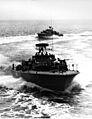
Two US Navy PTF boats training in 1963.
-
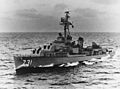
The USS Maddox, a US Navy destroyer.
-
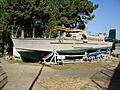
A P-4 torpedo boat, similar to those used by North Vietnam.
-
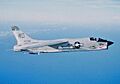
An F-8 Crusader jet, used by the US Navy.
-
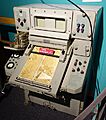
A sonar console, used to detect objects underwater.
-
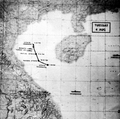
Map from a US Navy magazine showing the alleged attacks on August 4, 1964.
,_early_May_1963_(USN_711288).jpg)
.jpg)

.jpg)


See also
- Niger uranium forgeries
- Sinking of the RMS Lusitania
- Sinking of the USS Maine
- War Powers Clause
- PTF 3
