
Gymnosporangium sabinae facts for kids
Quick facts for kids Gymnosporangium sabinae |
|
|---|---|
 |
|
| A pear leaf showing signs of Gymnosporangium sabinae infection. | |
Scientific classification  |
|
| Kingdom: | Fungi |
| Division: | Basidiomycota |
| Class: | Pucciniomycetes |
| Order: | Pucciniales |
| Family: | Pucciniaceae |
| Genus: | Gymnosporangium |
| Species: |
G. sabinae
|
| Binomial name | |
| Gymnosporangium sabinae (Dicks.) Oerst. (1863)
|
|
| Script error: The function "autoWithCaption" does not exist. | |
| Synonyms | |
|
|
Script error: No such module "Check for conflicting parameters".
Gymnosporangium sabinae (also known as pear rust or European pear rust) is a tiny fungal plant disease. It's special because it needs two different kinds of plants to live and grow: juniper trees and pear trees. It's one of many "rust fungi" that can harm plants. This fungus causes a disease that can make pear leaves turn bright colors and even fall off.
Contents
What is Pear Rust?
Pear rust is a type of rust fungus. It's called a "plant pathogen" because it causes disease in plants. What makes it unique is that it needs two different types of plants to complete its full life cycle. These plants are called "hosts."
- The main host is a juniper tree or shrub. This is where the fungus spends its winter.
- The second host is a pear tree. This is where the fungus spends its summer.
The fungus gets its food from the living cells of these plants. It cannot survive on dead plant material.
How Pear Rust Spreads (Life Cycle)
The life cycle of G. sabinae is quite interesting because it involves two different plants.
Winter on Juniper Trees
The fungus spends the winter inside juniper plants. It forms small swellings or galls on the twigs and branches. These galls are like small bumps.
When spring arrives, especially after rain or heavy dew, these galls on the juniper grow tiny, dark, horn-like shapes. These shapes become covered in a gooey, orange-brown jelly. This jelly contains special fungal spores called teliospores.
Spreading to Pear Trees
The teliospores from the juniper galls are carried by the wind. They can travel a long way, sometimes up to 6 kilometers (about 3.7 miles). If these spores land on a wet pear leaf, they can infect it.
Once a pear leaf is infected, yellow-orange spots appear. These spots later turn bright red. On the underside of the pear leaf, the fungus forms small, lantern-shaped growths. These growths release another type of spore called aeciospores.
-
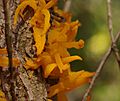
Telia emerging from juniper bark

Spreading Back to Juniper Trees
The aeciospores from the pear leaves are also carried by the wind. If they land on a juniper plant, they can infect it. This completes the fungus's life cycle, allowing it to survive another winter on the juniper.
Damage to Plants
On pear trees, the disease can be very harmful. It can cause many leaves to fall off early, which means the tree might not produce as much fruit. If the disease is not managed, it can lead to a complete loss of the pear crop.
How to Control Pear Rust
Controlling pear rust often involves managing both types of host plants.
Removing Infected Parts
One way to help stop the spread is to cut off any infected juniper twigs and branches. This is best done in winter or early spring before the fungus starts releasing its spores.
Separating Host Plants
The fungus usually cannot re-infect the same type of tree. It needs to move from a juniper to a pear, and then from a pear back to a juniper. Because of this, the most direct way to control pear rust is to remove juniper trees that are very close to pear trees.
Using Fungicides
If there's a risk of infection, you can spray pear trees with a special chemical called a fungicide in spring and summer. Fungicides are designed to kill fungi. However, this method is not always used because it can be a lot of work.
