
Izatha hudsoni facts for kids
Quick facts for kids Izatha hudsoni |
|
|---|---|
 |
|
| Scientific classification | |
| Kingdom: | |
| Phylum: | |
| Class: | |
| Order: | |
| Family: |
Oecophoridae
|
| Genus: | |
| Species: |
I. hudsoni
|
| Binomial name | |
| Izatha hudsoni Dugdale, 1988
|
|
The Izatha hudsoni is a special type of moth. It belongs to a group of moths called Oecophoridae. This moth is found only in New Zealand, which means it is endemic there. You can find it in many places across New Zealand's North Island.
Contents
About the Izatha hudsoni Moth
What Does the Izatha hudsoni Moth Look Like?
The Izatha hudsoni moth is a small insect. Its wingspan, which is the distance from one wingtip to the other, is about 19 to 26 millimeters for males. Females are a bit larger, with a wingspan of 20 to 27.5 millimeters.
This moth looks a lot like another moth called I. peroneanella. However, you can tell them apart by their hindwings. The Izatha hudsoni has hindwings that are a see-through whitish color. The I. peroneanella moth, on the other hand, has grey hindwings.
Where Does the Izatha hudsoni Moth Live?
This moth is special because it lives only in New Zealand. It can be found in many different areas of the North Island. These areas include Northland, Auckland, Coromandel, Waikato, and Bay of Plenty.
You can also find it in Taranaki, Taupo, Gisborne, Hawkes Bay, and Wellington.
Life and Habits of the Izatha hudsoni Moth
Adult Izatha hudsoni moths are usually seen flying around from November to January. This is their active period.
Where Does it Live and What Does it Eat?
The Izatha hudsoni moth prefers to live in forest areas. Its young, called larvae, have been found living in dead branches and twigs. They especially like the dead twigs of a plant called Aristotelia serrata.
How the Izatha hudsoni Moth Was Discovered
This moth species was officially named by a scientist named John S. Dugdale in 1988. Before that, other scientists like Edward Meyrick in 1916 and George Hudson in 1928 had also studied this moth. The very first example of this moth, called the holotype specimen, is kept safe at the New Zealand Arthropod Collection.
Images for kids
-
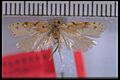
An image of Izatha hudsoni from 1988.
-
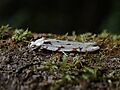
A close-up image of the Izatha hudsoni moth.


