
John Hammersley facts for kids
Quick facts for kids
John Hammersley
|
|
|---|---|
.jpg) |
|
| Born | 21 March 1920 Helensburgh, Dunbartonshire, Scotland
|
| Died | 2 May 2004 (aged 84) |
| Nationality | British |
| Alma mater | Sedbergh School Emmanuel College, Cambridge |
| Awards |
|
| Scientific career | |
| Institutions | University of Oxford Trinity College, Oxford |
| Academic advisors | Unknown |
| Doctoral students | Jillian Beardwood Geoffrey Grimmett Dominic Welsh |
John Michael Hammersley (21 March 1920 – 2 May 2004) was a very smart British mathematician. He is best known for his important work on complex math ideas. These include the theory of self-avoiding walks and percolation theory. These theories help us understand how things connect or spread out.
Early Life and Learning Journey
John Hammersley was born in Helensburgh, Scotland. He went to Sedbergh School for his early education. Later, he began studying mathematics at Emmanuel College, Cambridge.
In 1941, during World War II, he joined the Royal Artillery. While in the army, he worked on ballistics. This is the science of how things like bullets and rockets fly through the air. After the war, he finished his math degree in 1948. He never got a PhD, but his amazing work earned him special science degrees from Cambridge and Oxford universities in 1959.
Hammersley's Math Career
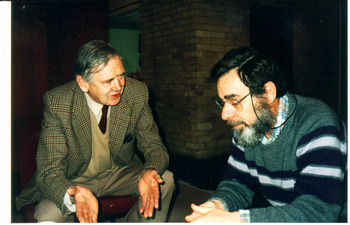
John Hammersley worked with other mathematicians, including Jillian Beardwood and J.H. Halton. Together, they created a famous math rule called the Beardwood-Halton-Hammersley Theorem. This theorem was published in 1959.
It helped solve a tricky puzzle called the "traveling salesman problem." Imagine a delivery person who needs to visit many different places. This theorem helps find the shortest possible route to visit all those places.
In 1964, he wrote a book called Monte Carlo Methods with David Handscomb. He also found an early solution to the "moving sofa problem" in 1968. This problem asks about the largest sofa shape that can be moved around a corner.
Hammersley strongly believed in solving real-world problems using math. He did not like math that was too abstract or hard to understand. He even took part in a discussion called the "New Math" debate. This debate was about how math should be taught in schools.
From 1961, he was a special professor at Trinity College, Oxford. In 1969, he became a reader in mathematical statistics at Oxford University. In 1976, he was chosen as a Fellow of the Royal Society (FRS). This is a very high honor for scientists in the United Kingdom.
See also
- Hammersley set
- Hammersley-Clifford theorem
- Low-discrepancy sequence
