
King Island (Alaska) facts for kids
|
Ugiuvak (Inupiaq)
|
|
|---|---|

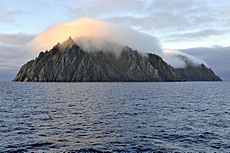
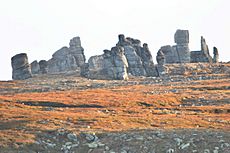
King Island, Alaska. The large boulders on the top of the island are barely visible through the fog.
|
|

 King Island
Location in Alaska
|
|
| Geography | |
| Location | Bering Sea |
| Coordinates | 64°58′30″N 168°03′35″W / 64.97500°N 168.05972°W |
| Area | 2.5 sq mi (6.5 km2) |
| Width | 1 mi (2 km) |
| Administration | |
|
USA
|
|
| Demographics | |
| Demonym | Ugiuvaŋmiut |
| Population | 0 (2008) |
King Island (called Ugiuvak by its native people) is a small, rocky island in the Bering Sea, located west of Alaska. It is about 40 miles (64 km) south of Wales, Alaska. For a long time, the Iñupiat people used King Island as their winter home. However, today no one lives on the island permanently.
Contents
Where is King Island?
King Island is located about 40 miles (64 km) offshore. It is south of the village of Wales, Alaska and 85 miles (137 km) northwest of Nome. The island is about 1 mile (1.6 km) wide and has steep slopes on all sides. It is part of the Bering Sea unit of the Alaska Maritime National Wildlife Refuge.
What's in a Name?
The Iñupiaq name for the island is Ugiuvak. This name means "a place for winter." The people who lived there called themselves Ugiuvaŋmiut, which means "residents of Ugiuvak."
In 1778, Captain James Cook was the first European to see the island. He named it "King Island" after Lieutenant James King, who was part of his crew.
How Many People Lived Here?
| Historical population | |||
|---|---|---|---|
| Census | Pop. | %± | |
| 1880 | 100 | — | |
| 1890 | 200 | 100.0% | |
| 1910 | 119 | — | |
| 1920 | 137 | 15.1% | |
| 1930 | 170 | 24.1% | |
| 1940 | 208 | 22.4% | |
| 1960 | 66 | — | |
| 1980 | 0 | — | |
| 1990 | 0 | — | |
| U.S. Decennial Census | |||
King Island first appeared in the U.S. Census in 1880. It was listed as the native village of "Ookivagamute." The population numbers changed over the years, showing how the community grew and then moved away. By 1980, no residents were reported on the island.
Origin myth
Long ago, a fisherman was paddling his kayak on the winding Kuzitrin River. Near the great Kigluaik Mountains, his fishing line suddenly tugged with enormous force. He had hooked a giant bullhead fish!
The fisherman tried with all his might to pull it in, but the fish was too strong. Instead, the mighty bullhead began to pull the kayak, swimming westward with powerful swishes of its tail. Each great thrash carved the land, widening the river and shaping new landforms, like the Imuruk Basin, the Tuksuk Channel, Grantley Harbor, and Port Clarence.
On and on the journey went, all the way into the wide, open Bering Sea. There, the fisherman safely unhooked the great creature. But when he turned to bring it home, he saw something amazing. Where the giant bullhead had been, there now rose a whole new island—rocky and tall, just waiting to be discovered.
And that is how, the story says, King Island was made.
A Look Back: Life on King Island
King Island was the winter home for the Ugiuvaŋmiut people. During the cold winter months, they hunted seals and walruses for food and resources.
Traditional Ways of Life
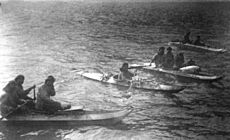
In the summer, the islanders would travel by kayak to the mainland. They went to an area near what is now Nome. There, they hunted caribou, caught salmon, and gathered berries and vegetables.
Winter days on the island had limited daylight. The community spent time dancing in the "Qagri," which was a special gathering house for men. For example, the month of December was known as Sauyatugvik, or "the time of drumming."
Challenges and Changes
Life on King Island became very difficult in the late 1800s. Many walruses, which were a main food source for the islanders, were hunted by whalers. This made it hard for the community to find enough food. The whaling industry in Alaska later declined after a big disaster in 1871.
After the town of Nome was established in the early 1900s, the islanders found new ways to trade. They began selling beautiful carvings made from walrus ivory to people in Nome and to travelers during the summer.
In 1929, the Bureau of Indian Affairs (BIA) opened a school and a Catholic church on the island. By 1937, about 190 people lived on King Island.
A teacher named Rie Muñoz worked at the BIA school. She lived on King Island for several years with her husband, Juan, starting in 1951.
Moving to the Mainland
During World War II, many men from the island joined the military. Sadly, some did not return. Some residents also faced health challenges, and others moved to the mainland for better healthcare.
In 1959, the BIA closed the island's school because of concerns about possible rockslides. Children had to move to the Alaskan mainland for their education. This led many families to leave the island to stay with their children. By 1966, all King Island residents had moved to mainland Alaska year-round.
Keeping Traditions Alive
Even though the King Islanders moved away, they have kept their unique culture strong. Some King Islanders still return to the island to gather traditional foods like walrus and seal.
Modern Efforts to Connect
In 1990, the Alaska Native Claims Settlement Act created the King Island Native Corporation. This corporation now owns King Island and parts of nearby Cape Woolley and Woolley Lagoon.
In 2003, Professor Deanna Kingston, who is a descendant of the Ugiuvaŋmiut, received a grant. She used this grant to study the island's environment and the traditional knowledge of the islanders. Her research helped create an interactive website about the island's nature and culture.
In 2005 and 2006, another research project helped some King Island natives return to the island. For some, it was their first time back in 50 years.
Gallery of King Island
-
King Island
-
Rock formations on King Island
-
King Island residents in kayaks around 1892. Notice the unique style of their kayaks.


The Unique Stilt Village
-
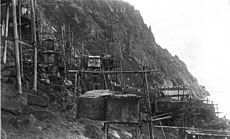
Ugiuvak around 1892, showing summer houses made of walrus hide and winter houses made of stone.
-
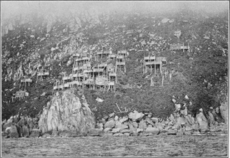
Ugiuvak photographed during the Fifth Thule Expedition, between 1921 and 1924.
-
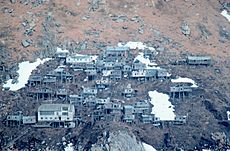
The abandoned stilt village in 1978. The large white building was the former BIA school.
-
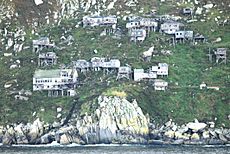
Ugiuvak in 2010.


Famous People from King Island
- Paul Tiulana (1921–1994), a talented Iñupiat artist and dancer who was born on the island.
- Dr. Iglahliq Suuqiina, an author of several books. He was born in Nome, Alaska, in 1950, and is the grandson of Chief Suuqiina of Okvok Island (now King Island). His mother was a full-blood Inuit. You can learn more in his book, Okvok, An Elder's Story.
See also
 In Spanish: Isla del Rey (Alaska) para niños
- King Island Native Community
