
Kingston upon Thames War Memorial facts for kids
Quick facts for kids Kingston upon Thames War Memorial |
|
|---|---|
| United Kingdom | |
.jpg) |
|
| For men from the town of Kingston upon Thames who died in the First and Second World Wars | |
| Unveiled | 1923 |
| Location | 51°24′37″N 0°18′18″W / 51.4104°N 0.305°W |
| Designed by | Richard Reginald Goulden |
|
IN HONOUR OF THE MEN OF THIS TOWN WHO GAVE THEIR LIVES IN THE GREAT WARS 1914–1919, 1939–1945.
|
|
|
Listed Building – Grade II*
|
|
| Official name | Kingston upon Thames War Memorial |
| Designated | 6 October 1983 |
| Reference no. | 1080054 |
The Kingston upon Thames War Memorial is a special monument in the Memorial Garden on Union Street, Kingston upon Thames, London. It was built to remember the brave men from the town who lost their lives in the First World War. After 1945, it was updated to also honor those who died in the Second World War.
The town council asked for this memorial to be built. It was designed by a British sculptor named Richard Reginald Goulden. The memorial features a bronze statue of a warrior. This warrior holds a flaming cross and uses a sword to protect two children from a snake. This statue stands on a granite base, which has bronze plaques listing the names of the soldiers who died.
Goulden created many memorials like this, often showing symbolic figures. The Kingston memorial was first recognized as a Grade II listed structure in 1983. This means it's an important historical building. In 2016, its status was upgraded to Grade II*. This shows it's a very important building or structure.
Memorial History
The town of Kingston upon Thames has a long history. It received its first official document, called a charter, in 1200. Even though it's now part of Greater London, it still has strong ties to its historic county, Surrey.
During the First World War, the town's librarian kept a record of all the men from Kingston who were killed. When the war ended in 1919, the town decided to build a memorial to remember them.
After some discussions about what the memorial should look like and where it should be placed, the job was given to Richard Reginald Goulden in 1920. Goulden himself was a soldier in the war. He was a captain in the Royal Engineers until 1916, when he had to leave due to injury. He had studied art and sculpture before the war.
In 1920, Goulden also won a project to design the Bank of England War Memorial. For that memorial, he chose to show St Christopher carrying a child. This idea of a strong figure protecting children became a common theme in his work, just like you see at the Kingston memorial.
Goulden designed many other war memorials in the 1920s. Some are in or near London, like at Middlesex Guildhall and Redhill. Others are further away in places like Dover and Malvern. Many of these memorials also feature a bronze figure holding something up high, or a man protecting one or two children.
-
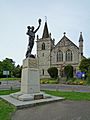
Redhill
-
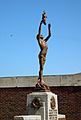
Dover
-
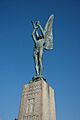
Malvern
-
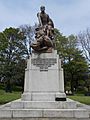
Crompton
.jpg)


.jpg)
Memorial Design
The Kingston upon Thames War Memorial has a large bronze sculpture on top. This sculpture shows a warrior holding a burning crucifix in his left hand. In his right hand, he holds a sword, which he uses to strike a snake. Next to him are two small children whom he is protecting. Goulden was very good at sculpting children, and they appear in many of his artworks.
At the base of the bronze sculpture, there are words from a famous poem called For the Fallen by Laurence Binyon. The words say: "AT THE GOING DOWN OF THE / SUN AND IN THE MORNING / WE WILL REMEMBER THEM".
The statue stands on a tall granite base. This base has an inscription that reads: "IN HONOUR OF / THE MEN OF THIS / TOWN WHO GAVE / THEIR LIVES IN / THE GREAT WARS / 1914 – 1919 / 1939 – 1945". Below this, bronze plaques list the names of the 624 men from Kingston who died in the First World War. These plaques extend onto lower granite sections that stick out from the sides.
The base and side sections stand on three granite steps. There are also bronze planters. After the Second World War, the inscription on the base was updated to include the dates for that conflict. However, the names of the individual soldiers from the Second World War were not added to the memorial. The bronze parts of the memorial were made at the A.B. Burton foundry.
The memorial is located in a public garden, which used to be an extra burial ground for All Saints Church, Kingston upon Thames. The dedication ceremony for the Kingston memorial took place on November 11, 1923. It was led by Frederick George Penny, who was the town's member of parliament.
See also
- Grade II* listed war memorials in England
- Grade II* listed buildings in the Royal Borough of Kingston upon Thames
- List of public art in the Royal Borough of Kingston upon Thames
