
LNWR 5ft 6in Tank Class facts for kids
Quick facts for kids LNWR 5ft 6in Tank class |
|
 |
|
| No. 1384 As built, photographic grey livery | |
| Power type | Steam |
|---|---|
| Designer | F. W. Webb |
| Builder | Crewe Works |
| Serial number | 3152–3171, 3222–3241, 3252–3261, 3385–3434, 3480–3489, 3495–3504, 3511–3530, 3757–3776 |
| Build date | Sept 1890 – July 1897 |
| Total production | 160 |
| Configuration | 2-4-2T |
| UIC classification | 1′B1′ n2t |
| Gauge | 4 ft 8 1⁄2 in (1,435 mm) |
| Leading wheel diameter | 3 ft 9 in (1.143 m) |
| Driver diameter | 5 ft 8+1⁄2 in (1.740 m) |
| Trailing wheel diameter | 3 ft 9 in (1.143 m) |
| Wheelbase | |
| Locomotive weight | 51 long tons (52 t) |
| Fuel type | Coal |
| Heating surface: Total | 1,074.6 sq ft (99.83 m2) |
| Cylinders | Two, inside |
| Cylinder size | 17 in × 24 in (432 mm × 610 mm) |
| Valve gear | Joy |
| Power class | LMS: 1P |
| Withdrawn | 1907–1955 |
| Disposition | All scrapped |
The LNWR 5ft 6in Tank was a type of steam locomotive built for passengers. The London and North Western Railway (LNWR) made 160 of these engines at their Crewe Works between 1890 and 1897. These locomotives were known as "tank engines" because they carried their water and fuel directly on the engine itself, instead of in a separate tender car.
The "5ft 6in" in their name referred to the size of their main driving wheels. These wheels were about 5 feet 8.5 inches (1.74 meters) across, which helped them move trains smoothly.
Contents
How These Locomotives Were Designed
These locomotives had a powerful boiler that created steam. This steam then pushed two large cylinders, which were connected to the driving wheels. This system used a special mechanism called Joy valve gear to control the steam and make the wheels turn.
The design of these tank engines was similar to another type of locomotive, the LNWR Webb Precursor Class. The main difference was that these new engines were built as tank locomotives.
Service History of the Locomotives
Most of these locomotives served for many years. Only three were taken out of service before a big change happened in 1923. This change was called the "Grouping," when many smaller railway companies in Britain joined together to form larger ones.
Life with the LMS Railway
After the 1923 Grouping, the remaining 157 locomotives became part of the London, Midland and Scottish Railway (LMS). The LMS gave them new numbers, from 6600 to 6757. They were also given a "power classification" of 1P, which helped the railway know how powerful they were.
Some of these locomotives were changed to work in a special way. Between 1929 and 1932, 42 of them were set up for "push-pull train" service. This meant they could pull a train from one end and then push it from the other, without needing to turn the engine around.
Military Service During Wartime
Two of these locomotives were sold to the War Department in the early 1930s. They were used on the Longmoor Military Railway, which was a special railway for military training. These two engines were named LMR 22 Earl Haig and LMR 23 Earl Roberts.
Unfortunately, LMR 22 was taken apart around 1939. LMR 23 lasted a bit longer and was even renumbered WD 206. However, it was also taken apart during the war.
Final Years with British Railways
By 1948, 43 of these locomotives were still in service when another big change happened. The railways in Britain were nationalized, meaning they became owned by the government under a new company called British Railways. Their numbers were changed again, by adding 40000 to their old LMS numbers.
The very last of these locomotives was taken out of service in September 1955. Sadly, none of the 160 LNWR 5ft 6in Tank locomotives were saved. All of them were eventually taken apart for scrap metal.
Images for kids
-
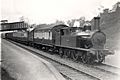
LNWR era shot, posed for the camera
-
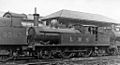
LMS Livery
-
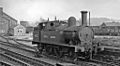
Early BR livery with "BRITISH RAILWAYS" lettering
-
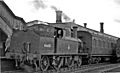
BR livery


