
Lutz jump facts for kids
Quick facts for kids Figure skating element |
|
|---|---|
| Element name | Lutz jump |
| Scoring abbreviation | Lz |
| Element type | Jump |
| Take-off edge | Back outside |
| Landing edge | Back outside |
| Inventor | Alois Lutz |
The Lutz is a special and challenging jump in figure skating. It gets its name from Alois Lutz, an Austrian skater. When a skater performs a Lutz, they use the toe pick of one skate to help them launch into the air. They start by gliding backward on the outside edge of one skate and then land backward on the outside edge of their other foot. It is considered the second most difficult jump in figure skating, right after the famous Axel.
Contents
The History of the Lutz Jump
The Lutz jump is named after Alois Lutz, a figure skater from Vienna, Austria. He might have been the first person to perform this jump around 1913. However, some historians found records of the jump appearing more often in the 1920s, after Alois Lutz had passed away. Before 1930, this jump was not very common in North America.
How Skaters Earn Points with the Lutz
In figure skating competitions, judges give points for each jump based on how many times the skater spins in the air. The more rotations, the more points!
Here are the base points for a successful Lutz jump:
- A single Lutz (one spin) is worth 0.6 points.
- A double Lutz (two spins) is worth 2.1 points.
- A triple Lutz (three spins) is worth 5.9 points.
- A quadruple Lutz (four spins) is worth 11.5 points.
- A quintuple Lutz (five spins) is worth 14 points.
Amazing Firsts in Lutz Jumps
Many talented skaters have made history by being the first to land different versions of the Lutz jump. Here's a look at some of these incredible achievements:
| Abbr. | Jump Element | Skater | Nation | Event | References |
|---|---|---|---|---|---|
| 2Lz | Double Lutz (women's) | Jacqueline du Bief |  France France |
1952 World Championships | |
| 3Lz | Triple Lutz (men's) | Donald Jackson |  Canada Canada |
1962 World Championships | |
| Triple Lutz (women's) | Denise Biellmann |  Switzerland Switzerland |
1978 European Championships | ||
| 4Lz | Quadruple Lutz (men's) | Brandon Mroz |  United States United States |
2011 Colorado Springs Invitational 2011 NHK Trophy |
|
| Quadruple Lutz (women's) | Alexandra Trusova |  Russia Russia |
2018 ISU Junior Grand Prix Armenia Cup | ||
| Side-by-side triple Lutz (pairs) | Meagan Duhamel and Ryan Arnold |
Canada |
2005 Canadian Championships |
How Skaters Perform the Lutz
The International Skating Union (ISU) describes the Lutz jump very precisely. It's a jump where the skater uses their toe pick to push off. They enter the jump from a backward glide on the outside edge of one skate and land backward on the outside edge of the opposite skate.
Skaters often approach the Lutz with a long, diagonal glide across the ice, heading towards a corner of the rink. This jump is tricky because it's "counter-rotational." This means the skater prepares for the jump by twisting their body slightly in one direction, but then they jump and rotate in the opposite direction. This makes it very challenging to do correctly!
What is a "Flutz"?
Because the Lutz is so difficult, some skaters might accidentally "cheat" the jump. This happens when they don't have enough strength to keep the correct outside edge during the take-off. Instead, they might take off from the wrong edge. When a Lutz jump is performed incorrectly, without the proper outside edge, it's given a special name: a "flutz." Judges will deduct points for a "flutz" because it's not the correct way to perform the jump.
Images for kids
-
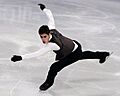
Semen Daniliants prepares a Lutz take-off
-

Wesley Chiu hits the ice with his right toe pick as his left blade remains on an outside edge
-

Jamal Othman landing


