
MacGregor's honeyeater facts for kids
Quick facts for kids MacGregor's honeyeater |
|
|---|---|
 |
|
| Conservation status | |
Scientific classification  |
|
| Kingdom: | Animalia |
| Phylum: | Chordata |
| Class: | Aves |
| Order: | Passeriformes |
| Family: | Meliphagidae |
| Genus: | Macgregoria De Vis, 1897 |
| Species: |
M. pulchra
|
| Binomial name | |
| Macgregoria pulchra De Vis, 1897
|
|
| Script error: The function "autoWithCaption" does not exist. | |
Script error: No such module "Check for conflicting parameters".
The MacGregor's honeyeater (Macgregoria pulchra) is a large and unique bird found only in New Guinea. It can grow up to 40 centimeters long, which is about the size of a crow. This bird is easy to spot because of its bright orange-yellow skin patches around its eyes, called wattles. It also has special black-tipped, ochre (yellowish-brown) feathers on its wings. Both male and female MacGregor's honeyeaters look similar, though the male is a bit bigger.
This interesting bird was once thought to be a type of bird-of-paradise, but scientists now know it's actually a honeyeater. Recent studies of its DNA confirm it belongs to the honeyeater family, called Meliphagidae. It is the only species in its group, or genus, called Macgregoria. The MacGregor's honeyeater mainly eats fruits and lives in the cool, high-up forests of New Guinea. It is a monogamous species, meaning a male and female bird stay together as a pair.
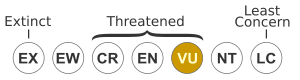
Sadly, the MacGregor's honeyeater is considered a vulnerable animal. This means its population is small and getting smaller. Because of this, it is listed on the IUCN Red List of Threatened Species and is protected under CITES.
Contents
Discovering the MacGregor's Honeyeater
This bird is named after Sir William MacGregor, who was the administrator of British New Guinea when the bird was discovered in 1897. Sir William's last name was originally spelled McGregor, but he preferred to use MacGregor during his time in New Guinea.
Where Does It Live? (Habitat)
The MacGregor's honeyeater lives on the island of New Guinea. It prefers to live in high-altitude areas, usually between 2,800 and 4,000 meters (about 9,200 to 13,000 feet) above sea level. These areas are often cloud forests or subalpine forests. Subalpine forests are found just below the treeline, where it can be quite cold.
The bird is often seen in areas with Dacrycarpus trees, especially when these trees are producing fruit. Scientists are still learning about where the birds go when these trees are not fruiting.
How It Reproduces (Life Cycle)
MacGregor's honeyeaters are monogamous, which means a male and female pair up and stay together. They build their nests high up in the tops of trees. The nest is a large, cup-shaped structure made from moss, lichen, and small sticks. They line the inside with tiny leaves and stems to make it cozy. The female usually lays one pink egg with spots.
Images for kids
-
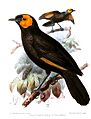
A drawing of the MacGregor's honeyeater.
