
Madagascar snipe facts for kids
Quick facts for kids Madagascar snipe |
|
|---|---|
 |
|
| Museum specimen | |
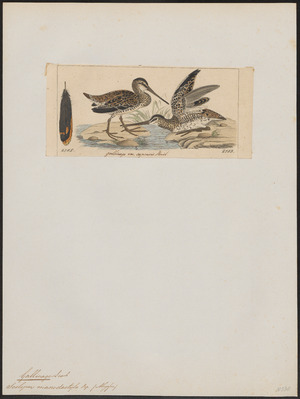 |
|
| Conservation status | |
Scientific classification  |
|
| Kingdom: | Animalia |
| Phylum: | Chordata |
| Class: | Aves |
| Order: | Charadriiformes |
| Family: | Scolopacidae |
| Genus: | Gallinago |
| Species: |
G. macrodactyla
|
| Binomial name | |
| Gallinago macrodactyla Bonaparte, 1839
|
|
| Script error: The function "autoWithCaption" does not exist. | |

Script error: No such module "Check for conflicting parameters".
The Madagascar snipe (Gallinago macrodactyla) is a special type of bird called a wader. It's a bit small and stocky. This bird lives only in the wet, eastern part of Madagascar, from the coast up to high mountains. It's more common in places higher than 700 meters. These snipes don't migrate; they stay in Madagascar all year round.
Contents
What Does It Look Like?
This snipe is a large and heavy bird for a wader, about 29 to 32 centimeters long. It has a strong body and legs that are quite short. Its back, head, and neck have cool patterns of dark brown stripes with gold edges. These patterns form lines down its back. Its belly is white, and it has some brown stripes on its sides, but not on its main belly area.
The Madagascar snipe has a very long, straight, and strong black bill. Its legs and feet can be yellowish-olive or greenish-grey. Male and female snipes look very similar. Young snipes are almost the same, but their wing feathers have buff (light yellowish-brown) edges.
When a Madagascar snipe takes off, it makes a rough hlip sound. When it flies, you can see a narrow grey edge on its wings and very dark feathers underneath its wings.
How Is It Different from Other Snipes?
The Madagascar snipe has only ever been seen in Madagascar. No other snipe species have been found there yet.
- The Common snipe is smaller and has lighter feathers under its wings. It also has white edges on its wings.
- The Pin-tailed snipe looks similar in color to the Madagascar snipe. However, it is smaller and has a shorter bill and tail.
- The African snipe is built similarly to the Madagascar snipe. But it has a clear white edge on its wings.
Snipes that might visit Madagascar from other places usually fly faster and lighter than the Madagascar snipe.
Life and Behavior
Where Does It Live and Build Nests?
The Madagascar snipe lives in wet places like marshes, swamps, and muddy areas. You can also find it in flooded fields and sometimes even in rice fields.
It builds a nest that looks like a shallow dish. It makes the nest from dry grass in the drier parts of its wetland home. The nest is hidden well in a thick clump of grass or other plants. These birds usually breed from July to January.
Amazing Flight Displays
This bird has a really cool aerial display. It flies high in circles, then dives down very fast. As it dives, it makes a special drumming sound. This sound comes from its outer tail feathers vibrating in the air.
What Does It Eat?
The Madagascar snipe finds its food by pushing its long bill deep into the mud. It looks for small creatures like insects and worms. It also eats seeds and other plant parts.
If it feels scared, it will stop moving completely. Its patterned feathers help it blend in perfectly with the marsh plants. This makes it very hard to see. When it is startled and flies away, it moves in a zigzag pattern.
Conservation Status
Why Is It Uncommon?
The Madagascar snipe is not a common bird. Experts believe there are only about 1,800 to 7,500 of these birds left. They are usually found in small groups of 4 to 8 birds.
What Threats Does It Face?
This species is in danger because its wetland homes are being changed. More and more wetland areas are being turned into rice farms. For example, at Lake Alaotra, which is a very large wetland in Madagascar, about 250 square kilometers of the 350 square kilometers around the lake are now used for growing rice.
The Madagascar snipe is also hunted for food. People hunt them for their own use or to sell them locally.
