
Masseter muscle facts for kids
Quick facts for kids Masseter |
|
|---|---|
.png) |
|
| The left masseter muscle (highlighted in red), partly hidden by other muscles like the platysma muscle and the zygomaticus major and minor muscles. | |
| Latin | musculus masseter |
| Artery | Masseteric artery |
| Nerve | Mandibular nerve (V3) |
The masseter is a very important muscle in your face! It's one of the main muscles that helps you chew your food. You can find it on the side of your face, near your jaw. This muscle is only found in mammals, like humans, dogs, and cows. It's super strong, especially in plant-eating animals (called herbivores), because they need to chew a lot of tough plants. The masseter is easy to spot because it's close to the surface of your skin and is one of the strongest muscles for chewing.
Contents
What is the Masseter Muscle?
How the Masseter Muscle is Built
The masseter muscle is thick and shaped a bit like a square. It's actually made up of three main parts, or 'heads': the superficial, deep, and coronoid parts. These parts work together to help your jaw move.
Main Parts of the Masseter
The superficial head is the largest part. It starts from your zygomatic arch (that's your cheekbone) and goes down to the corner of your jawbone. Its job is to pull your jaw up and back.
The deep head is smaller and sits underneath the superficial part. It also starts from your cheekbone but goes to the upper part of your jawbone, near a pointy part called the coronoid process. This part helps with jaw movement too.
The coronoid head is another part that connects your jawbone's coronoid process to the back of your cheekbone. Scientists believe it helps pull your jaw backward and keeps it steady.
How Your Masseter Muscle Works
The main job of your masseter muscle is to lift your lower jaw. Think about when you close your mouth or bite down on food – that's your masseter working! When both sides of the muscle contract, they pull your jaw up. The masseter is a very strong muscle, and its outer fibers can also help push your jaw forward a little.
Nerves and the Masseter
Like other chewing muscles, the masseter gets its signals from a special nerve. This nerve is called the mandibular nerve, which is a branch of the larger trigeminal nerve. These nerves tell your masseter when to contract and relax, allowing you to chew and speak.
Why the Masseter Muscle is Important
Common Issues with the Masseter
Sometimes, the masseter muscle can cause problems. For example, if someone often grinds or clenches their teeth (a habit called bruxism), or even chews a lot of gum, this muscle can get bigger. This is called masseteric hypertrophy, which just means the muscle has grown larger. It usually doesn't hurt and feels soft.
This enlargement can happen on one or both sides of the face. Sometimes, it might make the face look a little uneven. People often notice this change in their appearance. If this happens, it's a good idea to talk to a doctor or dentist, as it could be linked to issues with the temporomandibular joint (your jaw joint).
Also, singers sometimes feel tension in their masseter muscles. They often do special massages or stretches to relax these muscles as part of their vocal warm-up before singing.
The Masseter in the Animal Kingdom
Masseter Muscles in Different Animals
The masseter muscle looks and works a bit differently in various animals. For example, in some rodents like mole-rats, the masseter muscle has a unique position. It actually passes through a small opening in their skull and connects to a bone on the other side. This special setup helps them chew very effectively.
In toothed whales, like dolphins and orcas, the masseter muscle isn't needed for chewing anymore because they swallow their food whole. Instead, parts of this muscle have changed over time. They now form special fatty tissues, like the 'melon' in their heads. This 'melon' helps them with echolocation, which is how they use sound to find things underwater, like food or other whales.
Images for kids
-
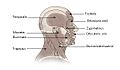
Muscles of the head and neck.
-
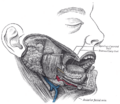
Dissection, showing salivary glands of right side (Masseter visible at center)
-
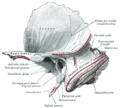
Left temporal bone, outer surface
-
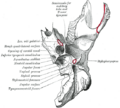
Left temporal bone, inferior surface
-
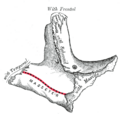
Left zygomatic bone, temporal surface
-
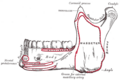
Mandible, outer surface, side view
-
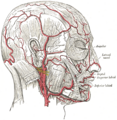
The arteries of the face and scalp.
-
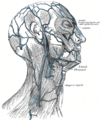
Veins of the head and neck.
-
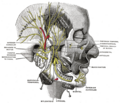
Mandibular division of the trifacial nerve.
-
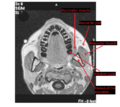
An MRI of head with captions for masseter muscle and other structures around it


See also
- Zygomasseteric system
