
Mediant (mathematics) facts for kids
In mathematics, a mediant is a special way to combine two fractions. Imagine you have two fractions, like 1/2 and 3/4. The mediant of these fractions is found by adding their top numbers (numerators) together and adding their bottom numbers (denominators) together. So, for 1/2 and 3/4, the mediant would be (1+3)/(2+4) = 4/6. This is different from how you usually add fractions!
The mediant is sometimes called the freshman sum. This name comes from a common mistake students make when they are first learning how to add fractions. Instead of finding a common denominator, they mistakenly add the numerators and denominators separately.
Contents
What is a Mediant?
A mediant is a third fraction created from two other fractions. It's a simple operation where you combine the parts of two fractions in a specific way. It's not the same as adding or multiplying fractions.
For example, if you have the fraction 1/1 and the fraction 1/2:
- The mediant is (1+1)/(1+2) = 2/3.
But if you use a different way to write the first fraction, like 2/2 instead of 1/1:
- The mediant of 2/2 and 1/2 is (2+1)/(2+2) = 3/4.
Even though 1/1 and 2/2 represent the same value (the number 1), their mediants with 1/2 are different. This shows that the mediant depends on how the fractions are written, not just their value.
How to Calculate a Mediant
Calculating a mediant is straightforward. If you have two fractions, let's call them a/c and b/d:
- The mediant is found by adding the numerators (top numbers) together.
- Then, you add the denominators (bottom numbers) together.
- The new fraction will have the sum of the numerators as its new numerator.
- The new fraction will have the sum of the denominators as its new denominator.
So, the formula looks like this:  The mediant is:
Let's try an example:
- Fractions: 2/5 and 1/3
- Add numerators: 2 + 1 = 3
- Add denominators: 5 + 3 = 8
- The mediant is 3/8.
Mediant vs. Adding Fractions
It's very important to understand that finding the mediant is not the same as adding fractions. When you add fractions, you need to find a common denominator first.
Let's compare:
- Adding fractions (2/5 + 1/3):
* Find a common denominator (like 15). * Convert fractions: 2/5 becomes 6/15, and 1/3 becomes 5/15. * Add: 6/15 + 5/15 = 11/15.
- Finding the mediant (2/5 and 1/3):
* Add numerators: 2 + 1 = 3. * Add denominators: 5 + 3 = 8. * The mediant is 3/8.
As you can see, 11/15 is very different from 3/8. The mediant is a unique operation with its own uses, separate from standard fraction addition.
Why "Freshman Sum"?
The term "freshman sum" is a playful name. It refers to a common mistake made by students who are new to adding fractions. Instead of learning the correct method of finding a common denominator, they might incorrectly assume they can just add the top numbers and bottom numbers.
This mistake leads them to calculate the mediant instead of the actual sum. While the mediant is a real mathematical concept, it's not the correct way to add fractions.
Where Mediant is Used
Even though it's often seen as a mistake in basic fraction addition, the mediant is a useful concept in higher mathematics. It plays a role in topics like Farey sequences. A Farey sequence is a special list of fractions between 0 and 1, arranged in order. The mediant helps to find new fractions that fit into these sequences.
It also has applications in areas like number theory and geometry, especially when dealing with rational numbers (fractions) and their properties.
Images for kids
-
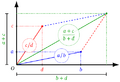
Determining the mediant of two rational numbers graphically. The slopes of the blue and red segments are two rational numbers; the slope of the green segment is their mediant.

See also
 In Spanish: Mediante (matemáticas) para niños
