
Moustached hawk-cuckoo facts for kids
Quick facts for kids Moustached hawk-cuckoo |
|
|---|---|
 |
|
| Conservation status | |
Scientific classification  |
|
| Kingdom: | Animalia |
| Phylum: | Chordata |
| Class: | Aves |
| Order: | Cuculiformes |
| Family: | Cuculidae |
| Genus: | Hierococcyx |
| Species: |
H. vagans
|
| Binomial name | |
| Hierococcyx vagans (Müller, S, 1845)
|
|
| Script error: The function "autoWithCaption" does not exist. | |
| Synonyms | |
|
Cuculus vagans S. Müller, 1845 |
|
Script error: No such module "Check for conflicting parameters".
The moustached hawk-cuckoo (scientific name: Hierococcyx vagans) is a type of cuckoo bird. It belongs to the Cuculidae family, which includes many different kinds of cuckoos. This interesting bird lives in several countries in Southeast Asia, like Brunei, Indonesia, Laos, Malaysia, Myanmar, and Thailand.
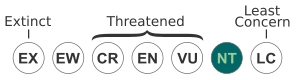
These cuckoos naturally live in evergreen forests and secondary forests. Sadly, their homes are shrinking because of habitat loss. Because of this, experts have listed the moustached hawk-cuckoo as a near-threatened species. This means it could become endangered if we don't protect its habitat.
Contents
Where the Moustached Hawk-Cuckoo Lives
The moustached hawk-cuckoo can be found in many parts of Southeast Asia. You might spot it in southern Myanmar, Thailand, and southern Laos. It also lives in Malaysia, Singapore, and Brunei. In Indonesia, it's found on the islands of Kalimantan, Sumatra, and Java.
These birds prefer to live in evergreen forests, which stay green all year round. They also live in secondary forests, which are forests that have grown back after being cut down. You can often find them at the edges of forests, especially on hills. They also like forests near rivers (alluvial forests) and areas with lots of bamboo. They can live at heights up to about 915 meters (3,000 feet) above sea level.
What the Moustached Hawk-Cuckoo Looks Like
The moustached hawk-cuckoo is a medium-sized bird, usually about 25 to 30 centimeters (10 to 12 inches) long. It weighs around 58 to 63 grams (2 to 2.2 ounces), which is about the weight of a small apple.
Here are some of its features:
- Its head and the back of its neck are grey.
- It has white feathers covering its ears.
- A cool feature is the blackish stripe on its face, which looks like a "moustache"!
- Its back is brown, and its tail has brown stripes with a light brown or white tip.
- The feathers it uses for flying have light brown stripes.
- Its belly is a creamy-white color with blackish streaks.
- Its eyes are dark brown or grey, surrounded by a bright yellow ring.
- The beak is black, and its feet are orange-yellow.
Young moustached hawk-cuckoos look a bit different. Their backs and wings are blackish, and they have black streaks on their chest. Even as young birds, they already have their distinctive "moustache"!
Moustached Hawk-Cuckoo Behavior and Diet
These cuckoos are mostly found hidden in the thick tops of trees, called the canopy. They are quite shy and can be hard to spot.
What do they eat?
- They mainly eat insects.
- They also enjoy small fruits.
- Sometimes, they join other bird species in "mixed-species foraging flocks." This means they team up with different kinds of birds to find food together.
The male cuckoos are known for their calls. They sing from the same spots in the treetops. Their calls sound like "chu-chu" or "kang-koh," repeated every two seconds. They also make a whistling sound that starts as "peu peu," changes to "hi-hi," and then stops.
Reproduction and Brood Parasitism
Like many cuckoos, the moustached hawk-cuckoo is a brood parasite. This means the female cuckoo lays her eggs in the nests of other bird species. The "host" birds then raise the cuckoo chicks as if they were their own.
Scientists have seen moustached hawk-cuckoos laying eggs in the nests of two specific birds:
- The Abbott's babbler
- The rufous-winged philentoma
In mainland Southeast Asia, the breeding season for these cuckoos is usually from June to August.
Why This Bird is Near Threatened
The moustached hawk-cuckoo is facing challenges that threaten its survival. The biggest problem is the rapid loss of its natural home. This habitat loss is caused by several human activities:
- Logging: Trees are cut down for wood and other products.
- Land conversion: Forests are cleared to make way for farms, buildings, or other developments.
- Forest fires: Fires, often started by humans, destroy large areas of forest.
Because of these threats, the number of moustached hawk-cuckoos is likely going down at a fairly fast rate. Even though they can live in secondary forests (forests that have grown back), these areas might not be as good for them as untouched evergreen forests.
The International Union for Conservation of Nature (IUCN) has carefully studied the situation. They have decided to list the moustached hawk-cuckoo as a near-threatened species. This means it's not yet endangered, but it's close, and we need to work to protect its forests to keep its population healthy.
