
Mucubaji stubfoot toad facts for kids
Quick facts for kids Mucubaji stubfoot toad |
|
|---|---|
 |
|
| Conservation status | |
Scientific classification  |
|
| Kingdom: | Animalia |
| Phylum: | Chordata |
| Class: | Amphibia |
| Order: | Anura |
| Family: | Bufonidae |
| Genus: | Atelopus |
| Species: |
A. mucubajiensis
|
| Binomial name | |
| Atelopus mucubajiensis Rivero, 1974
|
|
| Script error: The function "autoWithCaption" does not exist. | |
Script error: No such module "Check for conflicting parameters".
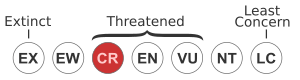
The Atelopus mucubajiensis, also known as the Mucubaji stubfoot toad, is a special kind of toad. It belongs to the Bufonidae family, which includes many types of toads. This toad is found only in the Mérida Andes mountains of Venezuela. Sadly, this toad was once very common but has not been seen since 2004. Scientists believe it might now be extinct.
What Does the Mucubaji Stubfoot Toad Look Like?
.jpg)
Adult male toads are about 30 to 42 millimeters long. This is about 1.2 to 1.7 inches. Female toads are a bit bigger, measuring 40 to 44 millimeters. That's about 1.6 to 1.7 inches. This measurement is taken from their snout (nose) to their vent (tail end).
Their snout does not stick out much. Their back legs are quite short. The toad's back can be yellow, yellowish-brown, or greenish-brown. It has irregular brown spots. Sometimes these spots form an "X" shape. The sides of its body are yellowish.
The throat and front part of the belly are yellowish with brown spots. The back part of its belly is red. This toad also has rows of warts along its back and sides. There are other warts scattered across its skin too.
This toad makes two types of calls. One is a "pure tone call." The other is a "pure tone short call." Scientists heard a male toad make the short call when it was with a female. They are not sure if females also make calls.
Where Does This Toad Live?
This toad lives in a very small area. Its home is only a few square kilometers wide. This special place is called Páramo de Mucubají. It is in the Sierra de Santo Domingo mountains in the Venezuelan Andes.
The toad lives at high altitudes. It can be found from 2,300 to 3,500 meters (about 7,500 to 11,500 feet) above sea level. This area is known as a páramo or sub-páramo environment. A páramo is a type of mountain grassland.
You can usually find these toads among grasses and Espeletia plants. They also live along streams. Streams are important because that is where they breed. At lower elevations, they might live in shrubs. They have also been seen in cloud forests. However, this is not their favorite place to live.
Why Is This Toad Disappearing?
The Mucubaji stubfoot toad was very common in the 1970s and 1980s. But after that, its numbers dropped very quickly. The last time anyone saw this toad was in 2004. People have searched for it since then, but they have not found any.
Scientists think a serious frog disease called chytridiomycosis is a main reason for its decline. Other problems also hurt the toad population. These include:
- Trout fish that were brought into the area.
- New types of trees (conifers) that were planted.
- Fires started by humans.
- Too many toads being collected by people.
- Farming and building new roads or buildings.
- Pollution.
It is not known if any of these toads are still alive today. Most of their habitat is inside the Sierra Nevada National Park. This park helps protect the area.
 | Toni Morrison |
 | Barack Obama |
 | Martin Luther King Jr. |
 | Ralph Bunche |
