
NAACP New Orleans Branch facts for kids
| Abbreviation | NAACP New Orleans Branch |
|---|---|
| Formation | Chartered July 15, 1915 |
| Purpose | "To ensure the political, educational, social, and economic equality of rights of all persons and to eliminate racial hatred and racial discrimination." |
| Headquarters | Branch Office 2475 Canal St., Ste. 308 New Orleans, Louisiana TEL: 504-822-8512 FAX: 504-821-3131 |
|
President
|
Atty. Danatus N. King Sr. |
| Website | neworleansnaacp.org |
The New Orleans Branch of the National Association for the Advancement of Colored People (NAACP) is a very important part of American history. It is the oldest active branch in the southern United States and was officially created on July 15, 1915. The NAACP is a civil rights group that works to make sure everyone has equal rights.
Even before 1915, people in New Orleans wanted to join the national NAACP, which started in New York City in 1909. In 1911, a few leaders from New Orleans wrote to the national office to learn more. They were so determined that they started meeting and organizing on their own. By 1917, the branch was already active, fighting for the rights of African Americans in their city.
Contents
Early Fights for Fairness

One of the first actions the New Orleans Branch took was to protest an unfair practice. They gathered over 5,000 signatures on a petition and gave it to the mayor. At this time, very few Black people were allowed to vote. Unfair laws had removed most of them from the voting lists. This made it hard to change things through elections.
Laws at the time supported racial segregation, which meant that Black people and white people were kept separate in public places. This idea was called "separate but equal," but in reality, things were not equal. For example, New Orleans did not have a single public high school for Black students until 1915. The NAACP branch knew that education was key to a better future.
To spread their message, the branch started a newspaper called The Vindicator. Throughout the 1920s, they spoke out against unfair voting taxes, segregated neighborhoods, and poor treatment by the police. They also successfully fought to keep the Joseph Craig School, a school for Black children, from being closed.
A.P. Tureaud: A Legal Champion
Alexander Pierre Tureaud was a lawyer who became a hero for the civil rights movement in Louisiana. He worked with the NAACP Legal Defense and Educational Fund, Inc. to fight for equality in the courts.
Thanks to his hard work, African American teachers in Louisiana started to receive the same pay as white teachers. He also fought for Black students to be admitted to state universities. A.P. Tureaud filed over 60 lawsuits against segregation. Some of his most famous cases helped to:
- End segregation on city buses.
- Allow Black students into Louisiana State University.
- Begin the process of desegregating public schools in New Orleans.
In 1959, a judge ordered New Orleans schools to integrate. On November 14, 1960, four young Black girls, including Ruby Bridges, became the first to attend all-white elementary schools. This was a huge step forward, and A.P. Tureaud’s legal work made it possible.
Fighting for the Right to Vote

In the 1940s, a new group of young, energetic leaders took charge of the branch. One of these leaders was Daniel Byrd. Under his leadership, the branch grew to over 3,000 members. Byrd also helped start the Louisiana State Conference of NAACP Branches.
Working with the lawyer A.P. Tureaud, the NAACP won many important legal battles. They were able to end the "white primary," a rule that stopped Black people from voting in certain elections. They also fought to desegregate schools in 53 of Louisiana's 64 parishes (counties).
The branch also held voter education classes. These classes helped increase the number of Black voters in New Orleans to over 30,000 by the early 1950s. This gave the African American community a stronger voice in politics.
The Fight to End Segregation Continues
From 1952 to 1962, the branch was led by Arthur J. Chapital Sr. During these "turbulent" years, the NAACP launched major attacks on segregation in schools, buses, parks, and public buildings.
The branch's work led to the desegregation of city buses in 1958. Lawsuits filed by the NAACP also opened City Park and Audubon Park to everyone, regardless of their race.
In the 1960s, the branch's Youth Council, led by Raphael Cassimere Jr., organized protests. They led a successful campaign that convinced many stores on Canal Street to hire Black employees for good jobs. The Youth Council became one of the most active and respected in the entire country.
New Challenges and Victories

In the 1970s, the branch focused on political power. They created a plan for new voting districts that led to the election of five Black state representatives. This showed how important it was for the community to be involved in politics.
The branch also continued to fight against discrimination in jobs and housing. They hosted the national NAACP convention in 1974 and again in 1983, bringing thousands of civil rights leaders to New Orleans.
Women Leading the Way

Women played a huge role in the branch's success. In 1975, Dyan F. Cole became the first woman elected as president. Later, Shirley B. Porter served as president for nearly 15 years, from 1980 to 1994.
Under her leadership, the branch protested against companies that supported the unfair apartheid system in South Africa. They also worked to address complaints about police misconduct and helped pass a city law to protect against discrimination. Sheila Williams, a former youth leader, became president in 1995, continuing the tradition of strong leadership.
The Branch in the 21st Century
In 2005, attorney Danatus N. King Sr. was elected president. Under his leadership, the branch embraced modern technology. They launched a website, a Facebook page, and an online newsletter called The Vindicator, named after the branch's first newspaper.
The branch continued to fight for justice. They called for investigations into the death of a Black college student and the police handling of a case after Hurricane Katrina. They also spoke out on important issues like education and public safety.
The New Orleans Branch has won many awards for its leadership and programs, showing that it remains a powerful force for good. Today, it continues its mission to ensure "the political, educational, social, and economic equality of rights of all persons."
Notable Presidents
The New Orleans Branch has been led by many dedicated presidents over the years. Here are some of the key leaders who guided the branch through its most important fights:
- H. C. Casa Calvo, founding president, 1911-1915
- Rev. Eugene W. White, 1915-1921
- Dr. George W. Lucas, 1921-1931
- Daniel E. Byrd, 1942-1943 and 1947-48
- Arthur J. Chapital Sr., 1951-1962
- Atty. Ernest N. "Dutch" Morial, 1963-1965
- Ms. Dyan French "Mama D" Cole, 1975-1976
- Mrs. Shirley B. Porter, 1980-1994
- Atty. Danatus N. King Sr., 2005-2015
- Ronald C. Coleman, Sr., 2019-Present
Images for kids
-
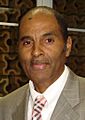
In 2005, Attorney Danatus N. King Sr. was elected President of the NAACP New Orleans Branch.

