
National Register of Historic Places listings in Barron County, Wisconsin facts for kids

Welcome to Barron County, Wisconsin! This article is all about the amazing historic places in our county that are listed on the National Register of Historic Places. This special list helps protect important buildings, sites, and objects across the United States. It's like a hall of fame for places that tell us about the past. In Barron County, we have 10 places on this list, and each one has a cool story to share!
Contents
Discovering Barron County's Historic Treasures
Let's explore some of the fascinating places in Barron County that have been recognized for their history. These sites help us understand how people lived, worked, and built communities long ago.
Ancient Quarries and Mounds
Barron County Pipestone Quarry
Imagine a place where people have been gathering special rocks for thousands of years! The Barron County Pipestone Quarry is one such spot, located east of Rice Lake. Native American people historically came here to quarry a unique type of stone called pipestone. This beautiful red stone was used to create ceremonial pipes and other important items. It's a place that connects us to the ancient traditions and cultures of the first people who lived here.
Rice Lake Mounds (47 BN-90)
Also near Rice Lake, you'll find the Rice Lake Mounds. These are several ancient burial mounds. Experts believe they were built by the Dakota people a very long time ago. These mounds are located near the lake and are now part of a city park. They are important reminders of the early communities that lived in this area and their customs.
Wajiwan ji Mashkode Archeological District
The Wajiwan ji Mashkode Archeological District is another important site near Rice Lake. While its exact location is kept private to protect it, this district is a significant area for understanding the history of the region's earliest inhabitants. Archeological districts often contain artifacts and clues that help scientists learn about past human life and activities.
Buildings from a Bygone Era
Chicago, St. Paul, Minneapolis and Omaha Railroad Passenger Station
Step back in time to 1909 at the Chicago, St. Paul, Minneapolis and Omaha Railroad Passenger Station in Rice Lake. Before cars became common, trains were the main way people traveled and goods were moved. This old train station, or depot, was a busy hub where people would arrive and depart, and freight would be loaded and unloaded. It shows us how important railways were to daily life and business in the early 20th century.
Cumberland Public Library
The Cumberland Public Library in Cumberland is a beautiful building with a special history. It opened in 1906 thanks to a generous $10,000 donation from Andrew Carnegie. Carnegie was a very wealthy businessman who believed in the power of education and helped fund thousands of libraries across the world. This library is built in the Classical Revival style, which means it looks a bit like ancient Greek or Roman buildings with grand columns and balanced designs.
Franklin School (Rice Lake, Wisconsin)
The Franklin School in Rice Lake is a brick school building that was built in 1936. This was during the Great Depression, a very tough time when many people didn't have jobs. Even though times were hard, the city of Rice Lake funded this school on its own. It was designed by William Linley Alban in the Art Deco style, which was popular in the 1920s and 1930s. Art Deco buildings often have sleek lines, geometric shapes, and decorative elements.
St. Mary's Rectory (Cumberland, Wisconsin)
In Cumberland, you'll find St. Mary's Rectory, built in 1904. A rectory is the home where a Catholic priest lives. This building is interesting because it mixes two different architectural styles: Queen Anne and Richardsonian Romanesque. Queen Anne style often features towers, turrets, and decorative details, while Richardsonian Romanesque uses heavy stone, rounded arches, and a strong, solid look. This mix makes the rectory quite unique!
Edward N. and Mary T. Stebbins House
The Edward N. and Mary T. Stebbins House in Barron was built in 1895. It's a beautiful example of a Georgian Revival house. Edward N. Stebbins was an important person in Barron; he owned a factory and was even the mayor! He moved to Barron in 1891 from Pennsylvania and built this grand home. Georgian Revival homes are known for their balanced, symmetrical designs and classic, elegant appearance.
ZCBJ Hall (Haugen, Wisconsin)
The ZCBJ Hall in Haugen was built in 1913. ZCBJ stands for Zapadni Ceska Bratrska Jednota, which means "Western Czechoslovakian Fraternal Association." This hall was a meeting place for people of Czech and Slovak heritage. It's built in the "Boomtown" style, which was common in rapidly growing towns. These buildings were often simple, functional, and built quickly to meet the needs of a growing community.
A Special Island Retreat
Island of Happy Days
Imagine having your own private island for summer vacations! The Island of Happy Days is located on Stout Island in Red Cedar Lake. From 1903 to 1927, this island was a summer retreat for the wealthy heirs of the Knapp-Stout & Co. lumber company. The buildings on the island are in the Rustic style, which means they use natural materials like logs and stones and blend in with the beautiful outdoor surroundings. It was a perfect getaway spot for relaxation and fun.
A Library That's No Longer Here
Sometimes, even historic places can change or disappear. The Rice Lake Carnegie Library was once on the National Register of Historic Places. It was a Neoclassical brownstone Carnegie library built in 1905. Sadly, it was demolished in 1985, so it was removed from the list in 1986. Even though it's gone, its history is still part of Barron County's story.
Images for kids
-
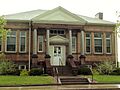
The Cumberland Public Library, a Carnegie Library built in 1906.
-
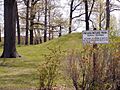
One of the ancient Rice Lake Mounds.
-
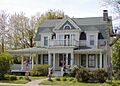
The Edward N. and Mary T. Stebbins House, built in 1895.
-

An image representing a site with a restricted address, like the Wajiwan ji Mashkode Archeological District.
-
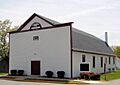
The ZCBJ Hall in Haugen, built in 1913.

.JPG)


