
Organization of the Air Service of the American Expeditionary Force facts for kids

World War I Air Service recruiting poster, 1918
|
|
| Active | 3 September 1917 - 1919 |
|---|---|
| Country |  United States United States |
| Branch | United States Army Air Service |
| Part of | American Expeditionary Forces |
Quick facts for kids Commanders |
|
| Chief of Air Service, American Expeditionary Forces, 3 September 1917 | William L. Kenly |
| Chief of Air Service, American Expeditionary Forces, 27 November 1917 | Benjamin Foulois |
| Chief of Air Service, American Expeditionary Forces, 19 May 1918 | Mason Patrick |
| Insignia | |
| Wing roundel of Air Service, United States Army aircraft |  |
The Air Service of the American Expeditionary Force was the air branch of the United States Army during World War I. It reached its largest size on November 11, 1918, the day the war ended with the Armistice with Germany.
The very first American air unit arrived in France in September 1917. Air operations began in April 1918. By the end of the war, 57,508 soldiers and officers were part of the Air Service. About 4,088 officers were pilots. Around 1,724 pilots and 100 observation balloon pilots served in combat.
The Air Service was organized into different groups and units. The main combat units were:
- The First Army Air Service, started on August 26, 1918.
- The Second Army Air Service, started on October 12, 1918.
- The Third Army Air Service, created after the war to support the army occupying Germany.
The first air combat groups were the 1st Corps Observation Group and the 1st Pursuit Group, both formed in April 1918. In total, 14 airplane groups and 7 balloon groups were created. These groups supported two field armies and five corps. The main units were squadrons for airplanes and companies for balloons.
At the front, there were 45 airplane squadrons (38 of which saw combat) and 17 balloon companies. Each pursuit (fighter) and bombardment (bomber) squadron had about 25 aircraft and 18 crews. Observation squadrons had 24 planes and 18 crews. Balloon companies had one balloon and about six observers.
Contents
Air Service Headquarters

The main headquarters for the Air Service in the combat zone was:
- Headquarters Air Service, Zone of Advance
- This was the main office for the Chief of Air Service, AEF, located at Chaumont Hill 402 Aerodrome. Major General Mason Patrick was in charge.
- There was also a headquarters for the Chief of Air Service, Group of Armies, at Ligny-en-Barrois. Brigadier General Billy Mitchell led this group.
First Army Air Service
The First Army Air Service was the largest combat group of the American Air Service in France. Most American combat units joined it when they went to the front lines.
Colonel William Mitchell became the Chief of Air Service for I Corps on January 15, 1918. This corps was set up to manage all American troops on the Western Front. When the first American Aero Squadrons arrived in April 1918, they were sent to the quiet Toul Sector. At that time, the American Air Service only had a few squadrons from the 1st Pursuit Group.
The First Army Air Service was officially formed on August 26, 1918, at Ligny-en-Barrois, France. It included many French pursuit and bomber squadrons, one French pursuit group, three American pursuit groups, one American day-bombardment group, and one French artillery group. Eight British Royal Air Force night-bombardment squadrons also worked with them. This was the first time American air forces were brought together under their own commander.
On November 11, 1918, all offensive flying stopped at 11:00 am because of the Armistice. As part of the peace agreement, Allied forces would occupy the Rhineland area of Germany starting December 1. The Third Army Air Service was created for this occupation. Units from the First Army Air Service made up more than half of the Third Army Air Service's strength. This included eight Aero Squadrons and the headquarters of the III Corps Observation Group and the VII Corps Observation Group.
The First Army Air Service headquarters was officially closed on April 15, 1919. Its members returned to the United States by the end of May. They either joined other Air Service units or went back to civilian life.
- HQ First Army Air Service (August 10, 1918 – April 15, 1919)
- Colonel Thomas D. Milling, Commander
- First Day Bombardment Group (September 10 – December 17, 1918)
- Major James L. Dunsworth, Commander
- 11th Aero Squadron (Day Bombardment)
- 20th Aero Squadron (Day Bombardment)
- 96th Aero Squadron (Day Bombardment)
- Major James L. Dunsworth, Commander
- First Army Observation Group (September 6, 1918 – April 15, 1919)
- Captain Harry T. Wood, Commander
- 9th Aero Squadron (Night Observation)
- 24th Aero Squadron (Army Observation)
- 91st Aero Squadron (Army Observation)
- Captain Harry T. Wood, Commander
- First Army Balloon Group
- Major John Paegelow, Commander
- 11th Balloon Company
- 43d Balloon Company
- Major John Paegelow, Commander
- I Corps Observation Wing
- Major Melvin Adams Hall, Commander
- I Corps Observation Group (April 21, 1918 – April 15, 1919)
- 1st Aero Squadron (Corps Observation)
- 12th Aero Squadron (Corps Observation)
- 88th Aero Squadron (Corps Observation)
- I Corps Balloon Group
- 1st Balloon Company
- 2d Balloon Company
- I Corps Observation Group (April 21, 1918 – April 15, 1919)
- Major Melvin Adams Hall, Commander
- 1st Pursuit Wing (July 6 – December 17, 1918)
- Major Burt M. Atkinson, Commander
- 1st Pursuit Group (May 5 – December 9, 1918)
- Major Harold E. Hartney, Commander
- 1st Pursuit Group (May 5 – December 9, 1918)
- Major Burt M. Atkinson, Commander
* 27th Aero Squadron (Pursuit) * 94th Aero Squadron (Pursuit) * 95th Aero Squadron (Pursuit) * 147th Aero Squadron (Pursuit) * 185th Aero Squadron (Night Pursuit)
Second Army Air Service

The Second Army Air Service was created on October 14, 1918. Colonel Frank P. Lahm was appointed its chief. Its headquarters was at Croix-de-Metz Aerodrome in Toul, France.
After the Armistice, American forces were sent to occupy the German Rhineland. The Third Army Air Service was formed for this purpose on November 14. The First and Second Army Air Services were ordered to transfer some of their units and staff to the Third Army. For example, the 5th Pursuit Group and several squadrons moved to the Third Army on November 19.
On April 15, 1919, the Second Army Air Service was ordered to close down. Some of its squadrons were transferred to the Third Army. The rest of its units sent their equipment to the 1st Air Depot. After that, the personnel were sent to staging depots in France to wait for transport back to the United States.
- HQ Second Army Air Service (October 12, 1918 – April 15, 1919)
- Colonel Frank P. Lahm, Commander
- Second Army Observation Wing
-
- Second Army Observation Group (October 25 – November 4, 1918)
- 85th Aero Squadron (Army Observation)
- Second Army Observation Group (October 25 – November 4, 1918)
-
- IV Corps Observation Group (October 14 – November 21, 1918)
- Major Harry B. Anderson, Commander
- 8th Aero Squadron (Corps Observation)
- 135th Aero Squadron (Corps Observation)
- 168th Aero Squadron (Corps Observation)
- Major Harry B. Anderson, Commander
- 2d Day Bombardment Group (November 1, 1918 – April 15, 1919)
- Major George E. A. Reinberg, Commander
- 100th Aero Squadron (Day Bombardment)
- 163d Aero Squadron (Day Bombardment)
- Major George E. A. Reinberg, Commander
- 4th Pursuit Group (October 26, 1918 – April 15, 1919)
- Major Charles J. Biddle, Commander
- 17th Aero Squadron (Pursuit)
- 25th Aero Squadron (Pursuit)
- 141st Aero Squadron (Pursuit)
- Major Charles J. Biddle, Commander
Third Army Air Service

Right after the armistice, the American Expeditionary Forces created the Third United States Army. This army was to march into Germany while the rest of the army was sent home. Brigadier General Mitchell was put in charge of the Third Army Air Service on November 14, 1918. Later, in January, Colonel Harold Fowler took over. He was a combat veteran from the British Royal Flying Corps.
The most experienced Air Service units were chosen for this new army. These included the 94th Aero Squadron (a fighter unit), the 166th (a day bomber squadron), and four observation squadrons (1st, 12th, 88th, and 9th Night).
- HQ Third Army Air Service (November 14, 1918 – July 2, 1919)
- 9th Aero Squadron (Night Observation)
- 91st Aero Squadron (Observation)
- 94th Aero Squadron (Pursuit)
- 166th Aero Squadron (Day Bombardment)
- III Corps Observation Group (November 21, 1918 – May 12, 1919)
- 1st Aero Squadron (Corps Observation)
- 24th Aero Squadron (Corps Observation)
- IV Corps Observation Group (November 21, 1918 – May 12, 1919)
- 12th Aero Squadron (Corps Observation)
- 88th Aero Squadron (Corps Observation)
- 5th Pursuit Group (April 15 – May 12, 1919)
- 41st Aero Squadron (Pursuit)
- 138th Aero Squadron (Pursuit)
On April 15, 1919, the First and Second Army Air Services in France closed down. Their remaining personnel returned to the United States. The Third Army Air Service received some of the few squadrons left in France. Its fighter squadrons were gathered at Coblenz. The 1st Aero Squadron and other observation squadrons formed the III Corps Observation Group at Weissenthurm.
On May 15, 1919, the Air Service was ordered to close all its flying units. They sent their equipment to the 1st Air Depot in Colombey-les-Belles, France. From there, personnel were sent back to the United States. All foreign aircraft were returned to the French and British governments. By the end of July 1919, most personnel were sent back to civilian life.
American Forces Germany

The Treaty of Versailles officially ended World War I in June 1919. The Third Army Air Service was then withdrawn. The Third Army Air Service officially closed on July 2, 1919. The American Forces Germany (AFG) took over the job of occupying the Rhineland.
In July 1920, it was decided to add an Air Service group to the AFG. A small group of officers and men were sent to Germany on July 23. Major Frank Maxwell Andrews led them. They were not assigned to a specific squadron but directly to the AFG.
These Air Service personnel were based at Weissenthurm, south of Coblenz on the Rhine River. A new airfield was built there with hangars and offices. The group received 24 De Havilland DH-4 aircraft. These planes were powered by American Liberty engines. Their duties included test flights, taking photos for radio missions, and flying with infantry, cavalry, and artillery units during training. They also took many aerial photos for map-making.
The occupation mission after the war was not very popular. In 1922, President Harding began pulling American forces out of the Rhineland. All AFG aviation activities stopped in April. Any extra equipment was sold. On January 24, 1923, the last American forces left Germany. This formally ended the United States' involvement in World War I.
Images for kids
-
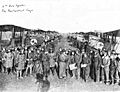
11th Aero Squadron posing with its De Havilland DH.4 Bombers (Note "Mr Jiggs" on each fuselage), Maulan Aerodrome
-

Caquot Type "R" kite balloon
-
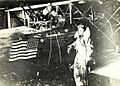
1st Aero Squadron Salmson 2.A2 reconnaissance aircraft, Remicourt Aerodrome
-
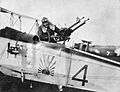
135th Aero Squadron De Havilland DH.4 No 4, Saizerais Aerodrome
-
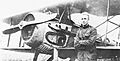
27th Aero Squadron - 2lt Frank Luke Jr with his SPAD XIII, Rembercourt Aerodrome
-
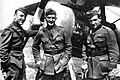
Eddie Rickenbacker, Douglas Campbell, and Kenneth Marr of the 94th Aero Squadron pose next to a Nieuport 28 fighter, 1918.
-
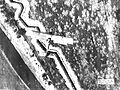
De Havilland DH.4 of the 354th Aero Squadron flying over the front line trenches in the Toul Sector, France, November 1918.
-
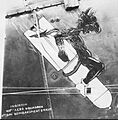
Squadron Emblem, painted on the fuselage of a De Havilland DH.4.
-
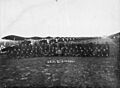
Royal Aircraft Factory S.E.5a's, 25th Aero Squadron enlisted corps with squadron commander Capt Reed Landis, Croix-de-Metz Aerodrome 1918
-
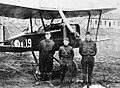
Joseph "Child Yank" Boudwin with mechanics and his last S.E. 5a, "19" of the 25th Aero Squadron
-
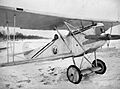
9th Aero Squadron - evaluating a captured Fokker D.VII, Trier Aerodrome
-
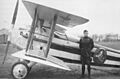
Major Reed Chambers, AEF 94th Pursuit Squadron next to a SPAD S.XIII, Coblenz Aerodrome
-
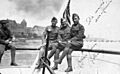
Members of the 1st Aero Squadron enjoying some R&R on a Rhine River Cruise, spring 1919


