
Orocrambus sophistes facts for kids
Quick facts for kids Orocrambus sophistes |
|
|---|---|
.jpg) |
|
| Male | |
| Conservation status | |
 Nationally Vulnerable (NZ TCS) |
|
Scientific classification  |
|
| Kingdom: | Animalia |
| Phylum: | Arthropoda |
| Class: | Insecta |
| Order: | Lepidoptera |
| Family: | Crambidae |
| Genus: | Orocrambus |
| Species: |
O. sophistes
|
| Binomial name | |
| Orocrambus sophistes (Meyrick, 1905)
|
|
| Script error: The function "autoWithCaption" does not exist. | |
| Synonyms | |
|
|
Script error: No such module "Check for conflicting parameters".
The Orocrambus sophistes is a special type of moth that belongs to the family Crambidae. This moth is found only in New Zealand, meaning it is endemic to that country. Because it is quite rare, the Department of Conservation has listed it as Nationally Vulnerable. This means it needs protection to survive.
Contents
Discovering the Orocrambus sophistes
This moth was first described in 1905 by a scientist named Edward Meyrick. He studied a specimen collected by J. H. Lewis in a place called Ida Valley in Otago, New Zealand. Meyrick first named the moth Crambus sophistes.
Later, in 1928, another scientist, George Vernon Hudson, also wrote about and drew pictures of this moth. Over time, scientists decided to move this moth into a different group, or genus, called Orocrambus. The original moth specimen that Meyrick used to describe the species is kept safe at the Natural History Museum, London.
What Does the Orocrambus sophistes Look Like?
The male Orocrambus sophistes moth is about 17 millimeters long. Its body and wings are mostly a brownish-grey color, mixed with some whitish spots. It has long, narrow front wings that get a bit wider towards the end.
A cool feature is a thin white stripe on its front wings, which has some dark scales around it. You might also see a few dark spots on its wings. The hind wings are a lighter, whitish-brown color.
One very interesting fact is that the female Orocrambus sophistes cannot fly! This is quite unusual for a moth. You can tell this moth apart from similar species by looking at its mouthparts, called labial palps. It is also bigger than a similar moth, Orocrambus cyclopicus, and its female has much shorter wings.
Where Does the Orocrambus sophistes Live?
This moth is found only in New Zealand. It lives in specific areas like the Mackenzie Basin, Central Otago, and Otago Lakes. Sadly, it might no longer be found in the very first place it was discovered, which is called its type locality. However, it has been seen in other spots, like Devils Elbow at Coronet Peak.
Life Cycle and Behavior
Adult Orocrambus sophistes moths can be seen flying around from mid-January until April. The male moths are often attracted to lights at night. This helps scientists find and study them.
Habitat and Host Plant
The Orocrambus sophistes moth is a specialist that loves dry, open areas. It lives in short tussock grasslands, which are fields covered in clumps of grass. These grasslands are important because they are where its favorite food plant grows.
The moth relies on a specific grass called Festuca novae-zealandiae. This grass is also endemic to New Zealand, meaning it only grows there. The moth needs this plant to survive and lay its eggs.
Why is the Orocrambus sophistes Vulnerable?
This moth is listed as Nationally Vulnerable under the New Zealand Threat Classification System. This means its population is at risk. There are a few reasons why this moth is in trouble.
First, the areas where it lives are shrinking. This is also happening to its host plant, Festuca novae-zealandiae. Second, because the female moths cannot fly, they cannot easily move to new places. This makes it hard for the species to spread out and find new safe homes if their current habitat is destroyed. Protecting their grasslands and host plants is very important for their future.
Images for kids
-
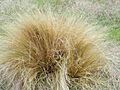
Festuca novae-zelandiae, host plant of O. sophistes.

