
Pair skating facts for kids

Riku Miura and Ryuichi Kihara of Japan, the reigning World champions in pair skating
|
|
| Highest governing body | International Skating Union |
|---|---|
| Characteristics | |
| Team members | Pairs |
| Mixed-sex | Yes |
| Equipment | Figure skates |
| Presence | |
| Olympic | Part of the Summer Olympics in 1908 and 1920; Part of the first Winter Olympics in 1924 to today |
Pair skating is an exciting sport where two skaters, usually a boy and a girl, perform together on the ice. They move in perfect sync, making it look like one smooth performance. The International Skating Union (ISU) sets the rules for this sport. Pair skating has been part of the Olympic Games since 1908, making figure skating the oldest Winter Olympic sport. It was also introduced at the 1908 World Figure Skating Championships that same year.
Competitions have two main parts: the short program and the free skating program. The short program is about two minutes and 40 seconds long. It has seven specific moves that teams must do. The free skating program is longer, about four minutes for older skaters and three-and-a-half minutes for younger ones. Skaters choose their own music for this part. They perform amazing moves like lifts, spins, and jumps. These moves must flow together smoothly. Judges look for specific elements like twist lifts, throw jumps, and death spirals. Skaters must follow the rules for each element. If they do extra moves, they won't get points for them. Rules also cover things like falls, timing, music, and costumes.
Pair skating is a very challenging sport. Skaters perform incredible feats that require great skill and courage. Because of the complex moves, skaters need to be very careful to avoid injuries. They train hard to stay safe while performing exciting lifts and throws.
Contents
The Story of Pair Skating
How it All Started


Pair skating began in the 1800s. It grew from social skating where friends and couples skated together. They enjoyed dances like waltzes on the ice. This "combined skating" led to the special moves we see today.
Early pair skating focused on skaters holding hands. They performed basic figures and smooth, flowing moves. Jumps and spins were not common at first. Over time, skaters like Heinrich Burger and Anna Hübler added more complex figures. They made the sport more exciting.
As skating became more popular, people loved watching pairs. Madge Syers, a famous early skater, said it was "most attractive to watch." Viennese skaters helped make pair skating popular in the early 1900s. They brought dance moves to the ice.
Early Olympic Days
Pair skating became an Olympic sport in 1908. This was at the 1908 Summer Olympics in London. It was also introduced at the 1908 World Figure Skating Championships. Anna Hübler and Heinrich Burger were the first Olympic gold medalists. They also won World Championships in 1908 and 1910.
In the 1920s, "shadow skating" became popular. This is when partners do the same moves side-by-side. By the 1930s, pair skating became more athletic. Skaters added spins, death spirals, and lifts. Teams like Maxi Herber and Ernst Baier helped develop these exciting elements.
Soviet and Russian Champions
From the 1950s, Soviet and Russian teams dominated pair skating. They won many Olympic and World titles. Liudmila Belousova and Oleg Protopopov were famous for their graceful style. They won Olympic gold in 1964 and 1968. They brought a new level of artistry to the sport.
Irina Rodnina was another legendary skater. With her partners, she won many championships in the 1970s. She showed how strong and athletic female pair skaters could be. Her teams won Olympic gold in 1972, 1976, and 1980.
Modern Pair Skating
For a long time, pair skating only had a free skating program. But in the 1960s, a "short program" was added. This program had specific required moves. It made competitions more challenging and fair. The short program is now a key part of all figure skating events.
A judging issue at the 2002 Winter Olympics led to big changes. The old 6.0 scoring system was replaced. The ISU Judging System was introduced in 2004. This new system aimed for more accurate and fair scores.
Building a strong partnership is key in pair skating. Skaters need to communicate well and resolve any disagreements. This helps teams stay together and succeed. Teams with good communication often achieve the best results.
How Pair Skating Competitions Work
The Short Program

The short program is the first part of a competition. It is also used in single skating and synchronized skating. This program must be skated before the free skate. It lasts for two minutes and 40 seconds for all pair skaters.
Skaters choose music that fits their routine. Since the 2014–2015 season, music with singing is allowed. Teams must perform seven specific elements. These include a lift, a twist lift, and a throw jump. They also do a solo jump, a spin combination, a death spiral, and a step sequence. The order of these elements is up to the team.
The short program was added to competitions in the 1960s. Before that, teams only performed a free skating program. Chinese pair Sui Wenjing and Han Cong hold the highest short program score. They earned 84.41 points at the 2022 Winter Olympics.
The Free Skating Program

The free skating program is the second part of the competition. Skaters choose their own music and create a balanced routine. This program should include moves done side-by-side or in mirror image. It also features special pair skating moves. These include pair spins, lifts, and partner-assisted jumps. All moves should flow together with the music.
The free skate lasts four minutes for older teams. Younger teams skate for three-and-a-half minutes. This program has many required elements. These include up to three pair lifts and one twist lift. Teams also perform solo jumps, throw jumps, and spin combinations. A death spiral and a choreographic sequence are also required.
Russian pair Anastasia Mishina and Aleksandr Galliamov hold the highest free skating score. They achieved 157.46 points at the 2022 European Figure Skating Championships.
Essential Pair Skating Moves
Pair skating is technically very challenging. Skaters perform jumps and spins similar to single skaters. But timing is extra important because they must move in perfect unison. They also do unique lifts that are only seen in pair skating.
The ISU gradually raised the minimum age for senior international competitions. It went from 15 to 17 years old over three seasons, ending in 2024-2025. As of 2024, junior competitors can be up to 21 for girls and 23 for boys. The age difference between junior partners can be up to seven years.
Amazing Pair Lifts

There are five groups of pair lifts. They are ranked by how difficult they are. The way the man holds the woman as she passes his shoulder determines the group. For groups three to five, the man's lifting arm must be fully straight.
Judges look for several things when scoring lifts. They check the speed of entry and exit. They also watch the woman's position in the air and the man's footwork. Quick changes of position and smooth flow are also important.
Skaters can also do "carry lifts." These are simple carries without rotation. They are not counted as overhead lifts. Teams can do as many carry lifts as they want, but they don't add to their score.
Exciting Twist Lifts
.jpg)
Skate Canada calls twist lifts "thrilling and exciting." They are also very difficult to do perfectly. In a twist lift, the man throws the woman into the air. She rotates and he catches her at her waist.
Judges look for speed, height, and clean rotations. They also check if the woman performs a split position. The man must catch her cleanly with both hands at her waist. Both partners should exit on one foot.
The first quadruple twist lift was performed in 1977. Russian pair Marina Cherkasova and Sergei Shakhrai achieved this at the European Championship.
All About Jumps
Pair teams must perform solo jumps in both programs. In the short program, they do one solo jump. In the free skate, they do one solo jump and one jump combination or sequence. A jump sequence can have two or three jumps.
If partners don't do the same number of rotations, only the jump with fewer rotations counts. They get no points if they do different types of jumps. Small hops or jumps with less than half a revolution are considered "transitions."
Powerful Throw Jumps
-

Deanna Stellato-Dudek & Maxime Deschamps set up for a throw jump.
-

Evelyn Walsh & Trennt Michaud set up for a throw jump.
-
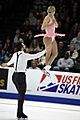
Ashley Cain rotates after being thrown by Timothy LeDuc.
-
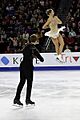
Aleksandra Boikova rotates after being thrown by Dmitrii Kozlovskii.
-
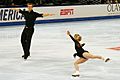
Anabelle Langlois lands after performing a throw jump with Cody Hay.


Throw jumps are where the man throws the woman into the air. She lands without his help on a backward outside edge. Many skaters see it as a jump, not just a throw. The man helps with her height, timing, and direction.
Types of throw jumps include the throw Axel and throw Salchow. The speed of entry and number of rotations increase difficulty. Height and distance also make them harder. Teams must do one throw jump in their short program.
The throw triple Axel is very difficult. The woman must do three-and-a-half rotations. Rena Inoue and John Baldwin Jr. were the first to do it in competition in 2006. The first quadruple throw loop was by Tiffany Vise and Derek Trent in 2007.
Graceful Spins

Solo Spin Combinations
Skaters must perform a solo spin combination once in the short program. It needs at least two revolutions in two basic positions. Both partners should include all three basic positions for full points. A spin with less than three revolutions is not counted.
Pair Spin Combinations
Both junior and senior teams do one pair spin combination in their free skate. It must have at least eight revolutions. Spins need at least two different basic positions. Each position must have two revolutions by both partners.
Teams get more points for difficult variations. They also earn more for difficult entrances or exits. If a skater falls, they can do another spin to fill the time.
Dramatic Death Spirals

The death spiral is a circular move in pair skating. The man lowers the woman while she arches backward. She glides on one foot with her head almost touching the ice. She holds his hand as he rotates her in a circle.
This move was created in the 1920s by Charlotte Oelschlägel and Curt Neumann. Suzanne Morrow and Wallace Diestelmeyer were the first to do it one-handed in 1948. There are four types of death spirals, with the forward outside being the most difficult.
Creative Step Sequences
A step sequence is a required element in all figure skating disciplines. It involves steps and turns in a pattern on the ice. Skaters earn points by performing with "flair and personality." They use both feet and turn in both directions.
In pair skating, step sequences should be done "together or close together." They must match the music's character. There is no required pattern, but teams must use the entire ice surface. The workload should be even between partners.
Rules and Regulations
Skaters must only perform the required elements. Extra or unprescribed elements will not count towards their score. Only the first attempt of an element is included. Rules cover falls, time limits, music, and clothing.
Falls and Interruptions
A fall is when a skater loses control and most of their body weight is on the ice. One point is deducted for each fall by one partner. Two points are deducted if both partners fall.
An interruption is when skaters stop performing their program. Points are deducted based on how long the interruption lasts. If it's due to something outside their control, like lighting, no points are deducted.
Time Limits
Judges penalize skaters one point for every five seconds they finish too early or too late. If they start their program late, they can also lose points. Elements performed after the allowed time limit receive no points.
Music Choices
All programs are skated to music chosen by the competitors. Since 2014, music with vocals is allowed. This change aimed to make the sport more appealing to audiences.
If there's a problem with the music, skaters must stop. If it happens early in the program, they can restart or continue. If it happens later, they must continue from where they stopped. No deductions are made for music problems.
Costumes and Appearance
Costumes must be "modest, dignified and appropriate." They should not be too flashy or theatrical. Props and accessories are not allowed. Clothing can reflect the music's character.
Men must wear full-length trousers. Women can wear skirts, trousers, tights, or unitards. Decorations on costumes must be securely attached. If parts fall off, one point can be deducted. Judges often give feedback on costumes before big competitions.
Staying Safe in Pair Skating
Pair skating is physically demanding. It requires incredible strength and coordination. Skaters perform complex moves at high speeds. This means they need to be very careful to prevent injuries.
Both partners can get injuries, like broken noses, especially from twist lifts. Male partners are trained to protect their partners during lifts. However, head injuries can still happen. The ISU has banned some dangerous moves to keep skaters safe.
Skaters often resist wearing protective gear during practice. They feel it interferes with their performance and the sport's artistic side. Studies show pair skaters have more upper body injuries, especially to the head. This is due to the throws and side-by-side jumps. Female pair skaters tend to have more injuries than male skaters. This highlights the unique demands of the sport.
