
Figure skating spins facts for kids
_(20).jpg)
Quick facts for kids Figure skating element |
|
|---|---|
| Element name | Spin |
| Scoring abbreviation | Sp |
Spins are a beautiful part of figure skating where a skater turns around and around on one spot on the ice. They hold different body shapes while spinning. Skaters in single skating, pair skating, and ice dance all perform spins. They are a must-do part of most figure skating competitions. Many people think jumps are exciting, but spins are like art on ice. They add beauty and grace to a performance. Famous skater Scott Hamilton said spins often help skaters catch their breath or move smoothly between other big moves.
Long ago, spins were special moves called "compulsory figures." They were always seen as a graceful and lovely part of skating, even in the 1800s.
Skaters do two main kinds of spins: forward spins and backward spins. There are three basic body positions for spins: the upright spin, the sit spin, and the camel spin. Skaters also do exciting "flying spins" and "spin combinations." The International Skating Union (ISU) sets the rules and points for all these different spins.
The History of Spins
Spins have been a beautiful part of figure skating for a very long time. In the 1800s, people already admired their grace. An early skating writer, Jean Garcin, even suggested using spins to finish a routine with an artistic touch.
Back then, spins were grouped by how skaters changed their feet, not by body positions like today. Skaters were encouraged to learn different spins on both feet. In early pair skating, skilled skaters often used spins to end their performances. Even now, spins often come at the end of programs to make them more thrilling for the audience.
Spin Evolution and Amazing Skaters
Spins became much more advanced between the two World Wars. Famous Norwegian skater Sonja Henie showed off incredible spins in her 1930s films. She could spin 40 times or more, fast and perfectly centered! By the late 1930s, skaters were using all three basic spin positions.
At first, skaters were expected to spin both ways. But as spins got harder and faster, they usually focused on spinning in one direction. Some skaters were truly amazing at spins. Ronnie Robertson (1950s), Denise Biellmann (1980s), and Lucinda Ruh (1990s) could spin incredibly fast. They sometimes did five turns every second in an upright position!
In 2015, Canadian skater Olivia Oliver set a Guinness World Record for the fastest spin, reaching 342 rotations per minute. Today, rules often ask skaters to change body positions during spins. This means they might not always reach the super-fast speeds of the past.
World champion Scott Hamilton said that Ronnie Robertson spun so fast it was unbelievable. He and Lucinda Ruh were so skilled, it seemed like their spins could go on forever! They could even change positions and then speed up again. Lucinda Ruh later shared that the intense speeds and long practice hours sometimes caused her to feel dizzy. This shows how much focus and physical control these amazing spins require.
Spins in Pair and Ice Dance
Pair skating started including spins between the World Wars. By the 1930s, pairs were doing side-by-side spins, death spirals, and lifts.
When ice dance became a competitive sport in the 1950s, there were rules to keep it different from pair skating. For example, dance spins had limits on how many times skaters could turn. This helped make sure ice dance had its own unique style.
How Skaters Spin
.jpg)
Spins are often called the "art" of figure skating. They are beautiful to watch, but there's a lot happening that's hard to see. Scott Hamilton explained that spins are complex. Things like changing edges are tricky to spot, even for experts.
Most new skaters learn to spin counter-clockwise, but some spin clockwise. Usually, spins are done on one foot. However, beginners often start with a two-foot spin. This spin has three main parts: getting ready, winding up, and the actual spin. There's also an exit, where the skater either slows down or changes feet.
The Science of Spinning
Spins are all about using forces to turn. When a skater enters a spin, they create something called angular momentum. This is the turning force that keeps them spinning. They spin around a central line that goes from their skate blade on the ice, up through their body.
It's actually better to enter a spin slowly. Trying to build up a lot of speed before a spin doesn't help much. A slow, controlled entry often leads to a better, more consistent spin.
Steps of a Spin
Every spin has four main parts: preparation, entry, the spin itself, and the exit.
- Preparation: Skaters get ready by leaning into a curve and building up the turning force. A strong push here helps create a faster spin.
- Entry: The skater glides into a curve that gets tighter and tighter. They do a special move called a 3 turn to start the spin.
- Spin: To spin well, a skater needs to keep their body perfectly balanced over their skate blade. If they are off-center, they will travel across the ice instead of spinning in one spot.
- Exit: This is how the skater stops spinning. There are many different ways to exit a spin gracefully.

Achieving a Great Spin
The goal for most spins is to turn as fast as possible. Skaters also want to hold a beautiful body position and stay perfectly balanced. Most importantly, they need to spin in one spot, which is called "centering." A good spin leaves tiny, overlapping circles on the ice. If a spin isn't centered, the skater will move across the ice.
To spin quickly, skaters pull their arms and free leg close to their body. This helps them rotate faster. The force from spinning pushes outward and upward. Skaters must keep their arms and free leg tucked in and down to use this force for speed. The exact way they do this depends on the type of spin.
Why Skaters Get Dizzy
Skaters can feel dizzy during spins. This happens because their eyes try to focus on things around them as they spin. With practice, skaters learn to control their eyes. This helps them overcome the dizziness.
Types of Spins
There are two main types of spins: the forward spin and the backward spin.
- Forward spin: This spin uses the back inside edge of the skate. It starts with a forward outside edge and a 3 turn.
- Backward spin: This spin uses the back outside edge. It starts with a forward inside edge and a 3 turn.
There are three basic body positions for spins: the upright spin, the sit spin, and the camel spin.
Upright Spin

The upright spin is one of the three basic spin positions. The ISU says it's any spin where the skating leg is straight or slightly bent, but not in a camel position. British skater Cecilia Colledge invented this spin.
Some variations of the upright spin include:
- Layback spin
- Biellmann spin (created by Denise Biellmann)
- Scratch spin (also called the blur spin)
Sit Spin
The sit spin was invented by American skater Jackson Haines. It's a very important spin in skating. To do it, a skater sits down low on one foot. The knee of the skating leg is bent, and the free leg is held out in front, to the side, or behind. It takes a lot of energy and practice to master this spin.
Camel Spin
Cecilia Colledge also invented the camel spin (sometimes called the parallel spin) in the mid-1930s. This spin looks like the arabesque pose in ballet. The skater is on one foot, with the free leg extended horizontally behind them. When done well, the skater's body should form a slight arch or a straight line.
At first, mostly women performed camel spins. But American skater Dick Button performed the first forward camel spin. After that, camel spins became a regular part of male skaters' routines too.
Flying Spins
A flying spin is an exciting move that combines a jump and a spin. It's fun for both the skater and the audience! There are a few types of flying spins:
- Flying camel: The skater jumps from a left forward outside edge, spins once in the air, and lands in a camel spin. Dick Button might have been the first to do this, and it was even called the "Button camel" for a long time.
- Flying sit spin: The skater takes off from a left forward outside edge, goes into a sit spin position in the air, and lands in a sit spin. Buddy Vaughn and Bill Grimditch first performed it, but Dick Button and Ronnie Robertson made it famous.
- Butterfly spin: This spin gets its name from the skater's body position in the air, which looks like a butterfly. The skater takes off from both feet, holds a horizontal body position, and lands in a back spin. Skaters often do this spin at the end of their program.
For flying spins, the jump part is at the beginning. The goal is to jump high but not travel too far forward. While flying spins are fast, they usually don't reach the same speed as basic spins. This is because some of the force is used to get height in the jump. Mastering flying spins is easier if a skater already has good basic spin and jumping skills.
Spin Combinations
Spin combinations are required in many skating programs. Skaters can combine flying spins and basic spins in many creative ways. The key is to keep the spin going fast and smooth during quick changes between positions. If a skater changes feet, the new spin should start very close to where the first spin ended. Spin combinations must include more than one basic position and can involve changing feet.

Rules for Spins
The International Skating Union (ISU) has specific rules for spins in competitions. These rules help make sure spins are performed correctly and fairly.
Single Skating Spin Rules
- Revolutions: A spin must have at least three revolutions to count as a spin. Flying spins and spins with only one position need six revolutions. Spin combinations need 10 revolutions.
- Positions: Skaters must make at least two revolutions in each basic position for it to count.
- Difficulty: Skaters can make spins harder by moving their body, head, leg, arm, or hand in ways that show great flexibility or strength. These "difficult variations" earn more points.
- Spin Combinations: A spin combination must include at least two different basic positions, with two revolutions in each. To get full points, skaters should include all three basic positions.
-
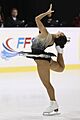
Haircutter spin
Wakaba Higuchi -
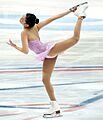
Catch-foot camel spin
Haruka Imai -

Donut spin
Maria Sotskova -
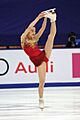
Upright spin
Marin Honda


.jpg)
_(16).jpg)
Pair Skating Spin Rules
Solo Spin Combinations
In pair skating, teams must perform a solo spin combination. Both partners need to include at least two revolutions in two basic positions. To get full points, both skaters should perform all three basic positions (camel, sit, and upright). Each skater must complete at least five revolutions on each foot. If a skater falls, they can do another spin, but it won't count as the required element.
-
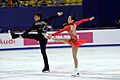
Side by side spins
Sui Wenjing and Han Cong -
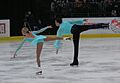
Side by side camel spins
Tatiana Totmianina and Maxim Marinin -
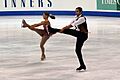
Side by side spins
Tiffany Vise and Derek Trent
_(35).jpg)


Pair Spin Combinations
Pair teams also perform a pair spin combination in their free skating programs. This spin must have at least eight revolutions. Both partners must perform at least two different basic positions, with two revolutions in each. For full points, both partners must perform all three basic positions.
Teams can earn more points for:
- Performing spins in both clockwise and counterclockwise directions.
- Including difficult variations.
- Having difficult entrances or exits.
- The man lifting the woman while he is spinning on one foot.
-
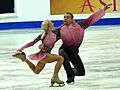
Aliona Savchenko and Robin Szolkowy -
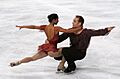
Pair sit spin
Amanda Evora and Mark Ladwig -
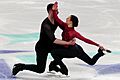
Annika Hocke and Robert Kunkel


Ice Dance Spin Rules
In ice dance, a dance spin is when both partners spin together while holding onto each other. They spin around a shared center on one foot each. Solo spins, where each partner spins alone but at the same time, are also allowed. The ISU announces specific dance spin variations each season.
Dance spins have three main positions:
- Upright position: Skating leg slightly bent or straight, upper body upright or arched.
- Sit position: Skating leg bent in a crouch, free leg forward, back, or side.
- Camel position: Skating leg straight or slightly bent forward, free leg extended horizontally or higher.
-
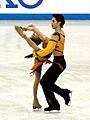
Jana Khokhlova & Sergei Novitski, 2003
-
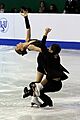
Oleksandra Nazarova & Maksym Nikitin, 2014
-
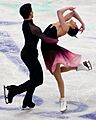
Charlene Guignard & Marco Fabbri, 2024
-
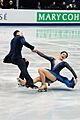
Natalia Kaliszek & Maksym Spodyriev, 2018
-
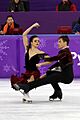
Sara Hurtado & Kirill Khaliavin, 2018
-
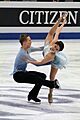
Yuka Orihara & Juho Pirinen, 2020


.jpg)

.jpg)
