
Paroedura masobe facts for kids
Quick facts for kids Paroedura masobe |
|
|---|---|
| Conservation status | |
Scientific classification  |
|
| Kingdom: | Animalia |
| Phylum: | Chordata |
| Class: | Reptilia |
| Order: | Squamata |
| Family: | Gekkonidae |
| Genus: | Paroedura |
| Species: |
P. masobe
|
| Binomial name | |
| Paroedura masobe Nussbaum & Raxworthy, 1994
|
|
| Script error: The function "autoWithCaption" does not exist. | |

Script error: No such module "Check for conflicting parameters".

The Masobe Gecko (scientific name: Paroedura masobe) is a special kind of gecko. It is an endangered animal, which means it is at risk of disappearing forever. These geckos are easy to spot because they have dark skin with white speckles and big, round eyes.
Masobe geckos usually live for about eight years. They can grow to be up to 17 centimeters (about 6.7 inches) long. This rare gecko has been sought after by people who keep reptiles as pets. Because of this, it was added to a special list called CITES Appendix II in 2017. This list helps control the trade of endangered animals.
Contents
About the Masobe Gecko
The Masobe Gecko was first described by scientists Nussbaum and Raxworthy in 1994. It is related to other geckos found in southern and southwestern Madagascar, like the Grandidier's Madagascar ground gecko and the Ocelot gecko.
Where Masobe Geckos Live
Habitat
Masobe geckos live in humid forests that are not very high up. They are arboreal, which means they spend most of their time in trees. You can usually find them climbing on branches, about 1 to 4 meters (3 to 13 feet) above the ground.
Distribution
These geckos are only found in Madagascar, an island country off the coast of Africa. They live in specific areas like Zahamena National Park and Betampona Special Reserve. Their total living area is quite small, about 410 square kilometers (158 square miles).
However, the actual area where they can live is even smaller, less than 100 square kilometers (38 square miles). This is because their forest home is broken up into many small pieces. They live at elevations between 300 and 600 meters (980 to 2,000 feet) above sea level. It is very hard to find these geckos because their habitat is shrinking and spread out. This is causing their population to decrease.
What Masobe Geckos Eat

Scientists haven't studied what wild Masobe Geckos eat very much. But in captivity, people feed them different insects like crickets and roaches. They also eat land snails and isopods (which are like small bugs, also called wood lice).
It's very important for female geckos, especially when they are ready to lay eggs, to eat snails and isopods. These foods give them extra calcium, which helps them stay healthy. Young geckos should eat about four to five insects every day. Adult geckos can be fed four to six times a week. Females that are going to breed should eat isopods or land snails at least twice a month. When hunting, geckos often ignore food that is too big or too small for them.
Reproduction and Life Cycle
Female Masobe Geckos lay pairs of eggs. These eggs have hard shells and are almost round, measuring about 18 by 17 millimeters. After about six months, the baby geckos hatch from the eggs.
Protecting Masobe Geckos
Threats
The Masobe Gecko faces many dangers. Their forest homes are being cut down to make space for farms or to get wood. People also collect honey and other things from the forest, which damages the gecko's habitat. This makes it harder for the geckos to survive.
Between 2010 and 2015, many Masobe Geckos were taken from Madagascar to be sold as pets around the world. In 2015, a rule was put in place to stop this trade. Now, it is not allowed to export any live Masobe Geckos from Madagascar.
Efforts
There are not many active efforts right now to protect the Masobe Gecko. Even though all the known areas where they live are protected, their habitats are still broken up. Scientists are not currently monitoring how many geckos there are. There are also no big plans to manage their habitats in the region.
More research is needed to understand how the Masobe Gecko population is changing. Also, there are no programs to teach people about these geckos and why they need protection. More work is needed to help save this unique species.
Images for kids
-
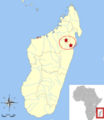
This map shows where the Masobe Gecko lives in Madagascar.

