
Peridot facts for kids
Quick facts for kids Peridot |
|
|---|---|
 |
|
| General | |
| Category | Silicate minerals |
| Formula (repeating unit) |
(Mg,Fe) 2SiO 4 |
| Identification | |
| Color | Yellow, to yellow-green, olive-green, to brownish, sometimes a lime green, to emerald hue |
| Crystal system | Orthorhombic |
| Twinning | Uncommon, simple twinning can occur on {100}, {011},{012}, cyclic twinning on {031} |
| Cleavage | Poor on {010} and {110}, {010} cleavage improves with increasing iron content |
| Fracture | Conchoidal |
| Mohs scale hardness | 6.5–7 |
| Luster | Vitreous to oily |
| Streak | Colorless |
| Diaphaneity | Translucent to transparent |
| Specific gravity | 3.2–4.3 |
| Refractive index | 1.64–1.70 |
| Birefringence | +0.036 |
| Pleochroism | Weak pale yellow-green to yellow, yellow to yellow orange |
| Melting point | between 1,200 and 1,900°C |
| Fusibility | Infusible avoid thermal shock |
| Solubility | Slowly forms gelatinous silica in H Cl |
Peridot (pronounced PERR-ih-dot), sometimes called chrysolite, is a beautiful yellow-green gemstone. It is a type of mineral called olivine. What makes peridot special is that it's one of the few gemstones that only comes in one main color.
Peridot forms deep inside Earth, in the hot, molten rock of the upper mantle. It's one of only two gemstones, along with diamonds, that forms this way. Sometimes, lava carries peridot to the surface. You can also find peridot in special meteorites! Finding gem-quality peridot on Earth's surface is rare. This is because it can change easily when it moves from deep inside the Earth or when exposed to weather. Its chemical formula is (Mg,Fe)
2SiO
4.
Peridot is one of the birthstones for the month of August.
Contents
What's in a Name? The Story of Peridot
The name 'peridot' has an interesting history. Experts are not entirely sure where it came from. Some think it might come from an old Anglo-Norman word, 'pedoretés'. Others believe it comes from the Arabic word 'faridat', which means 'gemstone'.
In old English, the word 'peridot' was spelled in many ways. You might see it as 'peridod', 'peritot', or 'pelidod'.
One of the first times the word 'peridot' appeared in English was in a record from St. Albans Abbey in 1705. This record mentioned that in 1245, a Bishop John left peridot gems to the Abbey when he passed away.
The Green Glow: Peridot's Appearance
Peridot is famous for its beautiful green color. It's one of the few gemstones that only comes in shades of green! The exact shade of green depends on how much iron is inside the crystal. This means peridot can be yellow-green, olive-green, or even brownish-green. Sometimes, you might find a rare peridot that is a pure, deep green without any yellow or brown hints. Lighter green peridots have less iron.
How Peridot Crystals Form

Peridot crystals have a special shape called an orthorhombic crystal system. This means their tiny building blocks, called atoms, are arranged in a specific way. These atoms include oxygen, silicon, magnesium, and iron. The amount of iron affects the gem's color.
Where Peridot is Found
Peridot is a type of olivine, a common mineral found in certain rocks. It often comes to the Earth's surface through lava from deep inside the Earth's mantle. However, only a small amount of this peridot is good enough to be a gemstone. Interestingly, peridot can also be found in meteorites that fall to Earth!
Scientists can tell the difference between peridot from Earth and peridot from space. Earth-grown peridot often has more lithium, nickel, and zinc.
Even though olivine is common, finding large, beautiful peridot crystals suitable for jewelry is rare. This is because olivine can break down easily when exposed to the weather on Earth's surface. So, peridot is considered a precious stone.
People have valued peridot for a very long time. Ancient miners started finding it on St. John's Island in the Red Sea around 300 BCE (Before Common Era).
Today, most of the world's peridot comes from the San Carlos Apache Indian Reservation in Arizona, USA. Other places where peridot is mined include Australia, Brazil, China, Egypt, Kenya, Mexico, Myanmar (Burma), Norway, Pakistan, Saudi Arabia, South Africa, Sri Lanka, and Tanzania.
Peridot from Space!

Did you know peridot can come from space? Scientists have found peridot crystals inside special pallasite meteorites. These space peridots are a bit different from Earth peridots because they don't have nickel. Some famous meteorites with peridot include the Jeppara, Brenham, Esquel, Fukang, and Imilac meteorites.
What Makes Peridot a Gemstone?

Peridot is a gemstone because of its unique properties. For example, when light passes through it, you might see a cool "doubling" effect. The amount of iron in the gem affects its color, weight, and how light bends when it goes through the crystal.
The largest cut peridot gemstone ever found weighs 310 carats. That's about 62 grams! You can see this amazing gem in the Smithsonian Museum in Washington, D.C.
Inside Peridot Gems
Sometimes, peridot crystals have tiny features inside them called inclusions. These inclusions can be small gas bubbles, or even other tiny minerals. For example, some peridots from Hawaii have rounded gas bubbles. Peridots from San Carlos often show "lily pad" patterns, which are small circular discs. Pakistani peridots might have silky or rod-like inclusions. These inclusions can tell scientists where the peridot came from and how it formed. The most common mineral found inside peridot is chromite.
Peridot in History and Culture
People have admired peridot for thousands of years. Ancient civilizations believed it had special powers. Some thought it could protect them from fears and bad dreams. Others believed it brought "inner radiance," helping people think clearly and discover their true purpose.
Peridot is the birthstone for the month of August.
For a long time, peridot was often confused with other green gems, like emeralds. A famous gem expert, G.F. Kunz, wrote about how peridot was mistaken for other gems in old church treasures, such as the "Three Magi treasure" in Germany.
Gallery
-
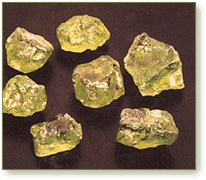
Peridot from the San Carlos Apache Reservation in Arizona.
-
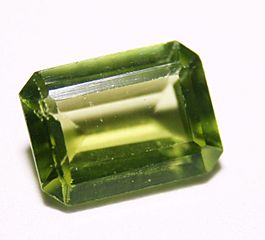
Olive green peridot
-
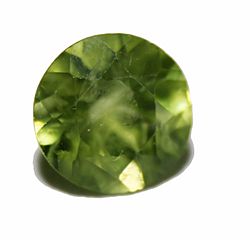
Peridot with milky inclusions


See also
 In Spanish: Peridoto para niños
