
Pooles Island Light facts for kids
 |
|
| 2011 | |

 Pooles Island Light
Location in Maryland

Pooles Island Light
Location in the United States
|
|
| Location | Pooles Island off Aberdeen Proving Ground |
|---|---|
| Coordinates | 39°17′25.6″N 76°15′58.8″W / 39.290444°N 76.266333°W |
| Year first constructed | 1825 |
| Year first lit | 1825 |
| Automated | 1918 |
| Deactivated | 1939 - 2011 |
| Construction | Stone |
| Tower shape | conical tower |
| Focal height | 44 feet (13 m) |
| Original lens | fourth-order Fresnel lens |
| Characteristic | FI(4+3) W 16s |
| Fog signal | none |
| Admiralty number | J2298.7 |
| ARLHS number | USA-646 |
| USCG number | 2-8693 |
The Pooles Island Light is a very old lighthouse in Maryland. It is the oldest lighthouse still standing in Maryland. It is also the fourth oldest lighthouse in the entire Chesapeake Bay area. Lighthouses are tall towers with bright lights that help ships find their way safely.
History of the Lighthouse
The island where the lighthouse stands was first called Powell's Island. This name was given by the famous explorer John Smith (explorer). Over time, the name changed to Pooles Island. This might be because there were many springs and pools of water on the island.
In the 1700s and 1800s, the island was known for its rich soil. Farmers grew many crops there, especially peaches in the 1880s and 1890s. Because the island is in the middle of the bay, near the mouth of the Gunpowder River, it was a good spot for a lighthouse.
In 1824, the United States Congress decided to spend $5,000 to build a lighthouse there. John Donahoo and Simon Frieze won the job to build it. This was the first of many lighthouses that Donahoo would build.
The lighthouse tower was made of strong granite stone. A house for the lighthouse keeper was also built. Three years later, in 1827, a fog bell tower was added. This was the first fog bell tower in Maryland. In 1857, the old lamps in the lighthouse were replaced. A new, more powerful Fresnel lens was put in. This lens made the light much brighter and easier to see.
In 1917, the United States government bought Pooles Island. This was done to create Aberdeen Proving Ground, a place for the United States Army to test weapons. The lighthouse was then given to the Army. The light was made automatic in 1918. This meant a keeper no longer needed to live there.
In 1939, the lighthouse was stopped from being used. This is called "decommissioned." The buildings around it were taken down.
In 1994, the Army wanted to bring the lighthouse back to life. They suggested adding it to the National Register of Historic Places. This is a list of important historical sites in the United States. They also planned to fix it up and use it again as a private light for boats. The lighthouse was added to the Register on February 19, 1997. It was called the Pooles Island Lighthouse.
It is important to know that Pooles Island is not open to the public. The island was used for bombing and shelling practice from 1918 to the early 1960s. Because of this, there are still many unexploded bombs and shells all over the island. It is very dangerous to visit.
The Lighthouse Relights
After 72 years of not being used, the Pooles Island Lighthouse is now working again! Army officials at Aberdeen Proving Ground turned the light back on. This happened with a big celebration on May 21, 2011. It was part of the Armed Forces Day celebrations.
The Harford County Chamber of Commerce helped organize a special dinner cruise. Officials and people from the community went on the cruise to see the historic relighting. More than 300 people watched the light turn on from a boat called the Spirit of Baltimore. This cruise was supported by several local groups and the Army.
Images for kids
-
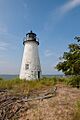
Aberdeen Proving Ground officials reactivated the Pooles Island Light using solar power in May 2011

- Pooles Island Lighthouse, Harford County, including photo dated 1990, at Maryland Historical Trust
