
Porthidium yucatanicum facts for kids
Quick facts for kids Porthidium yucatanicum |
|
|---|---|
 |
|
| Conservation status | |
Scientific classification  |
|
| Kingdom: | Animalia |
| Phylum: | Chordata |
| Class: | Reptilia |
| Order: | Squamata |
| Suborder: | Serpentes |
| Family: | Viperidae |
| Genus: | Porthidium |
| Species: |
P. yucatanicum
|
| Binomial name | |
| Porthidium yucatanicum (H.M. Smith, 1941)
|
|
 |
|
| Script error: The function "autoWithCaption" does not exist. | |
| Synonyms | |
|
|
Script error: No such module "Check for conflicting parameters".
The Yucatán hognosed pitviper, also known as Porthidium yucatanicum, is a type of venomous snake. It belongs to a group called pitvipers. These snakes have special heat-sensing pits on their heads. These pits help them find warm-blooded prey, even in the dark! You can find this snake living in Mexico. There are no different types or subspecies of this snake known right now.
What Does It Look Like?
Yucatán hognosed pitvipers are usually about 35 to 45 centimeters long. That's about the length of a standard ruler! Some of these snakes can grow even longer, up to 55 centimeters. Female snakes are often bigger than the males. These snakes have a sturdy body and live on the ground.
Where Does It Live?
This snake lives in the northern part of the Yucatán Peninsula. This area is located in Mexico. It's a warm, tropical place. The first time scientists officially found and described this snake was in Chichen Itza, Yucatán.
Is This Snake Safe?
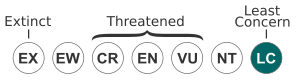
The Yucatán hognosed pitviper is listed as "Least Concern" (LC) by the IUCN. This means scientists believe it is not currently in danger of disappearing. It has a wide distribution across its habitat. There are also thought to be many of these snakes. Scientists don't think its numbers are dropping quickly. The exact number of these snakes is unknown. This assessment was made in 2007.
