
Red-naped trogon facts for kids
Quick facts for kids Red-naped trogon |
|
|---|---|
 |
|
| Female and male | |
| Conservation status | |
Scientific classification  |
|
| Kingdom: | Animalia |
| Phylum: | Chordata |
| Class: | Aves |
| Order: | Trogoniformes |
| Family: | Trogonidae |
| Genus: | Harpactes |
| Species: |
H. kasumba
|
| Binomial name | |
| Harpactes kasumba (Raffles, 1822)
|
|
| Script error: The function "autoWithCaption" does not exist. | |

Script error: No such module "Check for conflicting parameters".
The red-naped trogon (Harpactes kasumba) is a colorful bird that belongs to the Trogonidae family. You can find it in countries like Brunei, Indonesia, Malaysia, and Thailand. These birds love to live in warm, wet forests that are close to sea level. Sadly, their homes are shrinking because of habitat loss, which means they are a threatened species.
Contents
About the Red-naped Trogon
The red-naped trogon was first found in 1822 by Sir Stamford Raffles. He was a British naturalist who is also famous for starting the city of Singapore.
How Does the Red-naped Trogon Look?
Male and female red-naped trogons look quite different! This is called being sexually dimorphic. The males are much brighter than the females.
A male red-naped trogon has a black head and chest. Its beak and the skin around its eyes are bright blue. Its upper body and tail are yellowish-brown with black edges. It has a white line across its chest and bright red underparts. The feathers under its tail are black and white. The most special thing about the male is a bright red band of feathers around the back of its neck. This red band is how the bird got its name!
Female red-naped trogons are not as colorful. They have a grey-brown head and upper chest. Their underparts are yellow.
Both male and female trogons can grow up to 32 centimeters (about 12.5 inches) tall. They usually live for about 7.3 years.
How Do They Move?
Red-naped trogons have short, weak legs and feet. This means they cannot walk much. They can only shuffle a little bit along a branch. Their leg muscles are very small compared to their body weight.
Their toes are also very special. They have two toes pointing forward and two toes pointing backward. This is called heterodactylous. Because of this, a red-naped trogon needs to use its wings to help it turn around on a branch.
Even though their wings are short, they are very strong. However, red-naped trogons do not fly long distances. They usually fly only a few hundred meters at a time.

Red-naped Trogon Behavior
Red-naped trogons are usually not very active unless they are looking for food. Because they are so still, some people say they are not very exciting to watch. This quiet behavior helps them hide from animals that might want to eat them.
Like other trogons, they often turn their dull-colored backs towards anyone watching them. But their heads can turn all the way around, like an owl! This lets them keep an eye on any possible predators, such as hawks or other animals.
What Do They Eat?
The red-naped trogon mainly eats insects. They especially like stick insects and spiders. They also eat small lizards, fruits, and seeds.
The word "Trogon" comes from a Greek word meaning "to gnaw or eat." This describes how their beaks work. Their beaks have jagged edges that help them grab live prey and fruit. These edges, along with a curved tip, also help them cut food into smaller pieces.
They usually catch their food while flying. They often use a method called "sally-glean flight." This is when the trogon flies from a branch where it is watching to another branch or leaves where its food is. It hovers over the food, snatches it, and then flies back to its original branch to eat.
What Does Their Call Sound Like?
The red-naped trogon's song sounds slow and a bit sad. It is a series of five to eight notes that sound like "pau pau pau pau pau." Each note is short and goes down slightly in pitch. They sing about one note per second.
Besides their songs for finding mates or marking their territory, red-naped trogons also make sounds when they are angry or when they sense danger.
Reproduction and Life Cycle
Red-naped trogons are territorial birds, meaning they protect their nesting area. They are also monogamous, which means one male and one female stay together to raise their young. Males sing to attract females.
Sometimes, groups of 3 to 12 trogons are seen together before or during the breeding season. They call and chase each other, but scientists are not sure why they do this.
We do not know much about how red-naped trogons build their nests. They are thought to be "cavity nesters," which means they nest in holes. The only time a red-naped trogon nest was recorded was in July 1976 in Peninsular Malaysia. The nest was in a hole in a rotten tree stump, a few meters off the ground.
They usually lay one to three eggs. The eggs hatch after about 16 to 19 days. When the chicks hatch, they are blind and have no feathers. However, they grow their feathers very quickly. The young birds usually leave the nest after 16 to 23 days.
Where Do Red-naped Trogons Live?
Red-naped trogons do not migrate, which means they stay in the same place all year round. They are called "resident" or "sedentary" birds. About 40% of the world's birds migrate, but the red-naped trogon is not one of them.
These birds live only in the lowlands of the Sundaic region, also known as Sundaland. This area covers about 989,000 square kilometers. Sundaland is a part of Southeast Asia that includes the Malay Peninsula and large islands like Borneo, Java, and Sumatra, along with their smaller surrounding islands. The eastern edge of Sundaland is called the Wallace Line.

We do not know the exact number of red-naped trogons in the world. However, they are rare in Thailand and not very common in places like Singapore, Indonesia, Sarawak, Sabah, and Brunei. They are fairly common in Peninsular Malaysia and Sumatra.
The number of red-naped trogons is decreasing at a fast rate. This is mainly because they are losing their homes due to habitat loss.
Their Home Environment
Red-naped trogons mostly live in old, untouched lowland evergreen forests. They are most common below 600 meters (about 2,000 feet) in height. Sometimes, they are found higher up, even up to 1,200 meters (about 4,000 feet), in certain types of mountain forests in Borneo. They have also been seen in swamp forests, areas where trees have been cut, thick bamboo groves, and even in coconut and cocoa farms.
Threats to Red-naped Trogons
The Sundaic lowlands, where these birds live, are losing their forests very quickly. This is happening because of illegal logging and land being cleared for other uses. Forest fires have also caused a lot of damage.
Because of these dangers, the red-naped trogon is listed as a "Near Threatened" species by Birdlife International. This means they are close to becoming endangered.
Helping Red-naped Trogons
Right now, there are no special plans just for saving the red-naped trogon. However, experts have suggested some actions. They want to study the birds more to understand what kind of habitat they need. This would help them learn how well the birds can live in areas where the forest has been changed.
Other ideas for helping include improving how protected areas are managed where the birds live. This would help make sure there is enough good habitat for them. Also, they want to stop illegal activities that harm the forests where these birds live.
Images for kids
-
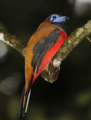
Borneo Rainforest Lodge - Danum Valley, Sabah, Borneo - Malaysia

