
Sahih al-Bukhari facts for kids

Manuscript of Sahih al-Bukhari from the 14/15th-century
|
|
| Author | Al-Bukhari |
|---|---|
| Language | Arabic |
| Series | Kutub al-Sittah |
| Genre | Hadith collection |
| ISBN | 978-1-56744-519-0 |
| OCLC | 47899632 |
Sahih al-Bukhari (Arabic: صحيح البخاري, romanized: Ṣaḥīḥ al-Bukhārī) is a very important collection of sayings and actions of Prophet Muhammad for Sunni Muslims. It is one of the Six Books of Hadith. A famous Islamic scholar named Al-Bukhari (who passed away in 870 CE) put this book together. Many Sunni Muslims consider it one of the most reliable books after the Qur'an. They often place it alongside another important collection called Sahih Muslim.
Al-Bukhari worked on this book in places like Mecca and Medina. He finished it in Bukhara around the year 846 CE. Before it was finalized, important teachers like Ahmad ibn Hanbal checked his work.
Contents
What is Sahih al-Bukhari?
This book contains many stories and sayings, known as Hadiths. These Hadiths tell us what Prophet Muhammad said, did, or approved. Scholars believe there are about 7,563 unique stories in the book. If you don't count repeated versions, there are around 2,600 Hadiths.
Al-Bukhari spent 16 years gathering these stories. He chose the best ones from a huge collection of 600,000 narrations. The book has 97 chapters. These chapters cover many topics, like how to pray and live a good Muslim life. Each chapter also connects to verses from the Qur'an. It helps Muslims understand how to do things like prayers and other acts of worship. This guidance comes directly from Prophet Muhammad's teachings.
How the Book Was Created
Gathering the Stories
Al-Bukhari traveled widely from the age of 16. He visited many cities to collect Hadiths. He noticed that earlier Hadith collections had a mix of strong and weak stories. This made him want to create a book with only the most authentic Hadiths.
His teacher, Ishaq Ibn Rahwayh, encouraged him. Al-Bukhari recalled his teacher saying, "If only you would compile a book of only authentic narrations of the Prophet." This idea stayed with him. He also had a dream where he felt he was protecting the Prophet. Dream interpreters told him this meant he would protect the Prophet's words from lies. These reasons pushed him to create Sahih al-Bukhari.
Al-Bukhari had strict rules for including a Hadith in his book. The people who shared the story (narrators) had to be honest. They needed to have excellent memories. Other scholars had to agree on their ability to remember and share stories correctly. Also, the chain of people telling the story had to be complete. Every person in the chain had to have met the person they heard the story from.
He started organizing his book in Mecca and then moved to Medina. Al-Bukhari finished writing the book in Bukhara around 846 CE. He then showed it to his teachers for review. They checked it and confirmed its authenticity. Al-Bukhari spent the rest of his life sharing and teaching these Hadiths.
Sharing the Knowledge

Different copies of Sahih al-Bukhari are named after the people who passed them down. The most common version we have today comes from Muhammad ibn Yusuf al-Firabri. He was a trusted student of Al-Bukhari and passed away in 932 CE.
Al-Firabri once said that about 70,000 people listened to him read the book. Many other scholars also shared the book. This helped make sure the knowledge was spread widely and accurately.
Old Handwritten Copies
There are many old handwritten copies of this book. Over 2,300 copies were listed in one catalog. More than 1,500 copies are found in Turkey alone.
The oldest known copy was written around 980 CE. It was first published as a printed book by Alphonse Mingana in 1936 CE. The oldest complete copy that still exists is in the Süleymaniye Library. It was finished in Spain (Al-Andalus) in 1155 CE. Other notable old copies include one written by Abū ʿAlī al-Ṣadafī in 1114 CE. Another copy was a gift to the Sultan of Bengal Alauddin Husain Shah.
-
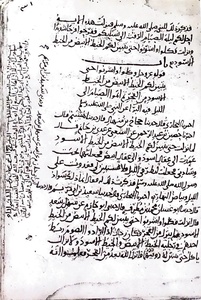
The oldest known extant manuscript of Bukhari, published by Mingana in 1936
-
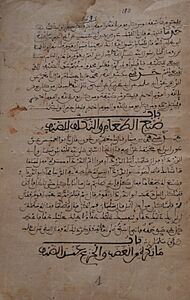
A manuscript of Bukhari, copied in Ramadan 490 AH/1097 CE in Maghrebi script, housed in a library of Mohammed V University
-
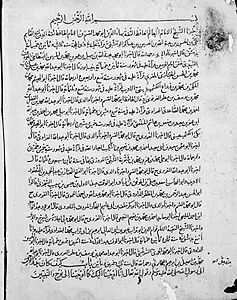
A manuscript of Bukhari containing an Ijazah (transmission license) tracing back to Al-Bukhari, housed in the Princeton University Library, c. 1400


Books That Explain It

Many scholars have written books to explain Sahih al-Bukhari. There are about 400 such 'commentaries' that help people understand the Hadiths better. A famous historian, Ibn Khaldun, said that explaining this book was a duty for the Muslim community.
Famous Explanations
Here are six of the most popular explanation books:
- A'lam al-Sunan by al-Khattabi (who passed away in 998 CE). This is the earliest commentary.
- Sharh Ibn Battal by Ibn Battal (who passed away in 1057 CE).
- Al-Kawakib al-Darari by Shams al-Din al-Kirmani (who passed away in 1384 CE).
- Fath al-Bari by Ibn Hajar al-Asqalani (who passed away in 1449 CE).
- Umdat al-Qari by Badr al-Din al-Ayni (who passed away in 1451 CE).
- Irshad al-Sari by Al-Qastallani (who passed away in 1517 CE).
Why the Chapters Have Their Names
Scholars have studied why Al-Bukhari chose specific names for the chapters in his book. These chapter titles are known as tarjumat al-bab. Ibn Hajar al-Asqalani was one of these scholars.
Some scholars found many reasons for his choices. One scholar, Zakariyya Kandhlawi, identified as many as 70 reasons! He even wrote a whole book about this topic.
Sahih al-Bukhari in Other Languages

The book was first translated into English by Muhammad Taqi-ud-Din al-Hilali and Muhammad Muhsin Khan in 1971. This version is called The Translation of the Meanings of Sahih al-Bukhari: Arabic-English. It is published by several companies and is available in many places. Other parts have been translated by Muhammad Ali and Thomas Cleary.
You can find Sahih al-Bukhari in many other languages too. These include Urdu, Bengali, Bosnian, Tamil, Malayalam, Albanian, Malay, and Hindi.
In 2019, a new complete English translation called Encyclopedia of Sahih Al-Bukhari was published. It was created by the Arabic Virtual Translation Center in New York. This version includes helpful notes, a glossary, and information about the people who shared the stories. The final edition came out on February 1, 2025.
