
Salchow jump facts for kids
Quick facts for kids Figure skating element |
|
|---|---|
| Element name | Salchow jump |
| Scoring abbreviation | S |
| Element type | Jump |
| Take-off edge | Back inside |
| Landing edge | Back outside |
| Inventor | Ulrich Salchow |
The Salchow jump is a famous and important move in figure skating. It's an "edge jump," meaning skaters use the edge of their skate blade to take off. This exciting jump was named after its creator, Ulrich Salchow, a Swedish champion who invented it in 1909.
To do a Salchow, a skater takes off from the back inside edge of one foot. They then spin in the air and land on the back outside edge of their other foot. It sounds tricky, and it is! Skaters often learn to do a single Salchow first. Then, they move on to more difficult versions like the double (two spins) and triple (three spins) Salchow.
Timing is super important for this jump. Both the takeoff and the landing must happen on the backward edge of the skate. If a skater's blade starts to turn forward too early before takeoff, or if it doesn't land completely backward, the jump isn't performed correctly.
In competitions, judges give points for each jump. A single Salchow has a base value of 0.40 points. A double Salchow is worth 1.30 points, a triple is 4.30 points, a quadruple (four spins) is 9.70 points, and a very rare quintuple (five spins) is 14 points.
Contents
The History of the Salchow Jump

The Salchow jump got its name from its inventor, Ulrich Salchow, a world champion from Sweden. He created this jump in 1909.
Figure skating rules have changed a lot over time. For example, at the 1920 Olympics, American skater Theresa Weld performed a single Salchow jump. Back then, there were very strict rules about how skaters should dress and move. Theresa Weld faced some comments because her skirt moved quite a bit during her jump, which was not considered appropriate at that time.
Who Performed the First Salchows?
Many amazing skaters have made history with the Salchow jump. Here are some of the "firsts" in different categories:
| Abbr. | Jump element | Skater | Nation | Event |
|---|---|---|---|---|
| 2S | Double Salchow (women's) | Cecilia Colledge |  Great Britain Great Britain |
1936 European Championships |
| 3S | Triple Salchow (men's) | Ronald Robertson |  United States United States |
1955 World Championships |
| Triple Salchow (women's) | Petra Burka |  Canada Canada |
1962 Canadian Championships
1965 World Championships |
|
| Helli Sengstschmid |  Austria Austria |
1961 European Championships | ||
| Jana Mrázková |  Czech Republic Czech Republic |
|||
| 4S | Quadruple Salchow (men's) | Timothy Goebel | United States |
1997–98 Junior Grand Prix Final |
| Quadruple Salchow (women's) | Miki Ando |  Japan Japan |
2002–03 Junior Grand Prix Final |

How Skaters Perform the Salchow
The International Skating Union (ISU) describes the Salchow as an "edge jump." This means skaters use a specific edge of their skate blade to launch into the air.
To start, a skater approaches the jump moving backward. They take off from the back inside edge of one foot. As they spring into the air, their free leg (the one not used for takeoff) swings forward. At the same time, they pull their arms close to their body. This helps them spin faster.
For a single Salchow, skaters don't always need to pull their arms and free leg in super tight. Just bringing the free side of their body forward helps create enough spin. However, for jumps with more rotations, like double or triple Salchows, pulling everything in tightly is key to spinning quickly.
The spin in the air is a little less than a full 360 degrees. This is because the curve of the takeoff edge helps with the rotation. When skaters pull their arms and free leg close, they can spin much faster. That's why the Salchow is often the first jump skaters learn to double or triple.
As U.S. Figure Skating explains, getting the timing right is very important. Both the takeoff and the landing must be on the backward edge of the skate. This precision makes the Salchow a challenging and beautiful jump to master!
Images for kids
-
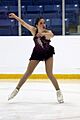
Sarah Isabella Bardua begins the take-off of a Salchow
-
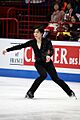
Keiji Tanaka begins the take-off of a Salchow
-
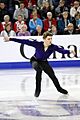
Roman Sadovsky begins the take-off of a Salchow
-
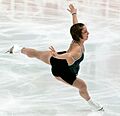
Amélie Lacoste landing

_(3).jpg)


