
Sesame oil facts for kids

Sesame oil is a special oil that comes from sesame seeds. People use it for cooking and to add flavor to food. It is one of the oldest oils known to humans, used for thousands of years!
Making sesame oil can be a bit tricky. Many sesame plants are still harvested by hand. This makes it harder to produce huge amounts of the oil quickly.
There are two main kinds of sesame oil. One is made from raw, untoasted seeds. This light-colored oil is great for general cooking. The other kind comes from toasted seeds. It has a strong, nutty smell and taste. This darker oil is often used to add flavor at the end of cooking. It's usually not good for frying, as it can taste burnt.
In 2023, about 1.2 million tonnes of sesame oil were made worldwide. India and Myanmar produced a large part of this total.
Contents
Discovering Sesame Oil
How Sesame Oil is Made

Sesame seeds grow inside special capsules on the plant. These capsules only open when the seeds are fully ripe. Because not all seeds ripen at the same time, farmers often cut the plants by hand. They then stand the plants upright to let all the capsules open. This careful harvesting is one reason why sesame oil can be a bit more special.
After harvesting, the seeds are pressed to get the oil. Some sesame oil is made from raw seeds. This gives a lighter oil. Other times, the seeds are toasted first. Toasted seeds create a darker oil with a much stronger, nutty flavor.
Some companies clean and process the oil even more. This can make it look clearer. However, many people prefer oil that hasn't been processed too much. They believe it keeps more of its natural goodness and taste.
Sesame oil stays fresh for a long time compared to some other natural oils. But it's still best to keep it in a cool, dark place, like a refrigerator. Using dark bottles also helps protect it from light. This keeps the oil tasting good and full of nutrients.
Sesame oil is mostly made of different kinds of fats. It has fats called oleic acid and linoleic acid. These are important for your body. The color of the oil can change. It depends on the seeds used and how they were processed. It can be light yellow or a deep reddish-yellow.
What's Inside Sesame Oil?
| Nutritional value per 100 g (3.5 oz) | |
|---|---|
| Energy | 3,699 kJ (884 kcal) |
|
0.00 g
|
|
|
100.00 g
|
|
| Saturated | 14.200 g |
| Monounsaturated | 39.700 g |
| Polyunsaturated | 41.700 g |
|
Protein
|
0.00 g
|
| Vitamins | Quantity
%DV†
|
| Vitamin C |
0%
0.0 mg |
| Vitamin E |
9%
1.40 mg |
| Vitamin K |
13%
13.6 μg |
| Minerals | Quantity
%DV†
|
| Calcium |
0%
0 mg |
| Iron |
0%
0.00 mg |
| Magnesium |
0%
0 mg |
| Phosphorus |
0%
0 mg |
| Potassium |
0%
0 mg |
| Sodium |
0%
0 mg |
|
Full Link to USDA Database entry
|
|
| †Percentages estimated using US recommendations for adults. | |
Sesame oil is made up entirely of fat. A small amount, like 100 grams (about 100 ml), gives you 884 calories of energy.
The main nutrient in sesame oil is vitamin K. This vitamin helps your blood clot and keeps your bones healthy. A 100-gram serving provides about 11% of the Daily Value for vitamin K. The Daily Value is a guide to how much of a nutrient you need each day.
The fats in sesame oil are mostly monounsaturated fat and polyunsaturated fat. These are often called "good fats." They make up about 80% of the oil. There's also a smaller amount of saturated fat.
Cooking with Sesame Oil
Sesame oil is a very popular ingredient in kitchens around the world. It's especially loved in Asian cooking.
You can use light sesame oil for many cooking methods. It's good for stir frying, making marinades, or even deep-frying. It has a mild, nutty taste.
Toasted sesame oil has a much stronger flavor. It's usually added at the end of cooking. This is to give dishes a rich, nutty aroma and taste. It's not ideal for frying because its strong flavor can become bitter when heated too much.
Sesame oil contains natural substances called antioxidants. These help the oil stay fresh longer. This means it doesn't go bad as quickly as some other oils, even when exposed to air.
This oil is a staple in many parts of Asia. It's widely used in East Asian countries like China and Japan. In South India, it's also a traditional cooking oil. Its use there is similar to how olive oil is used in Mediterranean countries.
Sesame Oil in Different Cuisines
- In East Asian cuisines, toasted sesame oil is often used as a seasoning. It can be added during cooking or at the table.
- In South India, sesame oil has been used for a long time in curries and gravies. It's often mixed with spicy foods, especially in Tamil Nadu and Andhra Pradesh. It helps to balance out the heat. It's also a common ingredient with dishes like idli and dosa.
Other Uses for Sesame Oil
Sesame oil has been used for more than just cooking throughout history and in different cultures.
Traditional and Religious Uses
In some traditions, like Mandaeism, sesame oil has a special role. It is used in important ceremonies, such as baptisms and death rituals. In these cases, it is called misha.
Industrial Applications
Sesame oil also has uses in industry.
- It can be a part of some medicines that are injected or given through an IV drip.
- It is used in some cosmetics as a carrier oil.
- Farmers sometimes use it as a coating for stored grains. This helps protect the grains from tiny insects called weevils.
- Lower quality sesame oil can be used to make things like soaps, paints, and lubricants. It can also be used in lamps for light.
Important Allergy Information
Just like with many seeds and nuts, some people can be allergic to sesame oil. This is not very common, affecting a small number of people. However, reports of sesame allergies have been increasing in some countries.
If someone is allergic, touching sesame oil might cause a skin rash. Eating it could cause a more serious reaction. It's always important to be careful if you or someone you know has a food allergy.
Sesame Oil Through History
Sesame plants were first grown over 5,000 years ago. They were very important because they could grow well even when there wasn't much rain. This meant they could survive when other crops failed.
Sesame was a main oil crop during the ancient Indus Valley Civilization. This was a very old civilization in what is now India and Pakistan. It is thought that sesame oil was traded to Mesopotamia around 2500 BCE.
Images for kids
-
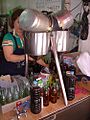
Bottling sesame oil at Moran Market, Seongnam, South Korea
-
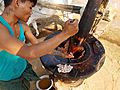
Extracting sesame oil by a bullock driven wooden press, Myanmar


See also
 In Spanish: Aceite de sésamo para niños
