
Slava Raškaj facts for kids
Quick facts for kids
Slava Raškaj
|
|
|---|---|

Photograph of Slava Raškaj
|
|
| Born |
Friderika Slavomira Olga Raškaj
2 January 1877 Ozalj, Kingdom of Croatia-Slavonia, Austria-Hungary
|
| Died | 29 March 1906 (aged 29) Zagreb, Kingdom of Croatia-Slavonia, Austria-Hungary
|
| Nationality | Croatian |
| Known for | Painting |
Slava Raškaj (born January 2, 1877 – died March 29, 1906) was a Croatian painter. Many people consider her the best Croatian watercolor artist from the late 1800s and early 1900s. Slava was deaf from birth. She went to school in Vienna and Zagreb. There, a famous Croatian painter named Bela Čikoš Sesija taught her.
In the 1890s, her paintings were shown in different parts of Europe. This included the big 1900 Expo in Paris. When she was in her twenties, Slava became very ill and needed special care. She spent her last three years in a hospital and sadly passed away in 1906 from an illness. For many years, people did not fully appreciate her art. But in the late 1990s and early 2000s, more and more people became interested in her amazing work.
Contents
Slava Raškaj's Life Story
Slava was born on January 2, 1877. Her full name was Friderika Slavomira Olga Raškaj. She grew up in a family that was not rich but had a good social standing. Her mother, Olga, managed the local post office in Ozalj, which was an important job back then. Ozalj is in modern-day Croatia. At that time, it was part of the Kingdom of Croatia-Slavonia, which belonged to Austria-Hungary.

Olga loved to paint in her free time. She shared her love for art with both her daughters, Slava and Paula. Paula later became a schoolteacher and also continued to paint as a hobby.
When Slava was eight years old, she went to a special school for deaf people in Vienna. This is where she first learned to draw. Her early drawings were mostly of old statues, made with pencil or ink. Two of these drawings are still kept at the Croatian School Museum in Zagreb. While in Vienna, she also learned German and French. Later, she started using watercolor and gouache paints. She returned to Ozalj in 1893.

When she came back home, a local teacher named Ivan Muha-Otoić saw how talented she was. He told her parents to send her to Zagreb for more art lessons. In 1895, she tried to get lessons from the famous painter Vlaho Bukovac. He was a friend of her teacher. However, Bukovac could not help her. Instead, another painter, Bela Čikoš Sesija, took her in. He started teaching her in his studio in 1896.
Slava worked with Sesija for the next few years. She lived at a special institute for deaf children in Zagreb. She even used a local morgue as her art studio! Her old teacher from Ozalj, Ivan Muha-Otoić, became the director of the institute in 1895.
Slava's paintings were quite unique for her time. She painted interesting still life pictures. These included watercolors of unusual things like a starfish or a silver jewelry box. She also painted pairs of objects, such as a red rose with an owl, or a lobster with a fan.
In the late 1890s, Slava started painting en plein air. This means she painted outdoors. She captured scenes from the Zagreb Botanical Garden and other parks in the city. These paintings often had lighter colors. In 1899, she went back to her hometown of Ozalj and kept painting outdoors. This was also unusual for artists at that time.
Her most important paintings were all made in the 1890s. These include Self-portrait, Spring in Ozalj, and The Old Mill. Her art was first shown to the public at the Art Pavilion in Zagreb in 1898. Six of her watercolors were displayed alongside works by famous painters like Menci Klement Crnčić and Vlaho Bukovac. Her paintings were also shown in Saint Petersburg, Moscow, and at the Exposition Universelle in Paris in 1900. Five of her paintings were part of that big show.
Around 1900, Slava started to feel very unwell. She was cared for at home for a while. However, her condition became worse. In 1902, Slava was moved to a special hospital in Stenjevec where she could get the care she needed. She stopped painting completely in her last years. She passed away on March 29, 1906, from an illness.
Slava Raškaj's Legacy
The first art show just for Slava Raškaj's work happened in 1957 in Zagreb. Her watercolor paintings made after 1900 are thought to be some of the best Croatian art.
In 2004, a Croatian film called 100 Minutes of Glory was made about her life. It was directed by Dalibor Matanić. A large exhibition showing 185 of her works opened at the Klovićevi Dvori Gallery in Zagreb in 2008.
In December 2000, the Croatian National Bank made a special silver coin. It showed Slava Raškaj as part of their "Famous Croatian Women" series. Other women on these coins included children's writer Ivana Brlić-Mažuranić and the noblewoman Katarina Zrinska.
Today, there is a school in Zagreb named after her: the Slava Raškaj Educational Centre. This center helps deaf students and those who have trouble communicating. It teaches them practical skills and helps them learn.
Selected Works
- “Stablo u snijegu” (Tree in the snow)
- “Rano proljeće” (Early spring)
- “Proljeće u Ozlju” (Spring in Ozalj)
- “Zimski pejsaž” (Winter landscape)
- “Lopoči” (Water lilies)
Images for kids
-
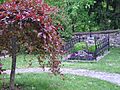
Slava Raškaj's grave in Ozalj
-
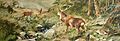
Deer on the battlefield
-
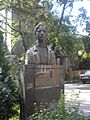
Slava Raškaj's bust in Zagreb


Gallery
-
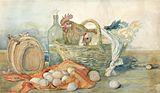
Yellow Rooster and White Chicken
-
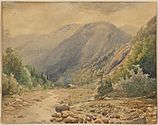
Rainy Day in Somobor Hills
-
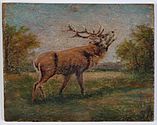
Study of Deer
-
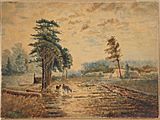
Three Deer Near the Settlement
-
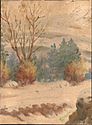
The Slope of Hills in Winter
-
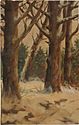
The Forest in Winter
-
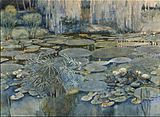
Lilies
-
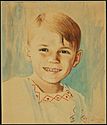
Vera Papić
-
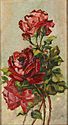
Bloody Roses for Hannibal
-
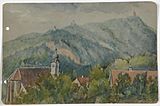
View From the HIll on Samobor


See also
 In Spanish: Slava Raškaj para niños
