
Slender-tailed woodstar facts for kids
Quick facts for kids Slender-tailed woodstar |
|
|---|---|
 |
|
| Conservation status | |
Scientific classification  |
|
| Kingdom: | Animalia |
| Phylum: | Chordata |
| Class: | Aves |
| Order: | Apodiformes |
| Family: | Trochilidae |
| Tribe: | Mellisugini |
| Genus: | Microstilbon Todd, 1913 |
| Species: |
M. burmeisteri
|
| Binomial name | |
| Microstilbon burmeisteri (Sclater, PL, 1888)
|
|
 |
|
| Script error: The function "autoWithCaption" does not exist. | |

Script error: No such module "Check for conflicting parameters".
The slender-tailed woodstar (its scientific name is Microstilbon burmeisteri) is a tiny, beautiful hummingbird. It belongs to a group often called "bee hummingbirds" because they are so small! This special bird is the only species in its genus called Microstilbon. You can find it living in Argentina and Bolivia.
Contents
Meet the Slender-tailed Woodstar
What's in a Name?
The slender-tailed woodstar was once thought to be part of a different bird group, Chaetocercus. But by the middle of the 1900s, scientists decided it truly belonged in its own group, Microstilbon. It's the only type of bird in this group, and there are no different kinds (subspecies) of it.
How to Spot One
The slender-tailed woodstar is a small bird, about 7 to 9 centimeters (3 to 3.5 inches) long. This includes its long tail, which can be about 3 centimeters (1.2 inches) by itself! Both male and female woodstars have a short, straight, black beak. Their upper body feathers are a shiny bronze-green. They also have a thin white stripe right behind their eye.
Male vs. Female
Male slender-tailed woodstars have a bright, reddish-purple patch on their throat, called a gorget. This patch flares out to the sides, looking a bit like a mustache! The rest of their throat is white. Their belly is a light grayish color with some green spots on the sides. The feathers under their tail are a pale cinnamon color. Their tail is very narrow and forked, and it's black.
Female woodstars look a bit different. Their cheeks are darker than the males'. They don't have the colorful throat patch. Instead, their underparts are a cinnamon-buff color. The feathers in the middle of their tail are green, while the other tail feathers are cinnamon with a black band near the end.
Where Do They Live?
Their Home Range
You can find the slender-tailed woodstar in Bolivia, specifically in the Cochabamba and Santa Cruz areas. They also live further south in Argentina, in the Jujuy, Salta, and Tucumán provinces. There's an old record of one being seen even further north in La Paz, Bolivia.
Preferred Hangouts
These hummingbirds like to live in different kinds of places. They enjoy deciduous woodlands, which are forests where trees lose their leaves in certain seasons. They also like bushy areas, thorny scrublands, and deep, plant-filled ravines. You can usually find them at elevations between 1,100 and 2,600 meters (3,600 to 8,500 feet) above sea level.
Woodstar Behavior
Traveling Around
Scientists believe that slender-tailed woodstars move to different elevations depending on the season. They might even travel long distances, like birds that migrate from the south. However, more research is needed to fully understand their movements.
What's on the Menu?
The slender-tailed woodstar usually looks for food high up in trees and plants. When it flies, its wings beat so fast that it can sound like a bumblebee! Other, larger hummingbirds often try to chase them away from food sources.
These birds have been seen drinking nectar from epiphyte flowers. Epiphytes are plants that grow on other plants, like trees, but don't harm them. Scientists think they also get nectar from other types of plants and eat small insects.
Reproduction and Nests
There aren't many records of slender-tailed woodstar nests, but the few found suggest they breed in December and January. One nest was a small cup made of soft plant fibers. It was covered with lichens (a type of moss-like growth) and attached to a tree branch with spiderwebs. This nest was about 6 meters (20 feet) above the ground. We don't know how long the eggs take to hatch or how long the young birds stay in the nest before they can fly.
Their Calls
We don't know much about the sounds the slender-tailed woodstar makes. However, when they are feeding and hovering, they make a series of quiet "chip" notes.
Status and Conservation
The IUCN (International Union for Conservation of Nature) has listed the slender-tailed woodstar as a species of "Least Concern." This means they are not currently in danger of disappearing. Even though we don't know exactly how many there are, their population seems to be stable.
These birds are considered fairly common, but they can be hard to see because they are so small and like to stay hidden. It's thought that they can adapt to living in areas changed by humans to some extent. They are also found in at least one protected area in Argentina, which helps keep them safe.
Images for kids
-
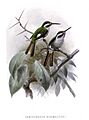
A male slender-tailed woodstar with its bright gorget.
-
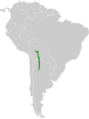
Map showing where the slender-tailed woodstar lives.
