
Smallscale redfin facts for kids
Quick facts for kids Smallscale redfin |
|
|---|---|
 |
|
| Conservation status | |
Scientific classification  |
|
| Kingdom: | Animalia |
| Phylum: | Chordata |
| Class: | Actinopterygii |
| Order: | Cypriniformes |
| Family: | Cyprinidae |
| Genus: | Pseudobarbus |
| Species: |
P. asper
|
| Binomial name | |
| Pseudobarbus asper (Boulenger, 1911)
|
|
| Script error: The function "autoWithCaption" does not exist. | |
| Synonyms | |
|
|

Script error: No such module "Check for conflicting parameters".
The smallscale redfin (Pseudobarbus asper) is a type of freshwater fish. It lives only in South Africa, meaning it is endemic there. This fish is currently threatened, which means its numbers are getting smaller. This is mainly because its home is being destroyed and because of other fish that don't belong there.
Contents
Meet the Smallscale Redfin
This fish is quite small, growing to about 12 centimeters (about 4.7 inches) long. It has special fins that help it swim. Its back fin, called the dorsal fin, has three or four stiff spines and seven soft rays. Its bottom fin, the anal fin, has three spines and five rays.
The smallscale redfin also has a special line along its side, called a lateral line. This line helps it sense things in the water. It has 37 to 40 small scales along this line. It also has a single pair of whiskers, called barbels, near its mouth. These help it find food. When males are ready to breed, their fins turn dark red. They also grow small bumps, called tubercles, on their heads.
Where the Smallscale Redfin Lives
The smallscale redfin lives in the dry Karoo region of South Africa. You can find it in the Gamtoos River and Gourits River systems. These rivers are located in the Eastern Cape province of South Africa.
Life of a Smallscale Redfin
Smallscale redfins often live in cloudy, nutrient-rich waters. These areas might have soft, muddy bottoms or lots of rocks and boulders. Being small helps these fish survive in places where the environment changes a lot. They can find food even in tiny spaces, like under rocks.
They have a long gut, which means they can eat many different kinds of food. Young smallscale redfins like to stay in safe spots. These include places with lots of plants or small ditches where they can hide.
These fish have a "boom and bust" way of life. This means their numbers can grow very quickly when conditions are good. They can even move into temporary homes. They grow fast and start breeding when they are only one year old. They can breed more than once a year. Smallscale redfins usually live for about three years. This is shorter than some related fish, which can live up to six years.
Adult smallscale redfins usually swim in small groups. They breed during the summer months. To lay their eggs, they move into parts of the river where the water flows faster. They lay their eggs in cracks in the riverbed. The eggs might be a little sticky or not sticky at all. After the eggs hatch, the tiny baby fish float downstream. They end up in calmer areas like pools or quiet spots. These places have lots of food for them to grow.
Protecting the Smallscale Redfin
The smallscale redfin faces a big danger from other fish. These are invasive species, meaning they are not native to these rivers. One big problem is the North African catfish (Clarias gariepinus). This catfish has moved into the Gamtoos River. It has also been put into farm dams in the Gourits River area. These invasive fish can harm the smallscale redfin.
One way to help the smallscale redfin is to release water from dams. This can create a sudden rush of water, like a flood. This helps encourage the fish to breed more.
Images for kids
-
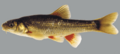
A smallscale redfin in its natural habitat.
