
Shinto shrew facts for kids
Quick facts for kids Shinto shrew |
|
|---|---|
| Conservation status | |
| Scientific classification | |
| Genus: |
Sorex
|
| Species: |
shinto
|
| Subspecies | |
|
|
 |
|
| Shinto shrew range | |

The Shinto shrew (Sorex shinto) is a small, mole-like mammal that lives only in Japan. It has a pointy nose, tiny ears, and a fairly long tail. Like most shrews, it is very small. Shinto shrews have poor eyesight but excellent hearing and smell. They use these senses to find their food, which is mostly insects.
Scientists once thought the Shinto shrew was a type of Laxmann's shrew (Sorex caecutiens). But after doing new studies, like genetic testing, they found out it was a different species. So, now it has its own classification.
There are three main groups of Shinto shrews in Japan. These groups live on different islands. Because they are separated, they do not breed with each other. This allows small differences to appear over time. These three groups are called subspecies. The shrews on Sado Island are S. shinto sadonis. Those on Shikoku Island are S. shinto shikokensis. The shrews on Japan's main island, Honshu, are S. shinto shinto.
Contents
What Does the Shinto Shrew Look Like?

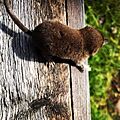
The Shinto shrew looks similar to the Laxmann's shrew. However, the Shinto shrew is smaller than the Laxmann's shrew. It is also larger than the Azumi shrew. A Shinto shrew's head and body are about 5.1 to 7.25 centimeters long. Its tail is about 4.4 to 5.7 centimeters long. This makes its tail shorter than the Azumi shrew's tail.
The Shinto shrew's head, from its front teeth to the back of its skull, is about 1.65 to 1.81 centimeters. Its teeth rows measure 3.9 to 4.4 millimeters. Its back foot is about 1.14 to 1.36 centimeters long. These shrews usually weigh between 4.1 and 6.2 grams. Their backs are gray-brown in color.
Scientists can tell the Shinto shrew apart from the Laxmann's shrew. They can even look at the surface of a specific tooth to see the difference.
Where Do Shinto Shrews Live?
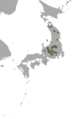
The Shinto shrew lives only in Japan. This means it is an endemic species there. You can find it on the islands of Honshu (including the Kii Peninsula), Shikoku, and Sado Island.
The main subspecies, Sorex shinto shinto, lives in the northern and central mountains of Honshu. It prefers middle and high altitudes. The Sorex shinto shikokensis subspecies lives on Shikoku. It is found in the Ishizuchi and Tsurugi Mountains. The Sorex shinto sadonis subspecies lives on Sado Island. It has also been seen on the western coast of Honshu, both in mountains and lower areas.
Fossils of Shinto shrews have been found on Honshu from the Pleistocene era. Later fossils from the late Pleistocene were found on Kyushu. Shinto shrews sometimes live in the same areas as Laxmann's shrews.
Shinto Shrew Habitats and Food
Shinto shrews live in both old and new forests. They especially like forests with pine trees and bushy areas. They can live at low altitudes, even near sea level. However, they are more often found in mountains. They can live as high as 2,900 meters above sea level. On Honshu, they live up to 1,200 meters high. On Shikoku, they are found from sea level up to 900 meters. On Sado Island, they have been seen at 300 meters above sea level.
We do not have specific information about what Shinto shrews eat. But their close relative, the Laxmann's shrew, eats spiders, beetles, woodlice, and caterpillars.
Sometimes, Shinto shrews can have tiny worms called nematodes living inside them. These include Parastrongyloides winchesi and Syphacia.
Life Cycle and Behavior
Most shrews live alone. We do not have much information about the Shinto shrew's social life. They live on the ground, often hidden in leaves and plants. Most Shinto shrews caught by scientists were active at night. But in high mountain areas, they were active during the day.
Female shrews get pregnant after mating with a male. Pregnant Sorex shinto shinto females have been found on Honshu in May and June. Pregnant Sorex shinto sadonis females were seen from March to May. After being pregnant, a female gives birth to one to six babies. The Sorex shinto sadonis subspecies usually has four to six babies.
Shrews generally do not live very long. Most Shinto shrews probably live for about one year.
Shinto Shrew Conservation Status
The number of Shinto shrews seems to be stable. The IUCN (International Union for Conservation of Nature) does not have exact numbers for their population. In some places, like northern and central Honshu, Shinto shrews are common. They are also common on Sado Island. However, on Shikoku, the Shinto shrew is rare. It can only be found in high-altitude areas there.
Many areas where the Shinto shrew lives are protected. The IUCN does not list any major threats to this species. Because of this, the Shinto shrew is classified as a species of least concern (LC). This means it is not currently in danger of disappearing.
Images for kids
-
Shinto shrew range
-
The Shinto shrew looks a lot like the Laxmann's shrew.
