
Space suit facts for kids


A space suit is a personal environmental suit designed to keep people alive in outer space. It works like a miniature spaceship shaped like a human body. Space suits act as a special pressure suit that protects an astronaut from the extreme cold and heat of the space environment. They also block dangerous radiation and stop tiny space rocks called micrometeoroids. Inside a spacecraft, astronauts wear lighter suits for safety if the cabin pressure drops. Outside the ship, they wear complex suits with a portable life support system to explore.
High up in space, there is no air to breathe. Humans need protection above the Armstrong limit, which is about 19,000 m (62,000 ft) above Earth. Without a suit, the low pressure would cause body fluids to bubble. A space suit supplies fresh oxygen to breathe and removes dangerous carbon dioxide. It also keeps air pressed firmly against the body. This lets an explorer move around in the airless vacuum of space.
Contents
How Do Space Suits Protect Astronauts in Space?

To keep an astronaut safe during extravehicular activity (EVA), a suit must perform several vital jobs at once. First, it holds a steady internal air pressure. Suits usually contain pure oxygen rather than the nitrogen mixture found on Earth. This lower pressure makes it easier to bend your fingers, knees, and elbows.
Suits also control temperature. In space, surfaces facing the Sun become boiling hot, while shaded spots turn freezing cold. The suit uses thick insulation layers to protect the body from extreme heat changes. Advanced suits use a special Liquid Cooling and Ventilation Garment next to the skin. This garment contains tiny tubes filled with chilled water to prevent sweating and overheating.
Every space suit needs an easy way to talk to other crew members. Inside the helmet, astronauts wear a headset with a microphone and speakers. In the American space program, this fabric cap is nicknamed the Snoopy cap because its black-and-white pattern looks like Snoopy. For long spacewalks, suits also have an absorbent undergarment called the Maximum Absorbency Garment to collect bodily waste.
Guarding Against Space Hazards


Space is filled with unseen dangers that could harm an unprotected traveler. Suits must provide shielding against bright ultraviolet light and energetic particle radiation. They must also stop flying bits of space dust called micrometeoroids. These tiny rocks travel faster than a speeding bullet.
To stop punctures, suits feature an outer layer called a Thermal Micrometeoroid Garment. For example, the Apollo/Skylab A7L suits worn on the Moon used eleven protective layers. They were made of fireproof Beta cloth, aluminized insulation, and sturdy rubber. This heavy fabric kept explorers safe in temperatures ranging from −156 °C (−249 °F) to 121 °C (250 °F). Modern explorers also use sturdy tethers and handholds to keep from floating away into the empty void.
Pre-Breathing Pure Oxygen

Earth's air has an atmospheric pressure that presses against our bodies constantly. Inside a spacecraft like the Space Shuttle or the International Space Station, the air is kept like Earth. A spacewalk suit operates at a much lower pressure so it does not inflate stiff like an overfilled balloon.
Because of this pressure change, astronauts must prepare before stepping outside. If pressure drops too quickly, dissolved nitrogen gas can form painful bubbles in the blood, causing decompression sickness. To prevent this illness, spacewalkers breathe pure oxygen for several hours before their mission. This simple safety step washes out extra nitrogen so astronauts can work without pain.
Types of Space Suit Designs


Engineers build suits in three main styles:
- Soft suits use flexible fabrics and rubber bladders. They are lighter and easier to store, but bending the joints can require extra muscle power.
- Hard-shell suits are made from metal or tough composite shells. These use rotating metal bearings at the joints. The experimental AX-5 hard-shell space suit showed that metal limbs can move very freely without extra effort.
- Hybrid suits combine both ideas. The American Extravehicular Mobility Unit (EMU) uses a fiberglass Hard Upper Torso attached to flexible fabric arms and legs.
- Elastic suits, like the Bio-Suit, are special designs that use tight stretchy bands instead of gas pressure.
Famous Space Suits in History

Long before humans reached orbit, aviation pioneers tested high-altitude pressure gear. In 1935, Spanish inventor Emilio Herrera Linares designed a full-pressure balloon suit. Early test pilots like Wiley Post flew high above the clouds in sealed flight gear. When Project Mercury started, inventor Russell Colley designed America's first space suits, which kept astronaut Alan Shepard safe in 1961.
Russian Space Suit Models
- The SK-1 suit was worn by Yuri Gagarin in 1961 during the very first human flight in orbit.
- The Berkut suit allowed cosmonaut Alexei Leonov to perform the first historical spacewalk in 1965.
- The Sokol suit is a bright white suit worn by crew members aboard every modern Soyuz spacecraft.
- The Orlan suit is a heavy spacewalk suit with a rigid back door that opens like a refrigerator.
American Space Suit Models
- Navy Mark IV suits kept pilots safe inside the tiny Mercury capsule.
- Gemini suits allowed American astronauts to test early spacewalk gear outside their capsule.
- The Apollo/Skylab A7L suit walked on the surface of the Moon during the famous Apollo program.
- The Advanced Crew Escape Suit was a bright orange suit worn during Space Shuttle takeoffs and landings.
- The modern Extravehicular Mobility Unit has served spacewalkers on the space station for over forty years.
Commercial and Modern Space Suits

Private companies now build space suits alongside government space agencies. The company SpaceX created a sleek black-and-white suit designed by CEO Elon Musk and Hollywood costume designer Jose Fernandez. A test dummy nicknamed "Starman", named after a song by David Bowie, wore it during the Falcon Heavy test flight. Astronauts Bob Behnken and Doug Hurley later wore it into orbit during the Crew Dragon Demo-2 mission. An upgraded version was used on the Polaris Dawn mission for commercial spacewalks.
In China, astronauts use the custom-built Feitian space suit to work outside the Tiangong Space Station. In Europe, engineers designed the EuroSuit for astronaut Sophie Adenot to test aboard the space station. Around the world, scientists are testing 3D-printed suits and new designs for the upcoming Artemis program moon missions.
Images for kids
-
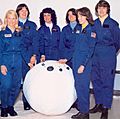
The first six female US astronauts with a Personal Rescue Enclosure escape ball
-
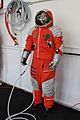
A commercial flight suit built by Final Frontier Design
-
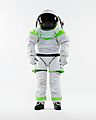
The prototype Z-1 space suit built by NASA
-
The European EuroSuit prototype designed for station tests


See also
 In Spanish: Traje espacial para niños
- Atmospheric diving suit
- Extravehicular activity
- Manned Maneuvering Unit
- Space exploration
