
State of Vietnam facts for kids
Quick facts for kids
State of Vietnam
|
|||||||||||
|---|---|---|---|---|---|---|---|---|---|---|---|
| 1949–1955 | |||||||||||
 National flag
 Coat of arms
(1954–1955) |
|||||||||||
|
Motto: Dân vi quý
"The people are the most important" |
|||||||||||
|
Anthem: Thanh niên Hành Khúc
"The March of Youths" |
|||||||||||
|
Grand Seal of the Chief of State
保大國長  |
|||||||||||
 The nominal territory of State of Vietnam (dark green)  The territory controlled by the State of Vietnam after the 1954 Geneva Conference (dark green); territory claimed but not controlled (light green). |
|||||||||||
| Status | Associated state in the French Union (until 1954) Independent state (from 1954) |
||||||||||
| Capital | Saigon 10°48′N 106°39′E / 10.800°N 106.650°E |
||||||||||
| Official languages | Vietnamese, French | ||||||||||
| Religion | Folk religions Confucianism Buddhism Taoism Catholicism Caodaism Hoahaoism Evangelicalism |
||||||||||
| Demonym(s) | Vietnamese, Vietnamian | ||||||||||
| Government | Unitary constitutional semi-monarchy | ||||||||||
| Chief of State | |||||||||||
|
• 1949–1955
|
Bảo Đại | ||||||||||
| Prime Minister | |||||||||||
|
• 1949–1950
|
Bảo Đại | ||||||||||
|
• 1950
|
Nguyễn Phan Long | ||||||||||
|
• 1950–1952
|
Trần Văn Hữu | ||||||||||
|
• 1952–1953
|
Nguyễn Văn Tâm | ||||||||||
|
• 1954
|
Bửu Lộc | ||||||||||
|
• 1954–1955
|
Ngô Đình Diệm | ||||||||||
| Legislature | National Advisory Council (1949-1954) National Assembly (1954-1955) |
||||||||||
| Historical era | Cold War | ||||||||||
|
• Élysée Accords
|
8 March 1949 | ||||||||||
|
• State formation
|
14 June 1949 | ||||||||||
|
• Matignon Treaty
|
4 June 1954 | ||||||||||
|
• Partition
|
21 July 1954 | ||||||||||
|
• Republic founded
|
26 October 1955 | ||||||||||
| Currency | piastre đồng (from 1953) |
||||||||||
|
|||||||||||
| Today part of | Vietnam | ||||||||||


The State of Vietnam was a country in Southeast Asia that existed from 1949 until 1955. It began as an associated state connected to the French Union. Later, it became a fully independent nation. The country claimed authority across the land during the First Indochina War. Its government ruled big cities like Saigon, while rivals held rural areas. Its leader was former emperor Bảo Đại, who served as the Chief of State.
During the global Cold War, this nation joined with the Western Bloc. In 1954, major treaties divided the land into two parts. In 1955, the country changed into the Republic of Vietnam, commonly known as South Vietnam.
Contents
History of the State of Vietnam

Changes after World War II
After World War II ended in 1945, Vietnam went through huge political changes. Leaders met at the Potsdam Conference and drew a boundary along the 16th parallel north. Troops arrived to disarm soldiers after the war ended. In the north, Ho Chi Minh set up the Democratic Republic of Vietnam. At the same time, France wanted to regain control of French Indochina.
Disagreements led to arguments between different groups and colonial leaders. Soon, fighting started between French soldiers and the Viet Minh. This conflict grew into the First Indochina War. Many people who supported Vietnamese nationalism wanted independence without joining communist leaders. They decided to work together and invited former emperor Bảo Đại to help build a new government.
Creating a Unified Government

In 1948, leaders signed the Halong Bay Agreements. This deal joined northern Tonkin and central Annam into one system. A group called the Provisional Central Government of Vietnam formed under leader Nguyễn Văn Xuân. Soon after, the southern region of French Cochinchina agreed to join as well.
On June 14, 1949, agreements called the Élysée Accords officially took effect. This created the State of Vietnam. The new government had power over many local matters. However, it still worked closely with France as part of the French Union. Other nearby nations in this group included the Kingdom of Cambodia and the Kingdom of Laos.
The Country Splits in Two


In June 1954, a treaty called the Matignon Treaty gave the State of Vietnam full independence. However, international leaders were meeting at the Geneva Conference to stop the war. The resulting 1954 Geneva Accords divided the country temporarily at the 17th parallel north.
The northern half became North Vietnam, led by the communist government based in Hanoi. The southern half remained under the State of Vietnam with its capital at Saigon. Hundreds of thousands of people chose to relocate. Many traveled south through a major sea effort known as Operation Passage to Freedom.
Government and Daily Life
Important Leaders
Several politicians helped lead the government during these fast-changing years:
- Nguyễn Văn Xuân led the early provisional council.
- Bảo Đại ruled as Chief of State and briefly served as prime minister.
- Nguyễn Phan Long worked as prime minister in 1950.
- Trần Văn Hữu directed the cabinet from 1950 until 1952.
- Nguyễn Văn Tâm served as leader of the ministers until 1953.
- Bửu Lộc held the top office during early 1954.
- Ngô Đình Diệm became prime minister in 1954 and led the country through major reforms.
In late 1955, voters took part in the 1955 State of Vietnam referendum. After the vote, Ngô Đình Diệm announced the founding of the Republic of Vietnam and became its first president.
Money and the Military


The nation built its own armed force called the Vietnamese National Army. General Nguyễn Văn Hinh served as its top military commander. The soldiers guarded cities and worked to protect citizens.
For money, people originally used paper cash called the French Indochinese piastre. Later, in 1953, the government created a brand-new national currency called the đồng.
Friends Around the World
The country quickly gained friends worldwide. Over thirty different nations recognized it by 1950, including the United States and United Kingdom.
The nation also joined major international agencies. It participated in the World Health Organization, the International Labour Organization, the United Nations Educational, Scientific and Cultural Organization, and the Food and Agriculture Organization.
Regions of the Country
The Three Big Areas
The country was originally split into three administrative parts:
- Bắc Phần in the north, based on Tonkin.
- Trung Phần in the central zone, based on Annam.
- Nam Phần in the south, based on Cochinchina.
In August 1954, new rules united these areas directly under the central government.
The Domain of the Crown
Special highland and forest areas were set aside as the Domain of the Crown. In these places, Bảo Đại kept his historic title as ruler of the Nguyễn dynasty. These lands included home territories for ethnic groups like the Mường Autonomous Territory, the Mèo Autonomous Territory, the Nùng Autonomous Territory, and mountain provinces like Pleiku and Kontum. This special area existed until 1955, when all parts were gathered into a single system.
Images for kids
-
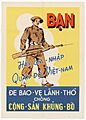
Army recruitment poster against communism.
-
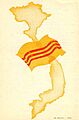
Flag of the State of Vietnam on map, from a 1955 book
-
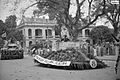
Reenactment of the presentation of the sacred sword to Lê Lợi. Parade in Hanoi 1952, commemorating the Élysée Accords.
-
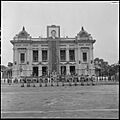
Commissioning ceremony in Hanoi, 1952


See also
 In Spanish: Estado de Vietnam para niños
- Vietnamese nationalism
- Cold War
- History of Vietnam
