
Stratosphere facts for kids

The stratosphere is the second layer of Earth's atmosphere. It sits right above the troposphere and rests below the mesosphere. The lower boundary of this layer is called the tropopause, while the top boundary is called the stratopause. In this layer, the air gets warmer the higher up you go. This warming happens because of the vital ozone layer found inside it.
Contents
How the Stratosphere Works

In our everyday air near the ground, temperature drops as height increases. However, the stratosphere has a temperature inversion. This means air near the bottom can be −51 °C (−60 °F), but it warms up to −15 °C (5 °F) near the top. This heating happens because ozone gas absorbs harmful ultraviolet sunlight from the Sun.
Scientists Sydney Chapman, Paul J. Crutzen, and Mario J. Molina studied how the ozone–oxygen cycle protects us. The ozone layer acts like invisible sunscreen. It absorbs dangerous UV rays so living things can survive safely on the ground. The layer is very dry and lacks big storm clouds. Because cool, heavy air stays at the bottom, there is very little normal convection or stormy turbulence.
Flying in the Stratosphere

Commercial airplanes love flying in the lower part of this calm zone, around 10 km (6.2 mi) high. The thin air creates less air resistance. This saves fuel and gives passengers a much smoother ride above stormy thunderstorms.
Famous high-speed jets have flown even higher. The passenger jet Concorde cruised at twice the speed of sound, while the SR-71 spy plane flew three times the speed of sound. In 2014, an adventurer named Alan Eustace used a giant weather balloon to float up to 135,890 ft (41.42 km) before making an incredible world-record parachute jump back to Earth.
Amazing Sky Wonders

The stratosphere features unique high-altitude electrical activity called upper-atmospheric lightning. Instead of normal lightning that strikes downward, scientists see colorful bursts shooting upward. These include bright flashes called a blue jet and red glow events known as a sprite.
Even tiny forms of life can survive in this high, cold place. Scientists have sent balloons high up and discovered living bacteria floating in the dust. Powerful winds also circle the poles here, creating a swirling air pattern known as the polar vortex.
Images for kids
-
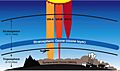
The ozone layer shields Earth from dangerous rays.

Related pages
 In Spanish: Estratosfera para niños
