
Tabby cat facts for kids
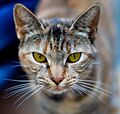
A tabby cat is a domestic cat with a special coat pattern. You can recognize a tabby by the "M" shape on its forehead. They also have stripes near their eyes, on their cheeks, back, legs, and tail. Tabby cats can have stripes, dots, lines, or swirled patterns on their bodies. There are four main types of tabby patterns: mackerel, classic, ticked, and spotted. Each pattern is created by specific genes.
It's important to know that "tabby" is a coat pattern, not a breed of cat. Many different cat breeds, and even mixed-breed cats, can be tabbies. This pattern is very common worldwide. The tabby look comes from the wild ancestors of domestic cats, like the African wildcat and European wildcat. These wild relatives also have similar striped or spotted coats.
Contents
The Name "Tabby"
The word "tabby" first described a type of striped silk fabric. This fabric was called tabis in French, meaning "rich silk." The name came from a place in Baghdad called Attabiya, famous for its striped cloth. This special silk became popular and the word "tabby" came to England.
People started using "tabby cat" to describe cats with striped coats around the late 1600s. Later, in the 1700s, it was shortened to just "tabby." Sometimes, people think "tabby" means a female cat. This might be because "Tabby" is a nickname for the girl's name "Tabitha."
Different Tabby Patterns
There are four main types of tabby patterns: mackerel, classic, ticked, and spotted. Each one has a unique look caused by different genes. Sometimes, these patterns can also appear on cats with mixed colors, like calico or tortoiseshell cats. These are called "patched tabbies," or "calibies" and "torbies."
Some cat breeds have even more special tabby patterns. For example, the Sokoke cat has a modified classic tabby. The Bengal cat has rosette or marbled patterns. These unique looks come from a mix of wild and domestic cat genes.
.jpg)
.png)
.jpg)

Mackerel Tabby: The Striped Look
The mackerel tabby has thin, vertical stripes that curve along its body. These stripes can be solid or broken into smaller segments and spots. You'll almost always see an "M" shape on its forehead. Dark lines also run from the corners of its eyes and across its cheeks. Many stripes appear on the neck, shoulders, legs, and tail. Mackerel tabbies are sometimes called "fishbone tabbies" because their stripes look like a fish skeleton. This is the most common tabby pattern.
Classic Tabby: Swirls and Bullseyes
The classic tabby also has the "M" on its forehead. But instead of thin stripes, its body has thick, swirling bands. These patterns often create a distinctive "bullseye" mark on each side of the cat. Classic tabbies usually have a light-colored "butterfly" pattern on their shoulders. They also have three thin stripes along their spine, with the middle one being the darkest. Their legs, tail, and cheeks have thick stripes or bands. Many American Shorthair cats show this beautiful pattern.
Spotted Tabby: Leopard-like Dots
The spotted tabby pattern is believed to come from a gene that breaks up the mackerel tabby stripes. This makes the stripes look like spots instead. Sometimes, even the classic tabby pattern can be broken into large spots. You can see both large and small spots in breeds like the Egyptian Mau and Ocicat. The most common spotted tabby looks a lot like the mackerel tabby. It has the classic marks on its limbs, tail, head, and the "M" on its forehead.
Ticked Tabby: The Agouti Effect
Ticked tabbies have a unique "salt-and-pepper" look. Their fur hairs have different bands of color, making them appear sandy. This pattern usually means they have very few or no stripes on their body. However, you might still see faint stripes on their lower legs, face, belly, and sometimes on the tail tip. They also have the standard "M" on their forehead and a dark line along their spine. These cats come in many colors and variations.
Orange Tabby: A Fiery Color
An orange tabby is also known as a red or ginger tabby. This is a color variation of the other tabby patterns. These cats have a pigment called pheomelanin, which gives them their orange color. Their fur can be mostly orange with a few white spots, or completely orange. The orange areas might have darker or lighter stripes or spots. White fur usually appears on their belly, paws, chest, and muzzle.
Their face markings often look like a mackerel or classic tabby. They often have a white spot on their face that covers their mouth and goes up to their forehead. About 75% of ginger cats are male. This is because the gene for orange color is linked to the X chromosome.
Torbies and Calibies: Mixed Colors
Female cats have two X chromosomes. This means they can have one X chromosome with the orange gene and another with the black gene. When this happens, both colors appear in random patches on their fur. These patches can be with or without a tabby pattern.
When a cat has both tortoiseshell markings and a tabby pattern, it's called a torbie cat. If the cat also has white patches, it's known as a caliby (especially in the US). These cats have a beautiful mix of colors and patterns!
How Genes Create Tabby Patterns
A cat's coat pattern is decided by its genes. For tabby cats, two main genes work together to create their unique looks. One gene, called the agouti gene, controls whether the tabby pattern shows up at all. If a cat has a certain version of this gene, its tabby pattern will be visible. If it has another version, the pattern might be hidden, making the cat look like a solid color. You might still see faint "ghost stripes" on solid-colored kittens or on an adult cat's tail.
The agouti gene mainly affects black pigment. This means that orange cats, or the orange patches on tortoiseshell cats, will always show a tabby pattern. Even if the stripes are a bit faded, they are still there!
Another gene determines which specific tabby pattern appears. For example, the gene for mackerel stripes is dominant over the gene for classic swirls. This means if a cat has even one mackerel gene, it will likely have mackerel stripes. The ticked tabby pattern is also dominant over the others. If a cat has the ticked gene, it will mostly have the "salt-and-pepper" look, hiding other stripe patterns. Finally, a separate gene is thought to create spots by breaking up the mackerel stripes.
Tabby Cat Personalities
Just like people, cats have different personalities. Many things can affect how a cat behaves, including its genes and how it grew up. A study from the University of California, Davis in 2015 looked at whether a cat's fur color or pattern was linked to its behavior.
Researchers asked over a thousand cat owners about their cats' behavior. They wanted to know if cats were aggressive when handled, with people, or at the vet. The study found that while there were small differences in behavior between cats with different coat colors, these were not very big. The biggest differences in behavior seemed to be linked to whether the cat was male or female, not its coat pattern. For example, female cats were sometimes seen as more aggressive during vet visits than male cats.
Another study also found no strong link between a cat's behavior and its coat pattern. It suggested that sometimes people just expect certain behaviors from cats based on their color. For instance, some people might think orange cats are always "friendly" or white cats are "shy."
A Look Back: Tabby Cat History
Since the tabby pattern is so natural, you might think that most cats in medieval times were tabbies. However, a natural philosopher named John Aubrey thought this wasn't true. In the mid-1600s, he wrote that William Laud, who was an important church leader, loved cats. Laud was given some "Cyprus-cats," which were tabby cats.
Aubrey also said he remembered that common English cats were usually white with some bluish-grey patches. He believed this type of cat was almost gone by his time. Despite his thoughts, most old drawings and paintings of cats from medieval times actually show them as tabbies.
Famous Tabby Cats
Many tabby cats have become famous! Here are a few examples:
- Think Think: One of two cats belonging to the former President of Taiwan, Tsai Ing-wen.
- The Ithaca Kitty: This grey tabby cat had seven toes on each front foot. It inspired one of the first mass-produced stuffed toys ever made.
- Morris the Cat: An orange tabby who became a famous advertising mascot for 9Lives cat food in 1969. Morris became a well-known TV character. Three different orange tabbies, all rescued from shelters, have played Morris since 1968.
- Maru: A tabby from Japan who is one of the most popular cats on the internet. He once held a Guinness World Record for the most-watched animal on YouTube.
- Orangey: An orange tabby who starred in many movies and TV shows. He is the only cat to win two PATSY Awards, which are awards for animal actors. He won for his roles in Rhubarb (1951) and Breakfast at Tiffany's (1961).
- Larry: A former stray tabby cat rescued by Battersea Dogs & Cats Home. He went on to become the Chief Mouser to the Cabinet Office at 10 Downing Street in London.
Images for kids
-
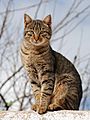
Mackerel tabby, with the distinctive striped pattern and forehead 'M'.
-
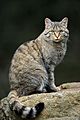
A European wildcat (Felis silvestris) bearing a similar coat pattern to that of a tabby cat. It is thought that the tabby pattern originates from the numerous related species of wildcat.
-
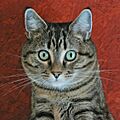
Typical tabby patterns in the head region: An 'M' on the forehead, bright eye rims and borders of the ears
-
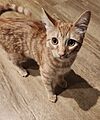
Orange tabby cat
-
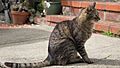
Black-striped mackerel tabby cat
-
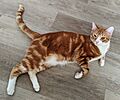
Orange-blotched tabby-and-white cat
-
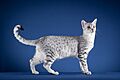
Black silver spotted tabby Egyptian Mau
-
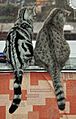
Black-blotched (left) and spotted (right) tabby British Shorthair cats
-
-
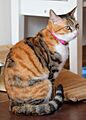
Black tortoiseshell mackerel tabby-and-white tricolor ("caliby") cat
-

Black tabby point Ragdoll
-
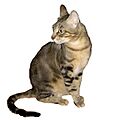
Black modified classic tabby Sokoke
-
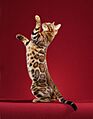
Black-rosetted tabby Bengal


_(cropped).jpg)


.jpg)


See also
 In Spanish: Gato atigrado para niños
