
Thirteenth Amendment to the United States Constitution facts for kids

The Thirteenth Amendment is a very important change to the United States Constitution. The Constitution is the main set of laws that guides the United States. This amendment made slavery illegal everywhere in the United States. It was passed on December 6, 1865. This happened right after the Civil War ended. It was one of the Reconstruction Amendments, which were changes made after the war. This amendment also removed an older part of the Constitution that dealt with runaway slaves.
Contents
What the Thirteenth Amendment Says

The Thirteenth Amendment has two main parts:
- Section 1: This part says that slavery and forced labor are not allowed in the United States. The only time someone can be forced to work is if they are being punished for a crime they were found guilty of. This rule applies to every part of the United States and any place it controls.
- Section 2: This part gives the U.S. Congress the power to make laws to ensure that the first section is followed.
Ending Slavery in America
Before the Civil War
Before the Civil War, the Constitution allowed slavery. Many people and groups wanted to end slavery in the United States. These groups were called abolitionists. They eventually formed the Republican Party in 1856. This party gained a lot of power in 1860 when Abraham Lincoln was elected president.
Lincoln and Freedom
In 1863, President Lincoln issued the Emancipation Proclamation. This important order freed slaves, but only in certain parts of the United States. It did not make slavery illegal everywhere. Slaves in states that had not left the Union were not freed by this order.
Making it Law Forever
As the Civil War was ending, the Republicans controlled Congress. They wanted to make sure slavery was illegal in every part of the United States. So, they introduced an amendment to the Constitution. For an amendment to become law, it must first be approved by both the United States Senate and the United States House of Representatives. Then, three-quarters (or 75%) of the states must also approve it. The Thirteenth Amendment was approved by enough states. It officially became law in late 1865, finally ending slavery across the nation.
The first 27 states to ratify the Amendment were:
- Illinois: February 1, 1865
- Rhode Island: February 2, 1865
- Michigan: February 3, 1865
- Maryland: February 3, 1865
- New York: February 3, 1865
- Pennsylvania: February 3, 1865
- West Virginia: February 3, 1865
- Missouri: February 6, 1865
- Maine: February 7, 1865
- Kansas: February 7, 1865
- Massachusetts: February 7, 1865
- Virginia: February 9, 1865
- Ohio: February 10, 1865
- Indiana: February 13, 1865
- Nevada: February 16, 1865
- Louisiana: February 17, 1865
- Minnesota: February 23, 1865
- Wisconsin: February 24, 1865
- Vermont: March 9, 1865
- Tennessee: April 7, 1865
- Arkansas: April 14, 1865
- Connecticut: May 4, 1865
- New Hampshire: July 1, 1865
- South Carolina: November 13, 1865
- Alabama: December 2, 1865
- North Carolina: December 4, 1865
- Georgia: December 6, 1865
Other states ratified it later, with Mississippi being the last in 1995, and its certification confirmed in 2013.
What Changed After the Amendment
Freedom for All Enslaved People
The most important effect of the Thirteenth Amendment was making the entire system of slavery illegal in the U.S. This expanded Lincoln's Emancipation Proclamation to the whole nation. For example, between 65,000 and 100,000 people in Kentucky became legally free when the amendment took effect. In Delaware, about 900 people gained their freedom.
Impact on Native American Territories
Even after the amendment, some forms of forced labor continued in areas controlled by Native American tribes. The federal government had to negotiate new agreements with tribes like the "Five Civilized Tribes" in 1866 to ensure slavery ended there too.
Political Changes in the South
Before the war, enslaved people were counted as three-fifths of a person for political representation. With all enslaved people now free, the Southern states' populations for representation purposes increased. This meant they would have more power in the House of Representatives and in presidential elections. Republicans in Congress later tried to address this in the Fourteenth Amendment.
New Challenges for Freed People

Even though they were free, many black Americans in the South faced difficult situations. Many white people in the South still held racist beliefs. New laws, called Black Codes, were passed to control the lives of freed people. These laws often forced black workers to sign unfair contracts or face punishment for minor offenses like "vagrancy" (being jobless).
These laws allowed states to sentence black people to forced labor for crimes. Their labor was then sold to farms, factories, and mines. This system was very similar to slavery and made it hard for freed people to truly be independent.
The Exception: Labor as Punishment
The Thirteenth Amendment has an important exception: it allows forced labor as punishment for a crime if the person has been properly convicted. This idea came from the Northwest Ordinance of 1787. Thomas Jefferson included this exception in an early version of that ordinance. He was influenced by thinkers who believed that forced labor could be a fair punishment for serious crimes.
Images for kids
-
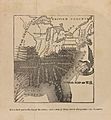
A map from 1847 showing states where slavery was allowed (in black).
-
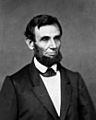
President Abraham Lincoln in 1861.
-
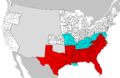
Lincoln's Emancipation Proclamation freed slaves only in the red states on this map (1863).
-

A slave trader's business in Atlanta, Georgia in 1864.
-
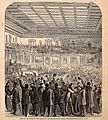
Members of the House of Representatives celebrating when the 13th Amendment passed in 1865.
-
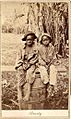
Two children who were freed from slavery by the 13th Amendment, around 1870.


See also
 In Spanish: Decimotercera Enmienda a la Constitución de los Estados Unidos para niños
