
Toe loop jump facts for kids
Quick facts for kids Figure skating element |
|
|---|---|

Illustration of a single toe loop jump
|
|
| Element name | Toe loop jump |
| Scoring abbreviation | T |
| Element type | Jump |
| Take-off edge | Back outside |
| Landing edge | Back outside |
| Inventor | Bruce Mapes |
The toe loop jump is a fundamental and often-used jump in figure skating. It was created in the 1920s by American professional skater Bruce Mapes. Skaters start this jump by moving forward on the inside edge of their blade. They then turn to face backward. The jump takes off from a back outside edge, with help from the toe pick of the other foot. Skaters land the jump on the same back outside edge they used for takeoff. This jump is frequently added to harder jumps in combinations. It is also the most common second jump in these combinations and the most attempted jump overall.
Contents
Understanding the Toe Loop Jump
The toe loop jump is known as the simplest of the six main jumps in figure skating. Its design makes it easier for skaters to perform. This jump is often a building block for more complex moves.
The History of This Jump
The toe loop jump was invented in the 1920s. Bruce Mapes, an American professional figure skater, developed this move. He might have also invented the flip jump. In competitive skating, each jump has a base value. This value increases with more rotations. For example, a single toe loop is worth 0.40 points. A double toe loop is 1.30 points. A triple toe loop earns 4.20 points. A quadruple toe loop is valued at 9.50 points. There is even a quintuple toe loop, which is worth 14 points.
Key Moments in Toe Loop History
Many skaters have made history with the toe loop. The first triple toe loop (3T) was landed by Thomas Litz from the USA. He achieved this at the 1964 World Championships.
The quadruple toe loop (4T) was first performed by a man, Kurt Browning of Canada. He did this at the 1988 World Championships. Later, Alexandra Trusova from Russia landed the first women's quadruple toe loop. This happened at the 2018 World Junior Championships.
Skaters have also combined toe loops with other jumps. Elvis Stojko of Canada was the first to land a quadruple toe loop-double toe loop (4T+2T) and a quadruple toe loop-triple toe loop (4T+3T) in men's competition. These were achieved at the 1991 World Championships. Alexandra Trusova also landed the women's quadruple toe loop-triple toe loop (4T+3T) at the 2018 Junior Grand Prix Lithuania.
How Skaters Perform the Toe Loop
The toe loop is considered simple for a few reasons. Skaters use their toe-picks for extra power. Also, their hips are already facing the direction they will spin. This makes it easier to add many rotations. The toe-assisted takeoff gives more power. Skaters can also turn their body towards the assisting foot. This slightly reduces how much they need to rotate in the air. It is often used as the second jump in a combination.
Breaking Down the Jump Steps
A toe loop jump involves several key actions. First, the skater approaches the jump moving forward. They are on the inside edge of their blade. Then, they switch to a backward-facing position. The takeoff happens from a back outside edge. The toe pick of the other foot helps push them into the air. The skater lands on the same back outside edge.
When doing a toe loop alone, the skater might enter it from a "three turn." This turn helps them get onto the correct back outside edge. If the toe loop is part of a combination, the skater lands the previous jump on this back outside edge.
After the turn or previous jump, the skater extends their free leg behind them. This leg is slightly outside their travel direction. It acts like a pole-vaulter's pole. They then place the toe pick of this free leg into the ice. As they jump, they pull their takeoff leg back and around. They also reach forward with the arm and shoulder on the same side as the takeoff leg. This movement helps them start rotating. Skaters pull their arms tightly into their body. This helps them spin faster for the desired number of rotations. At takeoff, the skater should face forward. Their free leg should be parallel to their takeoff foot. Their arms should be very close to their body. This tight position helps them achieve fast spins in the air.
The Science Behind the Spin
Researchers have studied how skaters perform jumps. For example, a study looked at quadruple toe loop jumps at the 2002 Winter Olympics. They found that increasing rotational speed in the air was vital for landing these jumps. Skaters performing quadruple toe loops started rotating their shoulders earlier. This helped their hips and shoulders align better. It allowed them to turn more smoothly during the jump's push-off phase. Also, the vertical takeoff speed was higher for quadruple and triple toe loops. This meant skaters jumped higher. More height gave them more time in the air to complete the extra rotations needed for a quadruple toe loop.
Images for kids
-

Satoko Miyahara begins a toe loop
-
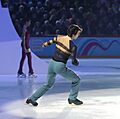
Stéphane Lambiel begins to take off by hitting the ice with his left toe pick
-
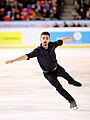
Kévin Aymoz landing
.jpg)
_212.jpg)

