
Tortoiseshell cat facts for kids
.jpg)
Tortoiseshell cats are famous for their unique and beautiful fur patterns. Their coats look like the shell of a tortoise, which is how they got their name! These cats, often called torties for short, have a mix of two main colors, usually black and red, or their lighter versions like blue and cream. These colors are spread out in an uneven way, either mixed together closely (called 'brindled') or in bigger patches.
Sometimes, tortoiseshell cats also have a tabby pattern mixed in with their main colors. When this happens, they are called tortoiseshell tabby cats or torbies. You can find tortoiseshell patterns in many different cat breeds and also in mixed-breed cats. The Japanese Bobtail breed, for example, really loves this pattern.
One of the most interesting facts about tortoiseshell cats is that almost all of them are female! It's very rare to find a male tortoiseshell cat. When male torties are born, they usually cannot have kittens of their own.
Contents
How Tortoiseshell Colors Appear
Cats get their fur colors from special tiny bits inside their bodies called pigments. For tortoiseshell cats, two main pigments are at play: one that makes orange colors (like red or cream) and another that makes black colors (like black, blue, or chocolate). Tortoiseshell cats have both of these pigments showing up in their fur at the same time.
The gene that controls the orange color is found on the X chromosome. This is a very important detail for understanding why most torties are female! There are two versions of this gene: one for orange (let's call it 'O') and one for non-orange (let's call it 'o').

Sometimes, another gene can make these colors lighter, or "dilute" them. For example, red can become cream, and black can become blue. This means you might see a "blue tortoiseshell" cat, which has blue and cream patches, instead of the more common "black tortoiseshell" with black and red patches.
The most common tortoiseshell pattern is a mix of black and red. But you can also find chocolate and red, or even lighter versions like blue and cream. People sometimes use different names for these colors, like "ginger" for red or "grey" for blue.
Why Most Tortoiseshell Cats Are Female
This is where the X chromosome becomes super important! Female cats have two X chromosomes (XX), while male cats have one X and one Y chromosome (XY).
In female cats, during their very early development, one of the two X chromosomes in each cell randomly "turns off." This process is called X-inactivation. Since the gene for orange color is on the X chromosome, this means that some cells will express the orange color, and other cells will express the non-orange (black) color. This mix of active X chromosomes in different cells is what creates the beautiful, patchy tortoiseshell pattern.

Because male cats only have one X chromosome, they can only show one color from this gene – either orange or non-orange (black). They don't have a second X chromosome to "turn off" to create a mix of colors. This is why male cats are usually solid orange or solid black, not tortoiseshell.

Rare Male Tortoiseshells
It's extremely rare to find a male tortoiseshell cat, happening in about 1 out of every 3,000 births. When a male tortie is born, it usually has an extra X chromosome (XXY). This is a special genetic condition. Because they have two X chromosomes, their cells can also go through the X-inactivation process, allowing them to have both orange and black patches.
However, male cats with this XXY condition are almost always unable to have kittens. Sometimes, a male tortoiseshell cat might also be a chimera. This means they started as two separate embryos that joined together very early on, each with different color genes. These cats are also very special!
Different Kinds of Tortoiseshell Cats
Tortoiseshell cats come in many beautiful varieties. Their patches can be small and mixed, like a 'brindled' pattern, or large and distinct. The colors are usually spread out unevenly, making each tortie unique!
Tortoiseshell-and-White (Calico)
Some tortoiseshell cats also have white patches. These are called tortoiseshell-and-white cats, or calico cats in North America. The white patches come from a different gene that stops pigment from reaching certain areas of the fur. The more white a cat has, the more separate and clear its colored patches will be.
.jpg)
_(cropped).jpg)
.jpg)
Other Patterns with Tortoiseshell
Tortoiseshell patterns can also combine with other cat coat patterns. For example, if a tortie has tabby stripes, it's called a tortie-tabby or torbie. If a calico cat also has tabby stripes, it's sometimes called a caliby. You can even find "tortie point" cats, which have the tortoiseshell colors only on their ears, face, paws, and tail, like a Siamese cat.
Tortoiseshell Cat Folklore
In many cultures around the world, tortoiseshell cats are thought to bring good luck!
- In Ireland, people believe torties bring good fortune to their homes.
- In the United States, they are sometimes called "money cats."
- In Japan, tortoiseshell cats are said to protect ships from shipwrecks.
There are also some older beliefs, like in England, where a strange tortie entering a house might mean something unexpected is about to happen.
Tortoiseshell Cat Behavior
Some people believe that tortoiseshell cats have a special personality, sometimes called "tortitude." This idea suggests they might be more feisty or have a stronger hunting instinct. However, there isn't much scientific proof to back this up. Most studies show that a cat's fur color doesn't really tell us about its personality. Just like people, every cat is an individual!
Gallery
-
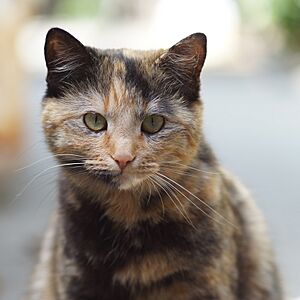
Black tortoiseshell ("tortie")
-
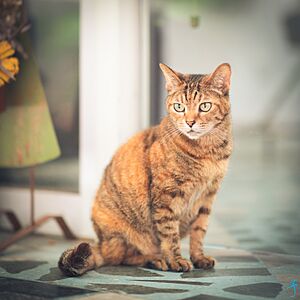
Black tortoiseshell tabby ("torbie/y")
-
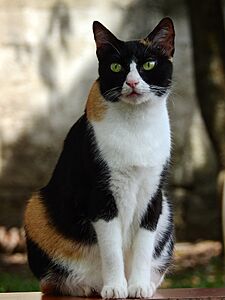
Black tortoiseshell-and-white tricolour ("calico")
-
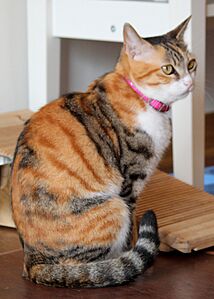
Black tortoiseshell tabby-and-white tricolour ("caliby")
-
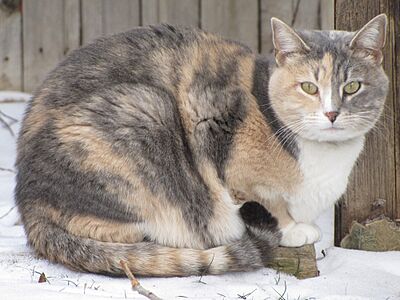
Blue tortoiseshell tabby and white
-
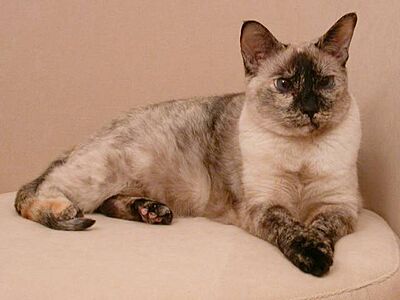
Black colourpoint tortoiseshell ("tortie point")
-
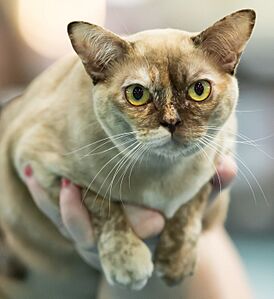
Chocolate tortoiseshell sepia Burmese
-
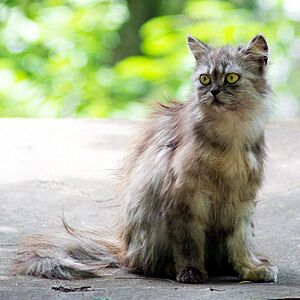
Black smoke tortoiseshell domestic longhair
-
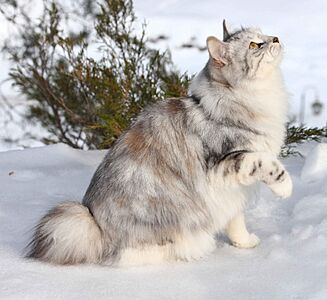
Black tortoiseshell silver blotched tabby Kurilian Bobtail Longhair
-
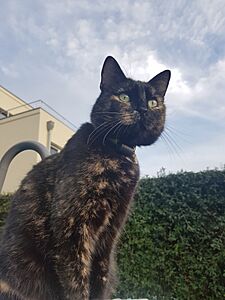
A female tortoiseshell cat with high black fur content
.JPG)
.jpg)
.jpg)
.jpg)
.jpg)

_BUR_h_female_EX1_CAPS_NOM.JPG)
.jpg)
.jpg)

See also
- Calico cat
- Deaf white cat
- Tabby cat
