
Trojan Horse facts for kids

In Greek mythology, the Trojan Horse was a giant wooden horse. The Greeks used it as a clever trick during the Trojan War. It allowed them to enter the city of Troy and finally win the war.
The story is famous, but it is not fully told in Homer's Iliad. That poem ends before the war is over. The horse is mentioned briefly in the Odyssey. The most complete story comes from the Aeneid by the Roman poet Virgil.
According to the legend, the Greeks and Trojans had been fighting for ten years. The Greeks could not break through the strong walls of Troy. Odysseus, a clever Greek leader, came up with a plan. They built a huge wooden horse and hid their best soldiers inside. The rest of the Greek army pretended to sail away, leaving the horse behind as a "gift."
The Trojans thought they had won. They pulled the heavy horse into their city as a trophy. That night, while the Trojans were sleeping, the Greek soldiers climbed out of the horse. They opened the city gates for the rest of the army, who had returned in the dark. The Greeks entered the city and ended the war.
Today, people use the phrase "Trojan horse" to describe a trick that causes someone to invite an enemy into a safe place. In computers, a "Trojan horse" is a type of harmful program that tricks users into running it.
Contents
The Legend of the Trojan Horse
Building the Trap
The war between the Greeks and the Trojans had lasted for a very long time. The Greeks could not get past the high walls of Troy. They needed a new plan. Odysseus had the idea to build a massive wooden horse. A master builder named Epeius constructed it.
Thirty of the best Greek warriors hid inside the hollow belly of the horse. Two spies hid in its mouth. The rest of the Greek army burned their camp and sailed their ships to a nearby island called Tenedos. They wanted the Trojans to believe they had given up and gone home.
The Surprise Attack

The Trojans saw the Greeks were gone and found the giant horse standing outside their gates. A Greek spy named Sinon had stayed behind. He told the Trojans a lie. He said the horse was a gift to the goddess Athena to ensure the Greeks had a safe trip home. He claimed it was built so big so the Trojans could not take it inside their city.
Some Trojans were suspicious. A priest named Laocoön warned them. He famously said, "I fear Greeks, even those bearing gifts." However, sea serpents appeared and attacked Laocoön. The Trojans thought this was a sign from the gods that Laocoön was wrong. King Priam's daughter, Cassandra, also predicted that the horse would destroy the city, but no one believed her.
Believing the lie, the Trojans pulled the horse into the city and celebrated their "victory." Late that night, Sinon signaled the Greek fleet to return. The soldiers inside the horse climbed out quietly. They killed the guards and opened the gates. The Greek army rushed in and captured Troy.
Who Was Inside the Horse?
Different ancient stories give different numbers of men inside the horse. Some say 30, others say 50. Later stories said there were 40 soldiers. Here are some of the famous heroes said to be inside:
| Name | Role |
|---|---|
| Odysseus | Leader of the group |
| Acamas | Warrior |
| Ajax the Lesser | Warrior |
| Diomedes | Famous hero |
| Epeius | Builder of the horse |
| Menelaus | King of Sparta |
| Neoptolemus | Son of Achilles |
| Teucer | Archer |
| Thrasymedes | Warrior |
Where the Story Comes From

The story of the Trojan Horse appears in several ancient works of literature.
The Odyssey and the Aeneid
The oldest mention is in Homer's Odyssey, written around the 8th century BC. It briefly talks about how Odysseus led the men into the citadel inside the "carven horse." It mentions that Helen walked around the horse calling out the names of the Greek wives to trick the men inside into answering. Odysseus stopped them from making noise.
The most detailed story is in the Aeneid, written by the Roman poet Virgil around 19 BC. Virgil describes the construction of the horse, the trickery of Sinon, and the tragic fall of Troy.
Was the Trojan Horse Real?

Historians and archaeologists have different theories about whether the Trojan Horse really existed.
Siege Engines
Some experts think the "horse" was actually a siege engine. In ancient times, armies used machines to break down walls. These machines were sometimes covered with wet horse hides to protect them from fire arrows. The story might have turned a military machine into a myth about a wooden horse.
Pausanias, a writer from the 2nd century AD, wrote that anyone with common sense would know the horse was actually a machine used to break the walls.
Ships
Another theory suggests the "horse" was a ship. Ancient Greek terms for putting men in a horse are similar to terms for boarding a ship. Also, some ships from that time were decorated with horse heads and were called "sea-horses." The Greeks might have hidden inside a boat to enter the city.
Earthquakes
A different idea is that the "Trojan Horse" is a metaphor for an earthquake. In mythology, Poseidon was the god of the sea, horses, and earthquakes. Archaeological digs show that the city of Troy VI was damaged by a large earthquake. The story might mean that an earthquake (represented by the "horse" of Poseidon) weakened the walls, allowing the Greeks to enter.
Ancient Art
Artists in ancient Greece made pictures of the Trojan Horse long ago. These pictures help us understand how people imagined the story.
- The oldest picture is on a bronze pin (fibula) from about 700 BC.
- The Mykonos vase (from about 675 BC) shows the horse with wheels and warriors peeking out.
- Other vases and carvings from Italy and Greece also show the scene.
-
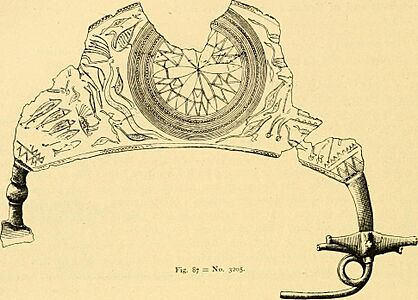
The oldest known picture of the Trojan Horse on a bronze pin (about 700 BC). Note the wheels.
-
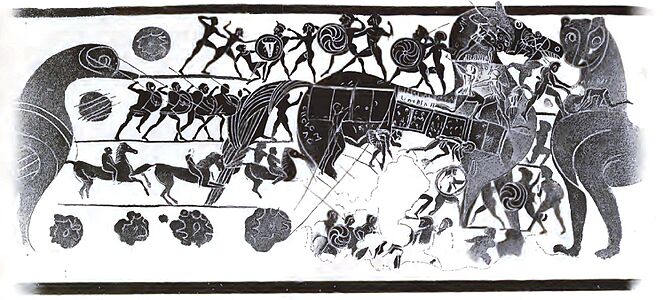
A painting of the Trojan Horse on a small jar (about 560 BC) found in Italy.
-
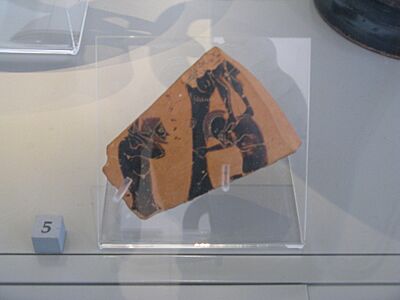
Warriors climbing out of the Trojan Horse. This is from a pottery fragment found in Italy (about 540 BC).
_(14780940341).jpg)


Modern Meanings
Today, the term "Trojan horse" is used in different ways:
- Metaphor: It describes a strategy where someone tricks an opponent into inviting them into a protected area.
- Computing: A "Trojan" is a type of computer virus. It looks like a safe or useful program (like a game), but when a user opens it, it causes damage to the computer or steals information.
See also
 In Spanish: Caballo de Troya para niños
