
Turner Prize facts for kids
_(2).jpg)
The Turner Prize is a famous annual award presented to a British visual artist. It is named after the English painter J. M. W. Turner. The prize was established in 1984 and has become the most discussed art award in the United Kingdom.
The winner of the prize receives £25,000, and the other shortlisted artists receive £5,000 each. The award ceremony is usually held at Tate Britain in London, although in some years it travels to other cities like Liverpool, Gateshead, or Margate.
The Turner Prize is known for sparking debates about the question: "Is this art?" Many of the artworks nominated are examples of conceptual art, where the idea behind the work is considered more important than the object itself.
Contents
What is the Turner Prize?
The prize is named after J. M. W. Turner (1775–1851). Today, Turner is considered one of Britain's greatest painters, but during his lifetime, his work was often seen as controversial and different. He changed the way people looked at landscape painting. The Turner Prize aims to do the same thing by celebrating artists who find new and exciting ways to create art.
Between 1991 and 2016, only artists under the age of 50 could win. This rule was removed in 2017 to allow artists of any age to be recognised.
How the Winner is Chosen
Every year, a jury of four judges selects a shortlist of four artists. These artists are chosen based on an exhibition of their work from the previous year.
- May: The four nominees are announced.
- October: An exhibition of the nominees' work opens at Tate Britain (or another host gallery).
- December: The winner is announced at a televised ceremony.
History and Famous Winners
Over the years, the Turner Prize has rewarded many different types of art, including painting, sculpture, video, and installation.
The Early Years and Shocking Art
In the 1990s, the prize became very famous because of the Young British Artists (YBAs). These artists often created work that shocked the public and the media.
- 1991: Anish Kapoor won the prize. He is known for his large sculptures made of pigment and stone.
- 1993: Rachel Whiteread won for House. She made a concrete cast of the inside of a real Victorian house in East London. It was the first time a woman won the prize.
- 1995: Damien Hirst won the award. His exhibit included a sculpture called Mother and Child, Divided, which consisted of a cow and a calf preserved in tanks of formaldehyde.
- 1998: Chris Ofili was the first painter to win in twelve years. His paintings were famous for using unusual materials, including balls of elephant dung.
- 1999: Steve McQueen won the prize for his video art. In the same year, nominee Tracey Emin attracted a lot of attention for her work My Bed. It was an installation of her own unmade bed, surrounded by everyday messy objects, representing a difficult time in her life.
Art in the 21st Century


As the prize moved into the 2000s, it continued to surprise the public.
- 2000: Wolfgang Tillmans became the first photographer to win the Turner Prize.
- 2001: Martin Creed won for a work called Work No. 227: The lights going on and off. It was an empty room where the lights turned on and off every five seconds.
- 2003: Grayson Perry won the prize. He is a potter who makes ceramic vases decorated with complex images. He is also known for his public appearances as his alter-ego, Claire.
- 2015: A group called Assemble won the prize. They are a collective of architects and designers who worked with a community in Liverpool to fix up houses and create a local workshop. It was the first time a group won, rather than a single artist.
Recent Winners (2019–2025)
- 2019: In a surprise twist, the four nominated artists—Lawrence Abu Hamdan, Helen Cammock, Oscar Murillo, and Tai Shani—asked the judges to treat them as a collective group. The judges agreed, and all four were named the winners together.
- 2020: Due to the global pandemic, the prize was replaced by bursaries (money grants) given to 10 different artists to support them during a difficult time.
- 2021: The prize was won by Array Collective, a group of artists from Belfast who work on social issues.
- 2022: Veronica Ryan won for her sculptures that explore themes of nature and memory.
- 2023: Jesse Darling won the award for sculptures made from everyday materials that looked fragile or broken.
- 2024: Jasleen Kaur was announced as the winner on 3 December 2024. She won for her animations and sculptures involving everyday objects like a Ford Escort car.
- 2025: On 9 December 2025, Nnena Kalu was named the winner.
Why is it Controversial?
.jpg)
The Turner Prize often divides opinion. Some people love it because it makes art exciting and gets people talking. Others dislike it because they believe the art is too strange or requires too much explanation.
- The Stuckists: A group of artists called the Stuckists have often protested against the prize. They believe art should be about painting and making pictures, rather than conceptual ideas. They have dressed as clowns to demonstrate outside the Tate.
- "Is it Art?": When Martin Creed won for the lights going on and off, or when Tracey Emin showed her messy bed, many newspapers asked if these things should really be considered art.
- Politics: Sometimes the prize is controversial because of politics. In 2024, there were protests outside the award ceremony regarding global conflicts and the funding of art galleries.
Despite the arguments, the Turner Prize remains a major event in British culture. It has helped many artists become famous and has encouraged thousands of people to visit art galleries.
Images for kids
-
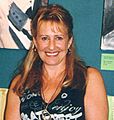
Jacqueline Crofton threw eggs in protest at winner Martin Creed's entry in 2001.

See also
 In Spanish: Premio Turner para niños
- List of Turner Prize winners and nominees
- Contemporary art
- Tate Britain
