
Waterspout facts for kids
.jpg)
A waterspout is a spinning column of air that forms over water. It usually looks like a funnel-shaped cloud reaching down to the water. Waterspouts are connected to a cloud above them. There are two main kinds of waterspouts, and they form in different ways.
The most common type is a "fair weather" waterspout. These are usually weaker. The other, less common type is a "tornadic" waterspout. This is actually a tornado that forms over water instead of land. Most waterspouts do not "suck up" water. Instead, they create a spray of water at their base.
Waterspouts mostly form in warm, tropical, and subtropical places. However, they can also appear in other parts of the world. These include Europe, Australia, New Zealand, and even the Great Lakes in North America. Sometimes, they are seen with lake-effect snow storms.
Contents
What is a Waterspout?
A waterspout is a swirling column of air. It stretches from the surface of a body of water up to a cloud. These amazing weather events are like nature's spinning tops over the sea or lakes. They are a type of vortex, which is a swirling mass of fluid or air.
Where Do Waterspouts Appear?
Waterspouts are most common in warm, tropical areas. But they can show up in many places around the world.
Waterspouts Around the World
You can find waterspouts in temperate regions too, especially during certain seasons. They are often seen along the western coast of Europe. They also appear near the British Isles and in parts of the Mediterranean and Baltic Seas. Waterspouts are not just found in saltwater. Many have been reported on large lakes and rivers. This includes the Great Lakes and the St. Lawrence River in North America.
The Great Lakes often see waterspouts in late summer and early fall. For example, in 2003, more than 66 waterspouts were reported in just one week! Waterspouts are more common closer to the coast than far out at sea. About 160 waterspouts are reported each year in Europe. The Netherlands sees the most, with about 60 annually. Spain and Italy each report around 25, and the United Kingdom sees about 15. They are most frequent in late summer. In the Northern Hemisphere, September is often the busiest month for waterspout formation. Many waterspouts are also seen off the east coast of Australia.
-
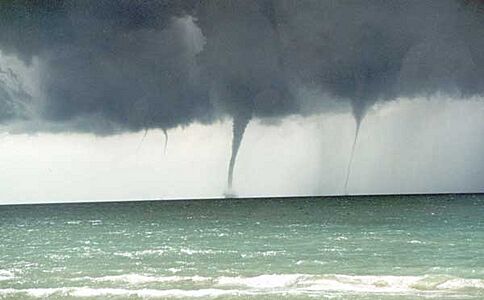
A family of four waterspouts seen on Lake Huron, 9 September 1999
-
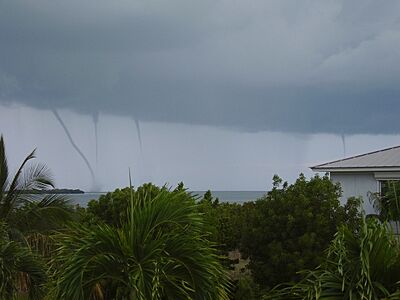
Four waterspouts seen in the Florida Keys, 5 June 2009
-
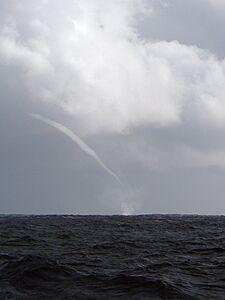
Waterspout in the Tasman Sea, 29 January 2009
-
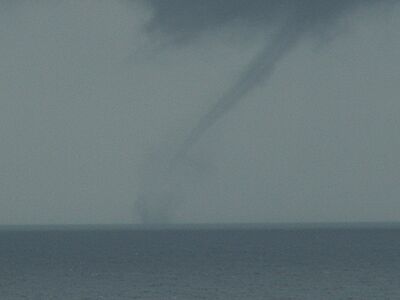
Waterspout in Adelaide, South Australia, June 20, 2014.


.jpg)
How Do Waterspouts Form?
Waterspouts are small weather events, usually less than two kilometers wide. The clouds they come from can be simple cumulus clouds or powerful supercell thunderstorms.
The Science Behind the Spin
Most waterspouts are not as strong as tornadoes. They form in moist air as their parent clouds are growing. Scientists believe they start spinning from horizontal wind changes near the water's surface. Then, this spin stretches upwards into the developing cloud. Some weaker tornadoes, called landspouts, form in a similar way over land.
Multiple Waterspouts at Once
Sometimes, more than one waterspout can appear in the same area at the same time. In 2012, nine waterspouts were reported on Lake Michigan in the United States. In May 2021, at least five waterspouts were filmed near Taree, off the coast of New South Wales, Australia.
Different Kinds of Waterspouts
There are two main types of waterspouts: non-tornadic (fair-weather) and tornadic.
Fair-Weather Waterspouts

These are the most common type of waterspout. They are also called "non-tornadic" or "fair-weather" waterspouts. They form in coastal waters from dark, flat-bottomed cumulus clouds that are still developing. Fair-weather waterspouts form and disappear quickly, usually lasting less than 20 minutes. They are generally weak, with winds less than 30 meters per second (67 miles per hour).
These waterspouts are seen most often in tropical and subtropical areas. Over 400 are observed each year in the Florida Keys. They usually move slowly, if at all. This is because the cloud they are attached to is not moving much horizontally. If a fair-weather waterspout moves onto land, it acts much like a landspout.
A fair-weather waterspout goes through five stages:
- First, a light-colored circle appears on the water, surrounded by a darker area.
- Next, spiral bands of light and dark colors develop from the dark spot on the water.
- Then, a dense ring of sea spray, called a "cascade," forms around the dark spot. It looks like an "eye" in the middle.
- After that, the waterspout becomes a visible funnel from the water to the cloud above. The spray can rise hundreds of feet.
- Finally, the funnel and spray begin to fade as the warm air feeding the vortex weakens.
Tornadic Waterspouts

"Tornadic waterspouts" are also known as "tornadoes over water." They form from mesocyclones, which are rotating updrafts in severe thunderstorms. This is the same way tornadoes form over land. A tornado that moves from land over a body of water also becomes a tornadic waterspout. These are rarer in places like the United States, where most severe thunderstorms happen over land. However, in some areas, such as the Adriatic and Aegean Seas, tornadic waterspouts can make up half of all waterspouts seen.
Snowspouts: Waterspouts in Winter
A winter waterspout, sometimes called an icespout or snowspout, is a very rare event. It forms under a snow squall cloud. For a winter waterspout to form, two things are needed. First, very cold temperatures must be present over a body of water. Second, the water itself must be warm enough to create fog, like steam, above its surface. Strong winds blowing along long lakes can help these rare waterspouts develop.
It's important to know that "snow devil" and "snownado" are different. These terms describe a snow vortex close to the ground without a cloud above it, similar to a dust devil.
What Are the Effects of Waterspouts?
Waterspouts can have various impacts, especially on human activities and the natural environment.
Staying Safe from Waterspouts

Waterspouts have long been known to be dangerous for boats. Stronger waterspouts can threaten boats, aircraft, and people. It's always best to stay far away from these phenomena. Keeping up with weather reports is also very important. The United States National Weather Service often issues special marine warnings when waterspouts are expected or seen over coastal waters. They issue tornado warnings if a waterspout is expected to move onto land.
Waterspouts causing severe damage and harm are rare. However, there have been some serious incidents. The Malta tornado of 1551 was one of the earliest recorded deadly waterspouts. It struck the Grand Harbour of Valletta, sinking several large ships and many smaller boats. The 1851 Sicily tornadoes were two waterspouts that moved onto land in western Sicily. They caused a lot of damage to the coast and countryside before moving back over the sea. In August 2024, a waterspout was reported by witnesses during the sinking of the large yacht Bayesian off the coast of Sicily. This might have caused or worsened the incident. It was a serious event where many people needed rescue, and sadly, some lives were lost.
Waterspouts and Animals
Depending on how fast the winds are spinning, a waterspout can lift things from the water's surface. This includes fish of different sizes, frogs, and even small turtles. A waterspout can sometimes carry small animals like fish high into the air, all the way up into the cloud. Even if the waterspout stops spinning, the fish can be carried over land by the cloud's winds. They might be tossed around until the cloud's currents can no longer keep them airborne.
Sometimes, these fish fall back to Earth, a phenomenon known as "raining fish." People as far as 100 miles (160 kilometers) inland have reported experiencing raining fish. Fish can also be lifted from rivers. However, raining fish is not a common weather event.
Studying and Predicting Waterspouts

Scientists and meteorologists work to understand and predict waterspouts.
The Szilagyi Waterspout Index
The Szilagyi Waterspout Index (SWI) helps predict when conditions are right for waterspouts to form. This index was created by Canadian meteorologist Wade Szilagyi. The SWI ranges from -10 to +10. Values of zero or higher mean that conditions are good for waterspout development.
The International Centre for Waterspout Research
The International Centre for Waterspout Research (ICWR) is a group of people from around the world. They are interested in waterspouts from a research, operational, and safety point of view. It started as a place for researchers and meteorologists. Now, it also includes storm chasers, media, and people from the marine and aviation communities.
Old Stories and Myths About Waterspouts

For a long time, sailors in the 1700s and 1800s believed something interesting. They thought that firing a cannon at a waterspout would make it disappear. Captain Vladimir Bronevskiy, for example, claimed this technique worked. He said he saw a waterspout break apart in the Adriatic Sea in 1806 after a cannon was fired.
A waterspout has also been suggested as a possible reason why the ship Mary Celeste was found abandoned.
See Also
 In Spanish: Manga de agua para niños
