
Winkelmann's mouse facts for kids
Quick facts for kids Winkelmann's mouse |
|
|---|---|
| Conservation status | |
Scientific classification  |
|
| Kingdom: | Animalia |
| Phylum: | Chordata |
| Class: | Mammalia |
| Order: | Rodentia |
| Family: | Cricetidae |
| Subfamily: | Neotominae |
| Genus: | Peromyscus |
| Species: |
P. winkelmanni
|
| Binomial name | |
| Peromyscus winkelmanni Carleton, 1977
|
|
| Script error: The function "autoWithCaption" does not exist. | |
Script error: No such module "Check for conflicting parameters".
The Winkelmann's mouse (Peromyscus winkelmanni) is a type of rodent that lives only in Mexico. It was named after John R. Winkelmann, who was the first person to collect these mice.
Description
The Winkelmann's mouse is a bit larger than a common house mouse. An adult mouse measures about 24 to 27 cm (9.4 to 10.6 in) from its nose to the tip of its tail. About half of this length is just its tail! It weighs around 54 g (1.9 oz), which is about the same as a small apple.
Its fur is a mix of brownish-yellow and black over most of its body. The fur gets darker on its back, sometimes forming a clear black stripe down the middle. On its sides and cheeks, the fur fades to a bright tan or cinnamon color. The fur on its belly is a pale gray. The tail has only a thin covering of hair and is usually darker on the top than on the bottom.
Compared to other mice that are related, the Winkelmann's mouse has ears that are quite small and dark. Its skull is also a little bit larger.
Where it Lives and Its Home
The Winkelmann's mouse is found only in a small area of southern Michoacán in Mexico. It lives in isolated spots on the western slopes of the Sierra Madre Occidental mountains.
These mice make their homes in patches of tall oak and pine trees. These areas have lots of plants growing close to the ground. They also have many epiphytes, which are plants that grow on other plants, like mosses, orchids, and bromeliads.
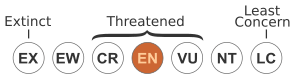
There are no different types (subspecies) of Winkelmann's mouse. Because it lives in such a small area, and because many of the forests it depends on are being cut down, it is considered an endangered species. This means it is at risk of disappearing forever. The IUCN (International Union for Conservation of Nature) officially lists it as endangered.
