
Woolwich Power Station facts for kids
Quick facts for kids Woolwich Power Station |
|
|---|---|

Woolwich Power Station from the ferry in 1973
|
|
| Country | England |
| Location | Greenwich, London |
| Coordinates | 51°29′40″N 0°03′57″E / 51.494400°N 0.065700°E |
| Status | Decommissioned and demolished |
| Construction began | 1891 |
| Commission date | 1893 |
| Decommission date | 1978 |
| Owner(s) | As operator |
| Operator(s) | Woolwich District Electric Lighting Company (1893–1903) Woolwich Borough Council (1903–1948) British Electricity Authority (1948–1955) Central Electricity Authority (1955–1957) Central Electricity Generating Board (1958–1978) |
| grid reference TQ434792 | |
The Woolwich Power Station was a large building in Woolwich, London, located right by the River Thames. It used to burn coal to create electricity for homes and businesses.
Contents
History of the Power Station
The power station first opened in 1893. A company called the Woolwich District Electric Lighting Company started it, using old boat repair shops. Later, the local council, the Metropolitan Borough of Woolwich, took over running it.
During construction work in 1912, something amazing was found. Workers uncovered old wooden parts of a Tudor warship! People believe it was the Sovereign, a ship built for King Henry VII in 1488.
The power station was updated several times, in the 1920s, 1940s, and 1950s. It eventually had three tall brick chimneys on its east side. The entire site covered just over seven and a half acres, which is about the size of five football fields.
By 1906, the station was making both alternating current (AC) and direct current (DC) electricity. It used a 2.5 megawatt (MW) machine for this. More machines were added between 1912 and 1917, with power from 1.5 MW to 6 MW.
The power station needed a lot of coal to work. This coal usually came by ship from areas like Yorkshire and Northumberland. Cranes would unload the coal onto a special conveyor belt. When it was busiest, the station burned over 1,000 tons of coal every day!
How Power Was Made
The power station was rebuilt and expanded in different stages.
- Low-Pressure Section (1924–1928): This part had four large boilers and one 12.5 MW generator. A generator is a machine that turns mechanical energy into electrical energy.
- Intermediate-Pressure Section (1940–1948): This section added six more boilers and three 34.5 MW generators.
- High-Pressure Section (1952–1957): The final part included four more boilers and two 30 MW generators.
All these generators were made by Fraser & Chalmers/GEC. They used steam to spin turbines, which then made electricity. The steam was created by heating water in the boilers using coal. The different sections used steam at different pressures and temperatures, like this:
| Pressure | Temperature | |
|---|---|---|
| Low pressure | 13 bar | 316 °C |
| Intermediate pressure | 27.6 bar | 427 °C |
| High pressure | 41.4 bar | 454 °C |
The station's total ability to make steam was very high, especially from 1966 to 1974.
Electricity Output
The Woolwich Power Station produced a lot of electricity over the years. The graph below shows how much electricity (in GWh, which stands for Gigawatt-hours) it generated each year. You can see that the amount of electricity produced changed over time.
Woolwich power station annual electricity output GWh.<graph>{ "version": 2, "width": 700, "height": 250, "data": [ { "name": "table", "values": [ { "x": 1966, "y": 255 }, { "x": 1967, "y": 173 }, { "x": 1968, "y": 168 }, { "x": 1969, "y": 179 }, { "x": 1970, "y": 198 }, { "x": 1971, "y": 166 }, { "x": 1972, "y": 141 }, { "x": 1973, "y": 47 }, { "x": 1974, "y": 41 }, { "x": 1975, "y": 28 }, { "x": 1976, "y": 1 }, { "x": 1977, "y": 3 }, { "x": 1978, "y": 3 }, { "x": 1954, "y": 351 }, { "x": 1955, "y": 395 }, { "x": 1956, "y": 344 }, { "x": 1957, "y": 389 }, { "x": 1958, "y": 349 }, { "x": 1961, "y": 249 }, { "x": 1962, "y": 206 }, { "x": 1963, "y": 287 }, { "x": 1946, "y": 227 } ] } ], "scales": [ { "name": "x", "type": "ordinal", "range": "width", "zero": false, "domain": { "data": "table", "field": "x" } }, { "name": "y", "type": "linear", "range": "height", "nice": true, "domain": { "data": "table", "field": "y" } } ], "axes": [ { "type": "x", "scale": "x" }, { "type": "y", "scale": "y" } ], "marks": [ { "type": "rect", "from": { "data": "table" }, "properties": { "enter": { "x": { "scale": "x", "field": "x" }, "y": { "scale": "y", "field": "y" }, "y2": { "scale": "y", "value": 0 }, "fill": { "value": "steelblue" }, "width": { "scale": "x", "band": "true", "offset": -1 } } } } ] }</graph>
Over time, some of the older generators were taken out of service. One 30 MW machine was stopped in 1971. The three 34.5 MW machines were stopped in 1973. The very last 30 MW generator was stopped in 1978.
Closure of the Station
The Woolwich Power Station officially closed on October 30, 1978. At that time, it could still produce 57 megawatts of power.
After it closed, the tall chimneys were taken down. One was taken apart by hand in 1978. The other two were carefully blown up using explosives in 1979.
The area where the main power station building stood became a car park for the Waterfront Leisure Centre. Part of the old coal jetty (a pier for unloading coal) is still there. Around 2020, the car park area was sold for a new housing development called Royal Arsenal. Eventually, the entire leisure centre will move to a new location.
Images for kids
-
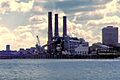
Woolwich Power Station from the ferry in 1973
See also
- Old Woolwich
- Woolwich Ferry
- Greenwich Power Station
