
Yellow-browed bulbul facts for kids
Quick facts for kids Yellow-browed bulbul |
|
|---|---|
 |
|
| Conservation status | |
Scientific classification  |
|
| Kingdom: | Animalia |
| Phylum: | Chordata |
| Class: | Aves |
| Order: | Passeriformes |
| Family: | Pycnonotidae |
| Genus: | Acritillas Oberholser, 1905 |
| Species: |
A. indica
|
| Binomial name | |
| Acritillas indica (Jerdon, 1839)
|
|
 |
|
| Script error: The function "autoWithCaption" does not exist. | |
| Synonyms | |
|
|

Script error: No such module "Check for conflicting parameters".
The yellow-browed bulbul (Acritillas indica) is a small, cheerful songbird from the bulbul family. It's also sometimes called the golden-browed bulbul. You can find this bird living in the forests of southern India and Sri Lanka.
This bulbul is easy to spot because of its bright yellow belly and olive-green back. It also has a clear yellow stripe above its eye, like a yellow eyebrow! Even though they make loud calls, these birds often hide among the leaves in the lower parts of the forest. Scientists have changed how they classify this bird over time, but right now, it's the only species in its group, called Acritillas.
Contents
About the Yellow-browed Bulbul
Scientists like to group living things to understand them better. This is called taxonomy. The yellow-browed bulbul has had a few different names and groups over the years.
When it was first discovered in 1839 by T. C. Jerdon, it was placed in a group called Trichophorus. Later, some scientists thought it belonged to the group Iole. However, more recent studies, especially one in 2018, looked at the bird's DNA. These studies showed that the yellow-browed bulbul is quite special and should have its own unique group, Acritillas. They also found that its closest living relative is another bird called Hemixos flavala.
Different Types of Yellow-browed Bulbuls
Even within the same species, there can be slight differences depending on where the birds live. These slightly different groups are called subspecies. There are three recognized subspecies of the yellow-browed bulbul:
- A. i. icterica: This type is found in the northern part of the Western Ghats in India. Its yellow feathers are a bit duller, and its upper parts are more grayish-green.
- A. i. indica: This is the most common type, found in the Western Ghats and Nilgiris in India, and also in northern and eastern Sri Lanka. Its yellow color is brighter than A. i. icterica.
- A. i. guglielmi: This subspecies lives in southwestern Sri Lanka. It has greener feathers, and its belly has a green tint, unlike the bronze tint seen in A. i. indica.
What Does It Look Like?
The yellow-browed bulbul is about 20 cm (7.9 in) long, which is about the length of a regular pencil. It doesn't have a crest (a tuft of feathers on its head). Its back is olive-green, and its entire underside is bright yellow. The most striking feature is the bright yellow stripe above its eye, which looks like a yellow eyebrow or "goggle."
Both male and female yellow-browed bulbuls look the same. Their beak is black, and their eyes are a reddish-brown color. The birds in the northern Western Ghats are a paler yellow. The ones in southwestern Sri Lanka are greener.

These birds are also known for their calls. They make a sound like a whistle and sharp "pick-wick" notes.
Where Do They Live?
The yellow-browed bulbul prefers wet, hilly forests and plantations. You can find them mainly in the Western Ghats mountain range in India and throughout Sri Lanka. They also live in some parts of the Eastern Ghats in India, like the Kolli hills and Nallamalas. They usually stay hidden below the main tree canopy, among the leaves.
Life Cycle and Habits
Yellow-browed bulbuls are often seen in pairs or small groups. They are quite noisy and call loudly to each other. Their diet includes both berries and insects.
They usually start their families during the dry season, just before the monsoon rains, which is typically from January to May. The female bulbul builds a cup-shaped nest in a low tree fork. She covers the outside with moss and cobwebs, making it look like a larger version of a white-eye bird's nest. The inside is lined with soft root fibers.
In India, they usually lay three eggs, while in Sri Lanka, they typically lay two. A study in Silent Valley National Park in India found that most nests had two eggs. The eggs are pale pink or white with small reddish-brown spots.
It takes about a week to build the nest. Once the eggs are laid, the parents sit on them for about 13 days to keep them warm until they hatch. All the eggs usually hatch at the same time. The baby birds, called nestlings, stay in the nest for about 13 days after hatching. During this time, their parents feed them caterpillars, soft insects, and berries to help them grow strong.
Images for kids
-
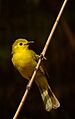
A Yellow-browed Bulbul in India.

