
Yosemite Valley facts for kids
Quick facts for kids Yosemite Valley |
|
|---|---|
| Ahwahnee Valley | |
| Floor elevation | 4,000 feet (1,200 m) |
| Length | 7.5 miles (12 km) |
| Width | 1 mile (1.6 km) |
| Geography | |
| River | Merced River |
Yosemite Valley is a famous glacial valley in Central California. It sits high in the Sierra Nevada mountain range. The valley is about 7.5 mi (12.1 km) long and more than 3,000 ft (910 m) deep. Huge cliffs of granite rock rise straight up from the ground. Two of the most famous rock towers are El Capitan and Half Dome. Forests of tall pine trees fill the valley floor, and the clear Merced River flows through the middle. Many rushing streams plunge into the canyon, making beautiful waterfalls like Yosemite Falls, which is the tallest waterfall in North America.
Every year, millions of travelers visit this natural wonderland in Yosemite National Park. Most families drive in from the west and stop to see the famous view at Tunnel View. From there, people hike on scenic hiking trail paths, sleep at Camp 4, or watch daring athletes try rock climbing. Long ago, Native American groups lived here in harmony with nature before the region became a protected public reserve. Today, Yosemite Valley is celebrated worldwide for its breathtaking wilderness and magnificent scenery.
Contents
What Does Yosemite Valley Look Like?

Yosemite Valley is located about 150 miles (240 km) east of the big coastal city of San Francisco. The valley floor sits about 4,000 feet (1,200 m) above sea level. Tall rock walls surround it on all sides. Even though the valley covers only one percent of the entire park, it is where most visitors spend their time.

When you enter the valley from the west, you quickly reach an opening called Tunnel View. Artists love this spot because you can see the giant stone cliff called El Capitan on the left side. On the right side, you can spot the Cathedral Rocks and the dancing spray of Bridalveil Fall.
As you travel deeper into the valley, you notice a pointed rock obelisk called Sentinel Rock. Across the way to the north stand the Three Brothers, three rocky peaks stacked neatly together like giant steps. The highest point of these three rocks is named Eagle Peak.
Further east, the valley floor opens into wide green meadows. Looking up to the northern wall, you can spot Yosemite Falls roaring down near the Royal Arches. High on the southern rim stands Glacier Point, which rises 3,254 feet (992 m) over the trees. At the eastern end of the canyon rests Half Dome, a giant smooth mountain shaped like a ball sliced in half. Beyond it towers Clouds Rest, the highest rock summit near the valley.
Waterfalls and Rivers

Winter snow high in the mountains melts during the warm spring weather. This melting water rushes into bubbling creeks, which speed toward the sheer stone edges of the valley. When the water leaps off these high cliffs, it creates roaring waterfalls that spray cool mists onto the trees below.
The main waterway is the Merced River. It starts high up and drops down a rocky section known as the Giant Staircase. The upper step is Nevada Fall, which drops 594 feet (181 m) onto rocky slopes. Right below it is Vernal Fall, which tumbles 317 feet (97 m) through bright rainbows. Other side streams like Illilouette Fall, Tenaya Creek, and Bridalveil Creek join the main river as it flows through the peaceful valley floor.

The valley features many world-famous waterfalls:
- Yosemite Falls: Drops 2,425 feet (739 m) in three giant sections, fed by Yosemite Creek.
- Snow Creek Falls: Plunges 2,140 feet (650 m) down steep rocky steps.
- Sentinel Fall: Tumbles down 1,920 feet (590 m) in multiple cascades.
- Ribbon Fall: A single, thin drop of 1,612 feet (491 m).
- Royal Arch Cascade: Slips 1,250 feet (380 m) down smooth granite walls.
- Lehamite Falls: Drops 1,180 feet (360 m) through a narrow canyon crack.
- Staircase Falls: Drops 1,020 feet (310 m) across wide rocky ledges.
- Bridalveil Fall: Leaps 620 feet (190 m), waving in the breeze like a veil.
- Nevada Fall: A powerful drop of 594 feet (181 m).
- Silver Strand Falls: Cascades 574 feet (175 m) near the valley entrance.
- Vernal Fall: A sheet of water falling 318 feet (97 m).
How the Valley Formed

The amazing landscape of Yosemite Valley is carved out of very tough granite. Millions of years ago, hot melted rock cooled deep underground into giant rock bodies called plutons. Over a very long time, natural forces pushed the Sierra Nevada mountains upward. Rain, wind, and river erosion slowly washed away the softer top layers, uncovering the hard granite underneath.
Water and ice carved the deep shape of the valley. Rushing rivers dug out deep canyons first. Then, during the great Ice age, giant rivers of ice called glaciers filled the whole valley. These moving ice sheets worked like giant bulldozers, scraping against the walls and smoothing the stone into a wide U-shaped canyon.

The ice carved sharp ridges called an arête, such as the narrow crest leading toward Clouds Rest. When the glaciers finally melted away, a natural barrier of dirt called a moraine trapped the water, creating Ancient Lake Yosemite. Over thousands of years, sand and mud settled at the bottom of the lake. Eventually, the lake dried up, leaving behind the flat, sandy floor where trees and plants grow today.
Plants and Wildlife

Yosemite Valley is home to many kinds of plants and animals. The floor of the valley is covered with mixed forests of ponderosa pine, sugar pine, and fragrant incense cedar trees. The shady branches provide shelter for many wild creatures. In sunny clearings, colorful wildflowers like lupines, buttercups, and bright shooting stars bloom from spring to late summer.
Many exciting animals explore the forest. A bold blue bird called the Steller's jay often flies through picnic areas looking for seeds. Visitors can also spot black bears, mule deer, chipmunks, and gray squirrels foraging along the trails. High up on rocky ledges, rare animals like the Sierra Nevada bighorn sheep and swift peregrine falcons find safe places to build nests and raise their young.
Fun Outdoor Activities

Yosemite Valley is an exciting place for outdoor adventures. Hiking is one of the most popular activities for visiting families. The famous Mist Trail leads hikers up stone stairs right next to splashing waterfalls. Another path, the Four Mile Trail, climbs high up the cliffs to give hikers a bird's-eye view from Glacier Point. Hikers who want a giant challenge can walk the John Muir Trail, which starts in the valley and travels all the way south to Mount Whitney.
The giant cliffs also attract athletes who love rock climbing. Climbers travel from around the world to test their skills on the vertical walls of El Capitan. Many climbers camp out together at Camp 4, sharing stories about their adventures on the rock. Hikers also love climbing to the top of Half Dome, where steel cables help them walk safely up the steep, curving granite peak.
The History of Yosemite

People have loved Yosemite Valley for thousands of years. The first people to live here were Native Americans. By the 1800s, a group of Miwok people lived in the canyon. They called the valley "Ah-wah-nee" and called themselves the Ahwahnechee, which means "dwellers in Ahwahnee."
The Ahwahnechee cared for the land carefully. They used controlled fires to clear thick brush and keep the valley open. This special care helped black oak trees grow healthy and strong. The people gathered acorn nuts from these oaks, which they ground up into meal for baking and cooking. They also hunted deer and traded with neighboring tribes like the Paiutes. Their respected leader during the mid-1800s was Chief Tenaya.

In 1849, the California Gold Rush brought thousands of new settlers to California. Troops known as the Mariposa Battalion entered the valley in 1851. An army doctor named Lafayette Bunnell was amazed by the towering cliffs and suggested naming the place "Yosemite." He believed the word came from a local Native American phrase meaning "those who kill," referring to the brave hunters of the valley.
Soon, artists like Thomas Ayres came to sketch the breathtaking landscape. His drawings were published in popular magazines across the country. Excited readers were amazed by pictures of giant trees and sky-high waterfalls. Travelers soon began riding horses into the wilderness to see the natural wonders with their own eyes.
Saving the Wilderness

As more people arrived, nature lovers realized that Yosemite needed special protection. Important leaders like writer John Muir and nature guide Galen Clark worked hard to protect the forest from damage.

On June 30, 1864, President Abraham Lincoln signed an important law called the Yosemite Grant. This law set aside Yosemite Valley and the nearby grove of giant sequoia trees for public recreation and protection forever. It was the first time any government in the world saved wild land just so people could enjoy its natural beauty. This important step later inspired the creation of Yellowstone National Park and America's entire system of national parks.
In 1916, the United States government created the National Park Service to care for these special places. Historic lodges, like the grand Ahwahnee Hotel and rustic cabins at Curry Village, were built so travelers could stay comfortably near the wilderness. Park managers also protected the Merced River under the Wild and Scenic River act to keep its waters clean and sparkling. Today, park rangers continue working every day to protect Yosemite Valley so that future generations can explore its wonders.
Images for kids
-
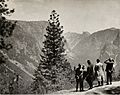
Visitors looking at Bridalveil Fall from Inspiration Point in 1921
-
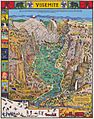
A colorful illustrated map of the valley from 1931
-
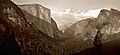
Black and white photograph showing the grand view of Yosemite Valley
-

Wide panoramic view of Yosemite Valley and Half Dome


See also
 In Spanish: Valle de Yosemite para niños
- Geology of the Yosemite area
- History of the Yosemite area
- Julia Parker (basketmaker)
- Yosemite West, California
