
Youssef Aftimus facts for kids
Quick facts for kids
Youssef Aftimus
|
|
|---|---|
 |
|
| Born | November 25, 1866 Deir el Qamar, Chouf, Ottoman Empire
|
| Died | September 10, 1952 |
| Nationality | Lebanese Ottoman |
| Occupation | Architect |
| Spouse(s) | Rose Bechara |
| Buildings | Beirut City Hall and Hamidiyyeh Clock Tower |
Youssef Aftimus (Arabic: يوسف أفتيموس; born November 25, 1866 – died September 10, 1952) was a famous Lebanese engineer and architect. He was known for designing buildings in a special style called Moorish Revival architecture. Youssef Aftimus was a very important architect and city planner in Lebanon during the early 1900s. He created many well-known buildings in Beirut. These include the Beirut Municipality Building, the Hamidiyyeh Clock Tower, the Hamidiyyeh Fountain, and the Barakat Building. Aftimus was also a city planner, a politician, and a kind person who helped others.
Contents
Youssef Aftimus's Early Life and Education
Youssef Aftimus was born on November 25, 1866. His family was Greek Catholic and lived in the old town of Deir el Qamar. He started school at Collège des Frères Maristes in his hometown in 1875. In 1879, he moved to the Syrian Protestant College to finish his studies. He earned a Bachelor of Arts degree from there.
After college, Aftimus taught Arabic for two years. He also helped write a textbook for learning Arabic grammar. In 1885, he moved to New York City in the United States. He studied civil engineering at Union College and finished his degree in 1891. His first job was with the Pennsylvania Railroad Company. He worked on the Hudson Canal and railway projects. Later, he worked for the Thomson-Houston Electric Company and then General Electric.
In 1893, Aftimus worked with a designer who specialized in Moorish revival architecture. He was chosen to design three special areas for the 1893 World's Columbian Exposition in Chicago. These were the "Persian Palace," "Turkish Village," and "Cairo Street" pavilions. The "Cairo Street" part was very popular at the fair. Aftimus also worked on the Egyptian area at the Antwerp International Exposition in 1894. The next year, he traveled to Berlin to learn more about construction engineering. He returned to Beirut in late 1896.
In 1898, the city of Beirut hired Youssef as a municipal engineer. He was in charge of building the Grand Serail Clock Tower. While working in Beirut, he met Bechara Effendi al-Muhandes, who would become his father-in-law. Youssef married Bechara's daughter, Rose Avedissian, on May 1, 1899.
Youssef Aftimus's Career in Lebanon
From 1898 to 1903, Youssef Aftimus worked as an engineer for the city of Beirut. In 1900, he designed the Hamidiyyeh Fountain. The city built this fountain to honor Sultan Abdelhamid II. The fountain was first in Riad el-Solh square. It was later moved and is now in the Sanayeh park. In 1911, Aftimus started his own design company with Emile Kacho, who was also an engineer.
Aftimus won a competition to design Beirut's City Hall in 1923. This important city building still stands today at the corner of Weygand and Foch streets. Aftimus also served as the minister of public works in the government from 1926 to 1927. This government was led by Auguste Basha Adib.
Besides his engineering work, Aftimus wrote a book about Arabic architecture. It was called "العرب في فن البناء" (The Arabs in the Art of Building). He was also chosen to be a member of the Arab Academy in Damascus. He became the president of the Syrian Protestant College alumni association. Aftimus also helped start and lead a charity that worked to stop tuberculosis.
Other Important Works by Aftimus
Youssef Aftimus designed many other buildings and projects:
- 1920: The old Damour river bridge in Damour (this bridge was bombed in 1941).
- 1923: The Beirut City Hall.
- 1924: A drinking water supply system for Nabatiyeh.
- 1924: The Nicolas Barakat building.
- 1925: Buildings for the Hotel-Dieu de France hospital.
- 1927: His own home, the Aftimus House in Kantari.
- 1929: The Issa building (Trad Hospital), which housed the US consulate.
- 1929: The Grand Theater in Beirut.
- 1932: The Zouheir building (Haïgazian University).
- 1933: The Beirut Municipality building, and Sage Hall at Beirut University College (BUC).
Projects That Were Not Built
- 1935: A design for a Greek Catholic cathedral that was never constructed.
Youssef Aftimus's Work Abroad
Youssef Aftimus also worked on projects outside of Lebanon:
- 1903: He worked on irrigation projects in Upper-Egypt for the Egyptian government.
- 1910: He worked on projects in the north of Iran.
Aftimus's Influence on Architecture
In the late 1800s, the Ottoman Empire wanted to create its own special architectural style. This idea grew after a book called Usul-i Mimari-i Osmani (Principles of Ottoman Architecture) was published in 1873. This new Ottoman style mixed many older styles. These included Ottoman Baroque, modern Islamic architecture, traditional local designs, and Neoclassicism.
Aftimus's work at the Chicago World's Fair was a big step for him as an Ottoman revivalist architect. Even though he didn't know much about Istanbul's architecture at first, his work for the Ottoman government helped him learn. Aftimus brought this Ottoman revivalist style from Istanbul and the Chicago World's Columbian Exposition to Beirut. His architectural ideas became very popular in Beirut's public buildings during the last 20 years of Ottoman rule over Lebanon.
The "Yellow House" (Barakat Mansion)
The Barakat mansion, also known as the "Yellow House," was designed by Aftimus. This building was badly damaged during the Lebanese Civil War. In 1997, it was planned to be torn down. The mansion is in the Sodeco area of Achrafieh, right where the civil war dividing line used to be.
Lebanese activists, especially architect Mona Hallak, worked hard to save it. They wrote articles in newspapers, signed petitions, and held protests in front of the building. In 2000, a group called Atelier de Recherche ALBA created an art project based on stories from the building. These protests finally stopped the demolition in 2003. The city of Beirut decided to buy the building. They planned to turn it into a city memory museum. This museum would show the 7,000-year history of Beirut. The government of France helped pay for the restoration. The museum, now called Beit Beirut (the House of Beirut), opened in 2017. This was just before the anniversary of the Lebanese Civil War.
Images for kids
-
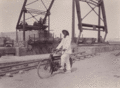
Youssef Aftimus - Upper Egypt - 1903

See also
- Mardiros Altounian
- List of Lebanese architects
