
Zbigniew Ścibor-Rylski facts for kids
Quick facts for kids
Zbigniew Ścibor-Rylski
|
|
|---|---|

Ścibor-Rylski during a ceremony on marking the 70th anniversary of the Warsaw Uprising (July 31, 2014)
|
|
| Nickname(s) | Motyl, Stanislaw |
| Born | 10 March 1917 Brovki-Pershi, Russian Empire |
| Died | 3 August 2018 (aged 101) Warsaw, Poland |
| Allegiance | Poland, Armia Krajowa |
| Service/ |
Aviation, infantry |
| Years of service | 1936–1945 |
| Rank | Brigadier general |
| Unit | 27 Volhynian Infantry Division |
| Battles/wars | World War II (Battle of Kock, Warsaw Uprising) |
| Awards | Virtuti Militari, Order of Polonia Restituta, Cross of Valor, Partisan Cross, Warsaw Cross of the Uprising |
Zbigniew Dionizy Ścibor-Rylski (born March 10, 1917 – died August 3, 2018) was a brave Polish brigadier general. He was also an aviator, which means he flew planes. He is famous for taking part in the Warsaw Uprising during World War II.
He joined the Polish Air Force and fought with the resistance movement from 1940. He quickly moved up in the ranks of the Armia Krajowa, which was a secret army. After the war, Ścibor-Rylski became a brigadier general in the Polish army. He received many important Polish awards and decorations, including the Virtuti Militari, which is a very high military honor. He also led the Association of Warsaw Insurgents.
Contents
Zbigniew Ścibor-Rylski's Early Life
Where and When Was He Born?
Zbigniew Ścibor-Rylski was born on March 10, 1917. This was during World War I. His birthplace was a village called Brovki-Pershi, which is now in Ukraine. At that time, it was part of the Russian Empire. His family was a Polish noble family, known as szlachta.
Moving to Poland
In 1918, a big change happened in Russia called the October Revolution. Because of this, his family had to leave their home. They moved to Bila Tserkva and then to Kiev. The family then traveled by train to the newly independent Polish Republic.
They settled in the Lublin region of Poland. First, they lived in Studzianki, then in Zwierzyniec. Zbigniew spent most of his childhood in Zwierzyniec until 1935.
His School Days and Aviation Training
Zbigniew went to high school in Zamość. After that, he studied at a gymnasium near Leszno and finished in 1936. Soon after, he joined the Aviation Cadet School in Warsaw. He learned to fly glider aircraft in Ustianowa.
By 1939, he was testing planes like bombers and PZL P.7 fighters for the Polish Air Force Academy. He graduated as a Cadet Sergeant Engineer. He specialized in aircraft engines. He was supposed to become a second lieutenant, but World War II started.
Zbigniew Ścibor-Rylski in World War II
Fighting in 1939
When Nazi German troops invaded Poland in September 1939, Zbigniew was part of the 1st Aviation Regiment. He left Warsaw with his squadron. They had to walk and use trucks to get through German lines.
They fought in battles and joined other Polish forces. After a battle in Kock, he tried to escape to Romania. But he was captured and became a prisoner of war.
Joining the Resistance
Zbigniew managed to escape from the prison camp. He returned to Warsaw and joined the underground resistance. He was sworn in during September 1940 and used the secret name Stanislaw.
From 1940 to 1943, he worked at a pharmaceutical company. At the same time, he was a partisan fighter. Partisans are people who fight in secret groups behind enemy lines.
The Warsaw Uprising
In January 1944, Zbigniew fought with the Armia Krajowa's 27 Volhynian Infantry Division. In July of that year, he was in Warsaw. He played a big part in the Warsaw Uprising.
He was a company commander in the Sokół 50 Infantry Battalion. During this time, he was also known by another secret name, Motyl, which means "Butterfly." When the war ended, he decided to stop his work with the resistance and return to a normal life.
Life After the War
Working in Civilian Life
After World War II, Poland was under a communist government. Zbigniew first worked as a manager for car repairs in Poznań. Later, he worked for a worker cooperative.
In 1984, he joined a group that planned the 40th anniversary of the Warsaw Uprising. He was also involved in creating the Warsaw Uprising Museum. He was on the committee that helped build the museum.
Honors and Recognition
Zbigniew Ścibor-Rylski received many honors for his bravery and service. He was a member of the Virtuti Militari Order's Chapter. This is a group that oversees the highest military award in Poland. He was also made an Honorary Citizen of the City of Warsaw.
Ranks He Held
- Lieutenant – September 4, 1939
- First lieutenant – 1943
- Captain – August 28, 1944
- Major – October 2, 1944
- Colonel in reserve – after the war
- Brigadier general in reserve – May 7, 2005
Awards and Special Honors
- Virtuti Militari, Silver Cross (twice)
- Polonia Restituta, Grand Cross
- Polonia Restituta, Commander's Cross with Star
- Cross of Valour (Poland), twice
- Partisan Cross
- Warsaw Uprising Cross
- Pro Patria Medal
- Augustus Ferdinand Wollf Medal – a top award from the Warsaw Medical Association
- Honorary Citizen of the City of Warsaw


_2r_BAR.PNG)


Images for kids
-
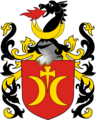
Ostoja Coat of Arms

See also
- Clan of Ostoja
- Ostoja coat of arms
